




Yellow Gold Stud Drops
Yellow gold stud drops combine a secure post fixing with a swinging gemstone below, offering movement and colour in everyday wear.
Yellow Gold Stud Drops
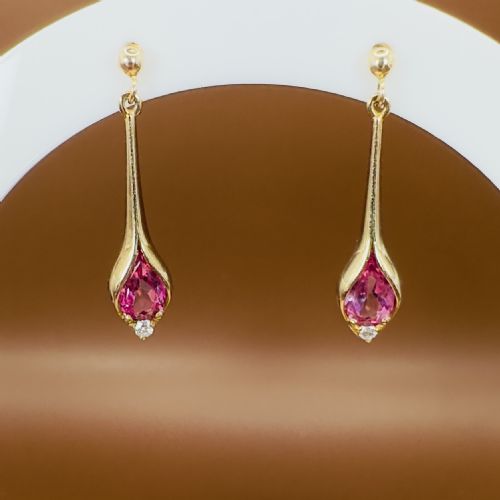
When you search for yellow gold stud drops, you encounter earrings that anchor firmly to the earlobe while dangling coloured stones or pearls beneath the fixture. These pieces span decades from the 1920s to the late 20th century, drawing on styles such as Modernist, Art Deco inspired and Victorian revival designs. You are most likely to meet 9ct gold examples set with garnets, amethysts, aquamarines or pearls, alongside rarer variations incorporating diamonds or emeralds.
The forms range from single pear cut drops and oval clusters to double drop configurations and geometric square cuts. Makers across the mid-century period favoured warm yellow metal frames to hold vibrant stones like pink topaz, blue zircon and green chalcedony. Each pair bridges the gap between a simple daily stud and a statement dangling earring, sitting neatly against the ear while providing gentle motion.
How they were made
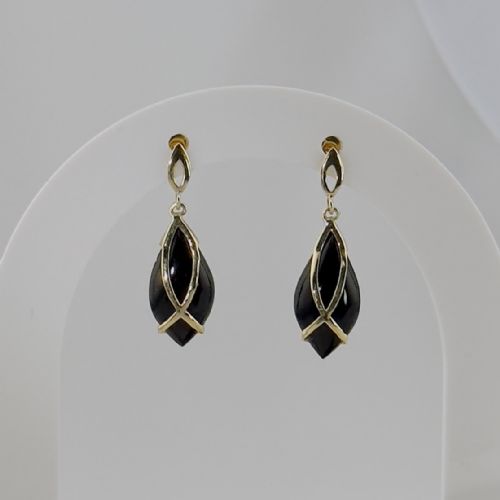
The construction relies predominantly on 9ct gold and 14ct gold, shaped into bezels, prongs and clusters to secure faceted or cabochon gems. Goldsmiths linked hanging drops to fixed studs using small jump rings or articulated hinges, allowing the lower portion to sway independently. Stones including garnet, amethyst, aquamarine and black onyx were cut into pear, marquis, oval and square shapes to catch the light from multiple angles.
Detailing often includes overlapping gold work, twisted wire borders and cluster arrangements combining diamonds with coloured gems like pink sapphire and peridot. Mother-of-pearl, amber, coral and white crystal also appear, bedded securely into metal settings designed for longevity and daily use.
Some mid-century pairs feature dangling green chalcedony that swings with every nod of agreement.
What varies in quality
Quality in these earrings rests upon the precision of the stone cutting and the robustness of the connecting links between the stud and the drop. Superior examples feature well-matched gems with clean saturation, whether deep red garnets or clear aquamarines, held firmly within balanced mountings. The weight and thickness of the 9ct yellow gold chassis also dictate the tactile feel and durability of the pair.
The Yellow Gold Stud Drops Glossary
- Stud drop
- An earring design featuring a fixed post that pierces the earlobe with a suspended element hanging below it. This configuration provides the stability of a stud with the visual interest of a drop earring.
- Pear cut
- A gemstone shape featuring a rounded end tapering to a single point, resembling a teardrop. It is frequently utilised in these listings for garnets, topazes and aquamarines to maximise light return.
- Cabochon
- A gemstone polished to a convex, smooth surface rather than faceted with flat planes. This style is often seen on opaque materials like black onyx, amber and turquoise.
- Cluster
- An arrangement of multiple smaller gemstones tightly grouped together around a central stone. This technique creates a larger visual impact using individual smaller carats.
- Articulated
- A method of construction using tiny hinges or joints to allow two or more metal sections to move independently. This ensures the dangling portion swings naturally with the wearer.
Yellow Gold Stud Drops: Frequently Asked Questions
How do I wear yellow gold stud drops daily?
These earrings transition easily from daytime wear to evening due to their secure post fastenings and balanced drop lengths. They sit comfortably against the ear while adding subtle movement and colour to everyday outfits.
Pair them with simple necklines to let the suspended gemstones remain the focal point of your jewellery ensemble.
What periods do these earrings come from?
The pieces span from the 1920s through the 1930s, 1940s, 1950s and 1960s, encompassing mid-century modernism and vintage revivals. Each decade brought distinct gemstone preferences and metalworking techniques to the standard drop format.
Mid-century designs from the 1950s and 1960s make up the majority of the available styles on this page.
Are all the gold mounts solid 9ct?
The vast majority of the listings utilise solid 9ct yellow gold, with occasional pieces fashioned from 14ct gold. This alloy provides a durable foundation for daily wear while maintaining a warm golden hue.
Hallmarks and testing confirm the metal standard used across the individual settings and posts.
How do I tell an amethyst drop from a spinel?
Amethysts typically display a distinct purple or violet hue with natural crystal inclusions visible under magnification. Spinels, such as the pink Mahenge variety, often exhibit a brighter, highly saturated pink tone with different refractive properties.
Examining the depth of colour and facet arrangement helps distinguish between these mid-century gemstone choices.