




Yellow Gold Onyx Jewellery
Yellow gold onyx jewellery pairs deep banded or black stones with warm metal, offering a striking contrast favoured across the Victorian, Edwardian and mid-century periods.
Yellow Gold Onyx Jewellery
Yellow gold onyx jewellery encompasses rings, earrings, cufflinks, brooches and sets spanning the Victorian era through to the 1970s. When searching for yellow gold onyx jewellery, buyers encounter pieces ranging from early nineteenth-century mourning rings to mid-century modernist designs and Art Deco revival works.
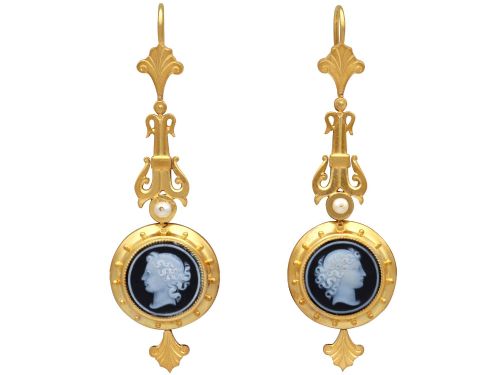
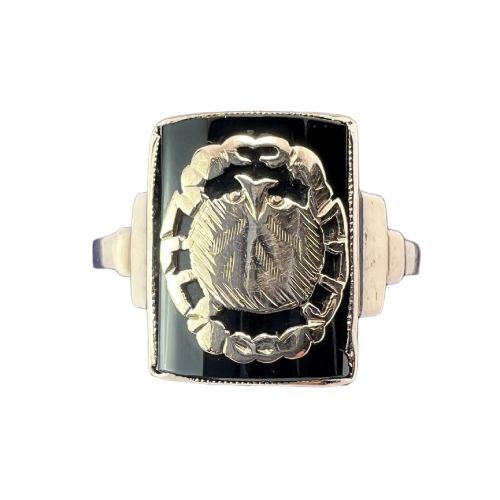
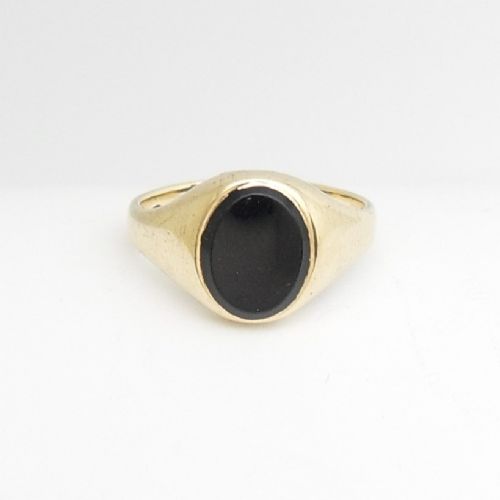
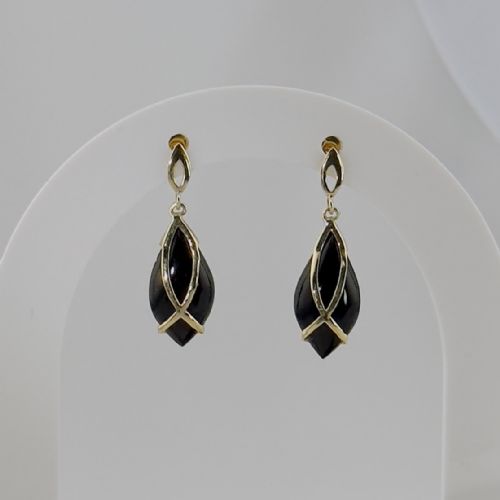
The selections on this page feature gold mountings in nine-carat and eighteen-carat fineness paired with dark chalcedony, banded agate and black onyx. Forms include signet rings, drop earrings, geometric target rings and zodiac motifs set against polished yellow gold backdrops.
Origins stretch from British workshops bearing London hallmarks to Italian studios like Kria Gioielli, alongside unsigned pieces from the Edwardian and Victorian decades. Buyers find both delicate pearl-accented drop earrings and heavy diamond-set cocktail rings.
What varies in quality in yellow gold onyx jewellery
Quality rests upon the crispness of the stone cutter's polish and the structural integrity of the gold mount. Superior items display evenly saturated black onyx or sharply defined natural banding in agates, free from internal fractures or surface clouding.
Maker attribution and hallmark clarity elevate certain items, particularly signed pieces from established twentieth-century houses. Metal weight and the secure bezel enclosure of hardstones separate robust daily wear items from lighter, more fragile constructions.
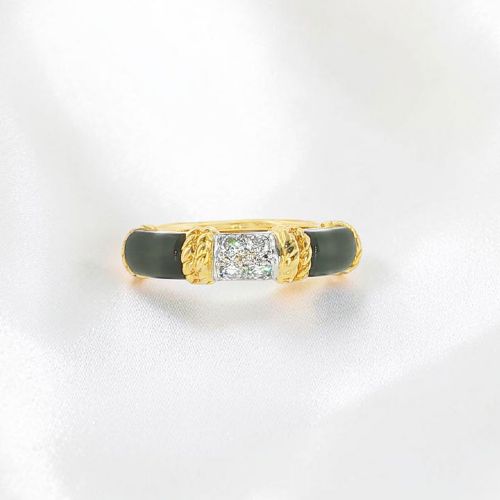
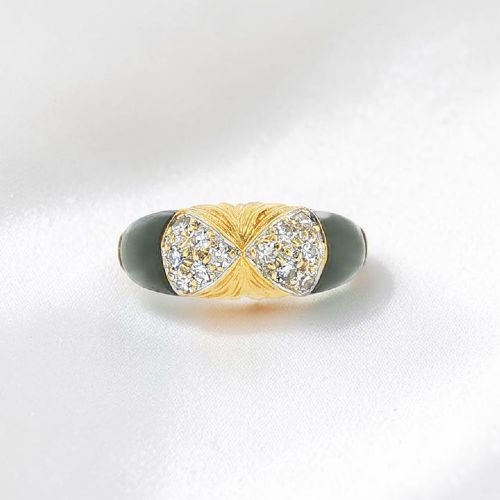
Materials paired with yellow gold and onyx across current items include diamonds, pearls, banded agate, and platinum.
Kutchinsky·Kria Gioielli
The Yellow Gold Onyx Jewellery Glossary
- Onyx
- A variety of chalcedony quartz with parallel flat bands in alternating colours, most commonly seen as solid black in antique jewellery. It provides a smooth, light-absorbing surface that contrasts sharply with reflective yellow gold.
- Cabochon
- A gemstone shaped and polished with a convex, rounded top rather than faceted edges. This smooth cut accentuates the dense, opaque depth of black onyx and banded agate.
- Target ring
- A circular ring style featuring a central gemstone surrounded by concentric rings of contrasting stones or metal. Art Deco examples often pair black onyx with diamonds in this layout.
- Intaglio
- A design incised into the flat top of a gemstone so that the image sinks below the surface. In antique rings, these carved hardstones were traditionally used as personal wax seals.
- Signet ring
- A solid ring featuring a flat face historically engraved with a crest, monogram or zodiac symbol. Mid-century examples frequently combine this heavy gold form with black onyx inlays.
Yellow Gold Onyx Jewellery: Frequently Asked Questions
What is black onyx?
Black onyx is a dense, cryptocrystalline form of quartz that takes a high, glossy polish. It has served as a durable foundation stone in jewellery since antiquity.
In Victorian and twentieth-century pieces, the stone was cut into geometric tablets or cabochons and set directly into yellow gold mountings.
How do I date antique gold jewellery?
Dating relies on official metal hallmarks, maker's marks, and the prevailing stylistic traits of the mounting. British pieces often bear date letters that pinpoint the exact year of assay.
Stylistic shifts, such as the geometric lines of the 1920s or the heavy textures of the 1960s, further narrow the period of manufacture.
Are these pieces made of solid gold?
The listings on this page utilise solid nine-carat and eighteen-carat yellow gold mountings. These metals provide the structural strength needed to hold heavy stone inlays securely.
Gold fineness is typically verified by physical hallmarks stamped into the interior of the shank or the reverse of the setting.
Can I wear an onyx ring daily?
Onyx measures seven on the Mohs hardness scale, making it durable enough for regular wear when properly set in gold. Rings benefit from protective bezel settings that shield the edges of the stone from impact.
Owners should remove hardstone jewellery during heavy manual work to prevent scratching the polished surface or bending the gold claw mounts.