




Yellow Gold Diamond Studs
Yellow gold diamond studs bring classic gemstone brilliance to the ear, offering endless versatility for everyday wear.
Yellow Gold Diamond Studs
When you search for yellow gold diamond studs, you are looking at classic lobe-hugging earrings that pair warm precious metal with sparkling gemstones. The pieces on this page span several distinct periods, including Victorian, Edwardian, Art Deco, and mid-century designs, alongside more contemporary items.
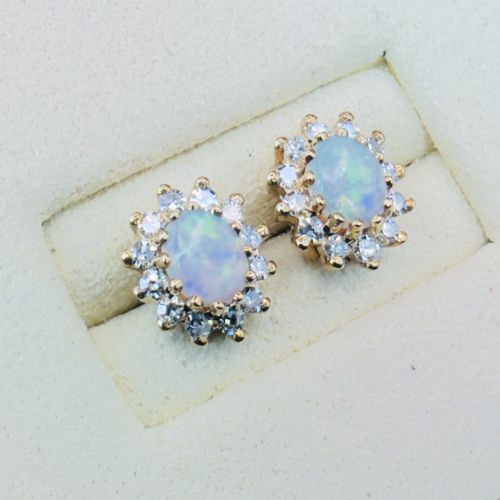
You will most frequently encounter cluster configurations and simple solitaires set in either nine-carat or eighteen-carat yellow gold. Many incorporate additional gemstones such as emeralds, sapphires, opals, or spinels alongside the diamonds, while others rely purely on the contrast between gold and stone.
The forms range from traditional round and floral clusters to stylized clover motifs and geometric shapes. Origins include British and French workshops, reflecting diverse European jewellery traditions from the late nineteenth century through to the modern era.
Materials and Construction
The construction of these earrings relies on standard precious metals, principally nine-carat and eighteen-carat yellow gold, occasionally combined with platinum or silver settings to enhance the whiteness of the diamonds. Gemstones are secured using traditional claw, bezel, or flush settings tailored to the cut of the stone.
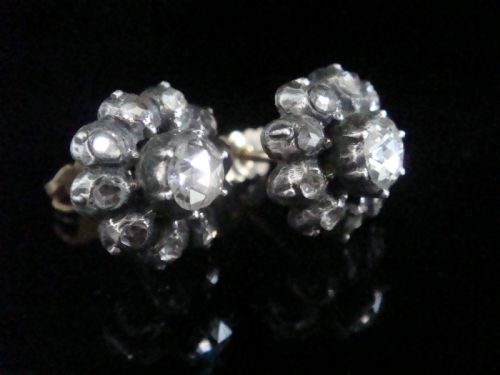
Early twentieth-century and Victorian examples often feature hand-cut stones such as old mine cuts, rose cuts, or old European cuts. Later mid-century pieces incorporate precision-cut stones held within sturdier cast gold mounts, reflecting shifts in workshop technology.
Materials recorded across the inventory include nine-carat and eighteen-carat yellow gold, platinum, silver, and diverse coloured gemstones.
Assessing Quality and Craftsmanship
The top of the range is defined by superior stone matching, precise setting work, and the harmonious integration of the gold mount with the cut of the diamond. Finer pieces display minimal excess metal around the stones and secure, well-balanced fastenings that ensure the earring sits correctly on the ear.
Lower tiers typically feature heavier, less refined metalwork or mismatched stones where clarity and colour vary noticeably across a cluster. The overall visual impact depends heavily on how cleanly the yellow gold reflects light relative to the brilliance of the central diamonds.
Ilias Lalaounis
The Yellow Gold Diamond Studs Glossary
- Cluster
- A setting style where a central gemstone is surrounded by a ring of smaller stones, often diamonds, creating a larger overall visual presence. This arrangement was widely favoured in Victorian and mid-century jewellery design.
- Rose cut
- An antique diamond cut featuring a flat base and a domed crown faceted with triangular shapes, resembling an unopened rose bud. This cut produces a softer, broader reflection of light compared to modern brilliant cuts.
- Old cut
- A generic term for hand-faceted diamond cuts predating modern brilliant standards, typically characterised by smaller tables and higher crowns. These stones display a distinctive, gentle scintillation under candlelight or low light.
- Cabochon
- A gemstone shaped and polished with a smooth, rounded convex surface rather than being faceted. This technique is frequently utilised for opaque or translucent coloured stones like opals and garnets.
- Solitaire
- A piece of jewellery featuring a single gemstone, most commonly a diamond, mounted independently. This minimalist approach focuses attention entirely on the quality and cut of the central stone.
Yellow Gold Diamond Studs: Frequently Asked Questions
How do I style yellow gold diamond studs?
These versatile earrings suit both casual daytime outfits and formal evening attire, pairing effortlessly with other yellow gold necklaces or bracelets.
Their compact size makes them practical for daily wear while adding a discreet touch of historical character to your outfit.
Are these earrings comfortable for daily wear?
Most stud configurations sit close to the earlobe, distributing weight evenly and reducing the risk of snagging on clothing or hair.
When fitted with secure backings, they remain comfortable throughout long periods of continuous wear.
How do I identify a Victorian pair?
Victorian examples frequently utilise rose-cut or old-cut diamonds set in yellow gold or silver-topped gold, often featuring floral or star motifs.
Examining the back of the setting often reveals hand-cut metalwork characteristic of nineteenth-century bench jewellers.
What is the difference between cluster and solitaire studs?
Solitaire studs feature a single prominent diamond per earring, whereas cluster studs arrange several smaller stones around a central focal point to create a larger silhouette.
Clusters offer a more decorative, textured appearance, while solitaires emphasise the clean lines of an individual stone.