

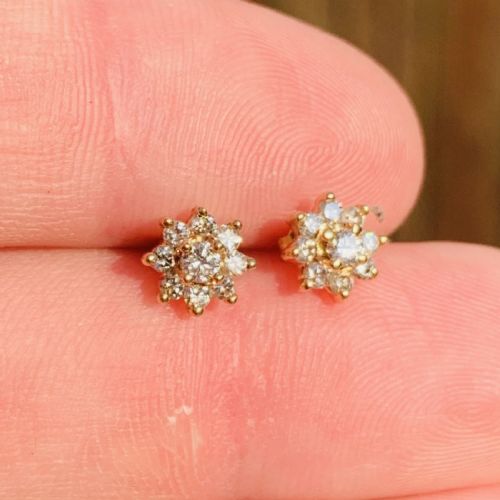
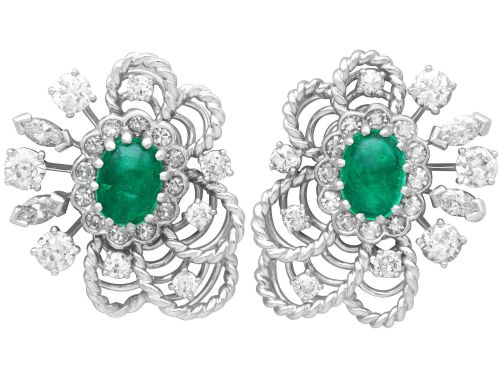
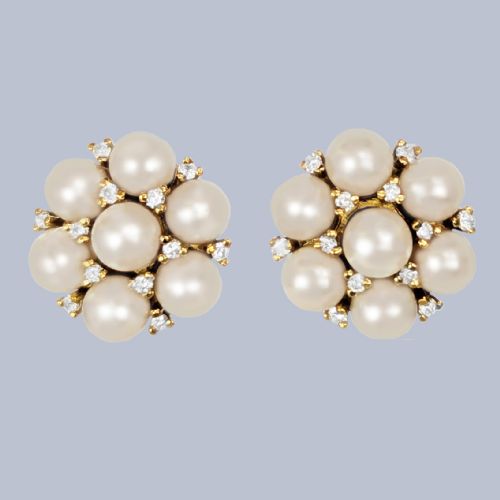
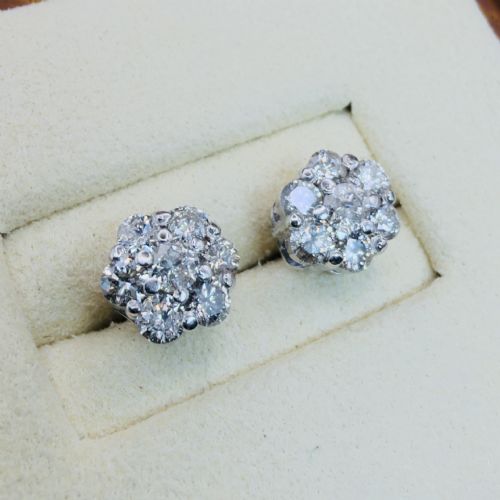


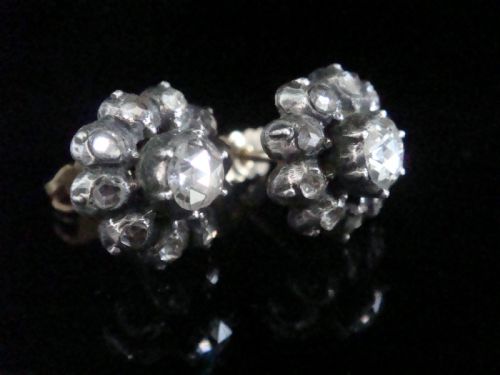
Floral Diamond Stud Earrings
Floral diamond stud earrings bring together fine gems and organic motifs in wearable pieces that span from the Victorian era to the mid-twentieth century.
Floral Diamond Stud Earrings
When you search for floral diamond stud earrings, you encounter cluster designs that arrange smaller stones around a central point to form petals and daisy motifs. These pieces appear across several distinct historical periods, including the Victorian era, the Art Deco years, and the 1950s and 1960s.
The most common formats on this page are cluster and daisy configurations fashioned as straightforward studs or screw backs, alongside occasional clip-ons. Makers from different decades interpreted the botanical theme using both yellow and white precious metals.
Earrings in this category range from delicate rose cut diamond arrangements to substantial brilliant cut gemstone clusters. Each era brings its own distinct proportion and mounting style to the enduring floral subject.
Materials and construction
The construction of these jewels relies upon a combination of diamond settings paired with robust mountings in 18ct gold, white gold, platinum, and palladium. Older examples frequently incorporate silver top settings combined with yellow gold backs to enhance the sparkle of the stones.
Metalwork techniques evolved from the hand-forged yellow gold settings of the Victorian period to the precise platinum and white gold fabrication seen in Art Deco and mid-century designs. Gemstones are secured using traditional claw settings and close-set cluster arrangements that mimic natural blossoms.
Floral Diamond Stud Earrings Retail Price Guide 2026
Typical asking prices for floral diamond stud earrings among the pieces listed under this phrase on Sellingantiques today, from the lower quarter to the upper quarter. They describe what is for sale here now, not the wider market.
Some floral clusters feature tiny hidden petals that curve inward to mimic a flower closing for the evening.
Assessing quality and craftsmanship
Quality in these jewels rests upon the uniformity of the diamond cuts and the integrity of the metal settings holding the cluster together. Finer examples display meticulous stone matching and secure claw work that maintains the structural harmony of the floral shape.
The weight and gauge of the precious metal used in the backing and stem also separate standard pieces from superior examples. Better construction ensures the cluster sits flush and secure against the lobe without tilting.
The Floral Diamond Stud Earrings Glossary
- Cluster
- A gemstone setting where a central stone is surrounded by a tight ring of smaller gems to create a unified focal point. This arrangement is fundamental to the floral aesthetic.
- Rose cut
- An antique diamond cut featuring a flat base and a faceted dome that resembles an unopened rosebud. This cut was favoured in older Victorian and Art Nouveau pieces.
- Platinum
- A dense, durable white metal used for fine jewellery settings because it holds small stones securely with minimal visible metal. It appears frequently in twentieth-century pieces.
- Screw back
- A fastening mechanism utilising a threaded post and a threaded nut to secure the earring firmly in the ear. This type provides extra security for heavier cluster designs.
- Daisy design
- A specific floral configuration featuring a central gemstone encircled by a single ring of matching round stones. It represents the most prevalent botanical layout in vintage jewellery.
Floral Diamond Stud Earrings: Frequently Asked Questions
How do I date my floral diamond earrings?
Dating relies on examining the metal combinations, the type of diamond cuts used, and the fastening mechanisms. Older Victorian pieces often feature silver-topped gold with rose cut stones, whilst mid-century examples typically utilise white gold with brilliant cuts.
Looking at the construction of the cluster and any maker's marks or hallmarks inside the mount helps narrow down the specific decade of production.
Are screw back earrings difficult to convert?
Screw back findings are characteristic of mid-century construction and provide a secure fit for lobes without standard piercings. Converting them to modern posts is possible through a jeweller, though many collectors prefer to keep the original mechanism intact.
Preserving the original screw back maintains the historical integrity of the piece and its period mounting.
How should I clean antique diamond clusters?
Cleaning requires warm soapy water and a soft brush to remove dust settled between the tight cluster settings. Avoid harsh chemical dips, especially on pieces that combine silver and gold or incorporate pearls.
Gentle drying with a soft cloth ensures the metal retains its finish and the diamonds maintain their brilliance.
Can I wear these earrings every day?
Wearing these jewels daily depends on the sturdiness of the settings and the type of metal used. Platinum and 18ct gold mountings offer good durability for regular use, provided the stone claws remain secure.
Older antique pieces with delicate silver work benefit from more careful handling to protect the aged metal and stone arrangements.