



Yellow Enamel Necklace
A yellow enamel necklace brings together vibrant colour and precious metal, offering striking wearable history for the discerning collector.
Yellow Enamel Necklace
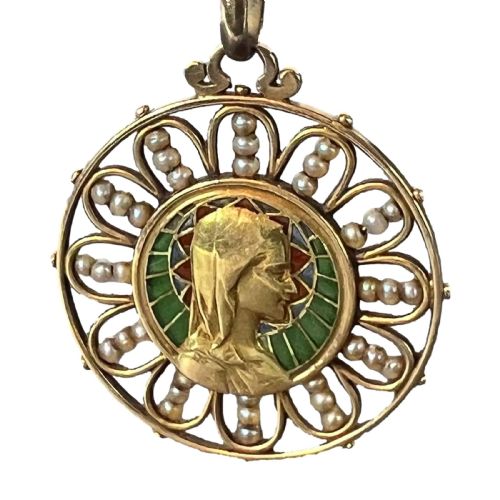
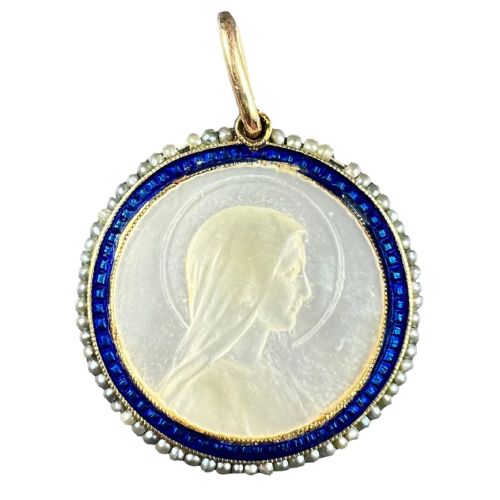
The version most commonly encountered on this page is the French pendant medal or charm, frequently cast in 18K yellow gold and depicting religious subjects like the Virgin Mary.
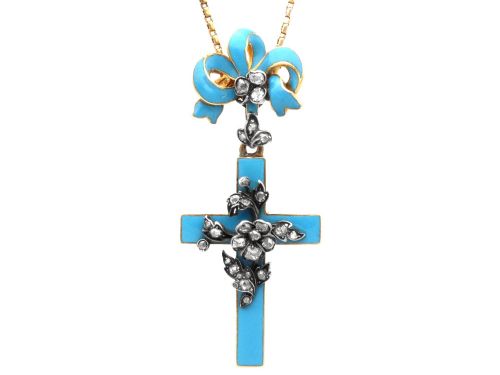
Other notable forms include peridot and seed pearl pendants from circa 1900, geometric Art Deco charms, and modernist silver torque necklaces from later decades.
Materials and construction
Goldsmiths utilised 15ct and 18K yellow gold alongside silver as the primary structural metals for pendants, crosses, and torques. These metal mounts secure intricate glass-based vitreous enamel work.
Plique-a-jour enamel technique creates a stained-glass effect by firing translucent coloured enamel within open gold wire cells without a backing. Makers enhanced these compositions with seed pearls, diamonds, peridots, and mother-of-pearl.
Listings feature yellow enamel necklaces spanning Victorian, Edwardian, Art Nouveau, Art Deco, and Scandinavian Modern styles.
Factors determining quality
The finesse of the plique-a-jour technique dictates the sophistication of the piece, particularly the translucency and even suspension of the enamel across open gold cells. Intricate hand-chasing on the surrounding gold mount also elevates the standard.
The integration of secondary gems, such as calibrated diamonds or natural seed pearls, marks out superior examples from simpler stamped metalwork.
David-Andersen of Norway·Sellier
The Yellow Enamel Necklace Glossary
- Plique-a-jour Enamel
- An enamelling technique where the enamel is applied in cells without a backing, allowing light to shine through like stained glass. This method requires exceptional skill to prevent cracking during firing.
- Torque
- A rigid neck ring that sits open or close to the collarbone, often terminating in decorative motifs or pendants. Scandinavian Modern makers utilised this architectural form.
- Seed Pearl
- Very small, naturally occurring or cultured pearls threaded or set into Victorian and Edwardian jewellery. They provide a delicate, luminous contrast to bright enamel.
- Pendant Medal
- A wearable devotional or commemorative medallion fitted with a suspension loop. French examples frequently portray the Virgin Mary.
- Peridot
- A transparent yellowish-green gemstone frequently paired with gold and plique-a-jour work around nineteen hundred. It complements warm yellow enamel tones.
Yellow Enamel Necklace: Frequently Asked Questions
What periods do these necklaces cover?
The selections span from the late Victorian and Edwardian eras through Art Nouveau and Art Deco periods, extending into mid-century Scandinavian modernism.
Pieces range chronologically from eighteen-eighty creations up to works produced later than nineteen-sixty.
How do I care for historic enamel?
Vitreous enamel is essentially glass and requires gentle handling to prevent chipping or scratching against harder metals and stones. Avoid ultrasonic cleaners and harsh chemical dips.
Store pendants individually in padded boxes and clean only with a soft, damp cloth.
What is plique-a-jour?
Plique-a-jour translates from French as letting in daylight, describing an enamel work lacking a solid backing metal. Light passes directly through the translucent coloured glass.
This creates a shimmering, translucent panel resembling miniature stained glass within a gold or silver frame.
Are these pieces marked for gold purity?
Many period items feature historic hallmarks or stampings denoting fifteen carat or eighteen karat yellow gold content. French items often bear specific regional control marks.
Assay stamps help confirm the material composition alongside visual inspection of the mount.