

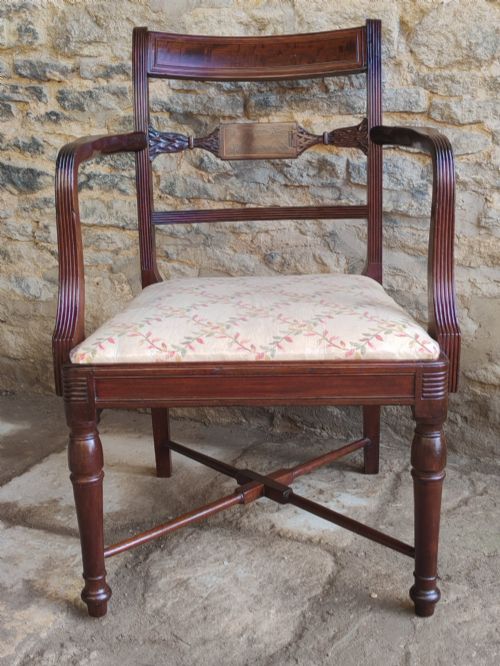


X Stretcher Armchair
An x stretcher armchair brings robust country character into a room, offering sturdy support through intersecting wooden braces beneath the seat.
X Stretcher Armchair
When you search for an x stretcher armchair, you encounter robust seating largely rooted in the 18th and 19th centuries, predominantly taking the form of traditional Windsor chairs with crinoline stretchers, alongside walnut and oak frame designs influenced by Carolean and revival aesthetics.
The versions most commonly met on this page span the Georgian and Victorian eras, frequently constructed as Windsor armchairs or carvers combining elm seats with yew or ash components.
Regional British vernacular traditions dominate the selection, showing how provincial makers built sturdy seating suited to domestic and farmhouse interiors.
Materials and construction
Timbers like yew, elm, and ash dominate the construction, selected for their distinct grain patterns and resilience in steam-bent or turned components.
Makers utilised rigid jointing techniques, pairing turned spindles and legs with intersecting stretcher bars to brace the undercarriage against daily stress.
X Stretcher Armchair Retail Price Guide 2026
Typical asking prices for x stretcher armchair among the pieces listed under this phrase on Sellingantiques today, from the lower quarter to the upper quarter. They describe what is for sale here now, not the wider market.
Several makers left their stamp directly into the wood, ensuring their handiwork survived centuries of heavy farmhouse sitting.
Assessing quality and craftsmanship
The distinction between ordinary and superior examples lies in the selection of timbers, particularly figured yew wood or well-matched elm seats with distinct grain.
Refined turning on spindles and stretchers, combined with balanced proportions in the bow and arm supports, separates utilitarian seating from finer regional craftsmanship.
Gabbitass Worksop·Rockley Maker·Fred Walker·James Shoolbred
The X Stretcher Armchair Glossary
- Crinoline stretcher
- An arched or curved wooden brace connecting the legs of a Windsor chair, resembling the shape of a crinoline skirt. This feature strengthens the underframe.
- Windsor chair
- A wooden chair featuring a solid sculpted seat into which the legs and back spindles are directly inserted. This form evolved through various regional British styles.
- Carver armchair
- A sturdy wooden armchair traditionally placed at the head of a dining table. These chairs often match a set of simpler dining chairs.
- Spindle back
- A chair back constructed from multiple thin, turned wooden uprights. These spindles provide flexible support to the sitter.
X Stretcher Armchair: Frequently Asked Questions
What is a crinoline stretcher?
A crinoline stretcher is a curved wooden brace linking the legs beneath a chair seat. It adds structural stability while providing a characteristic silhouette.
This form of underframe is commonly found on traditional provincial seating from the 18th and 19th centuries.
Which woods were used?
Makers relied on native hardwoods selected for specific structural properties. Elm provided a tough, split-resistant seat.
Yew and ash were chosen for their bending strength in spindles, arms, and bows.
How do I date an armchair?
Dating relies on examining tool marks, timber shrinkage, and stylistic vernacular details. Earlier pieces often display distinct regional turning patterns.
Later Victorian revivals incorporate machine-tooled components and different assembly methods.
Where were these chairs made?
Production occurred across provincial English workshops, with distinct regional styles emerging from the West Country and Nottinghamshire. Local makers adapted designs to suit available timber.
Workshops utilised local woods like yew and elm to produce durable domestic seating.