

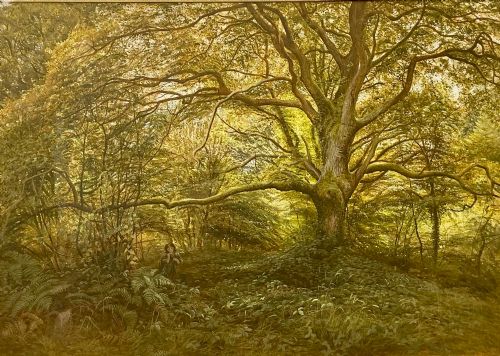


Woodland Watercolour
These woodland watercolour works capture tranquil tree-lined paths and forest floors, offering buyers delicate pigment on paper that brings natural serenity indoors.
Woodland Watercolour
A woodland watercolour presents rural scenes, forest paths, and bluebell woods rendered in fluid pigments on paper, spanning periods from the Victorian era through the mid-twentieth century. Collectors encounter framed paintings and drawings showcasing British Impressionist, Edwardian, and Victorian landscape traditions.
The most common examples on this page are nineteenth-century and early twentieth-century works, often depicting specific rural locations, trees, and riverbanks in watercolour, ink, and gouache. These pieces range from intimate miniature paintings to larger framed landscapes signed by listed artists.
What varies in quality
The distinction between standard works and finer pieces rests on the artist's handling of light, brushwork precision, and the atmospheric depth achieved within the woodland setting. Named artists with established exhibition histories typically command greater attention than anonymous landscape studies.
Condition of the paper support and vibrancy of the original watercolour pigments also determine overall merit, as exposure to light over decades can alter the subtle tones.
Woodland Watercolour Retail Price Guide 2026
Typical asking prices for woodland watercolour among the pieces listed under this phrase on Sellingantiques today, from the lower quarter to the upper quarter. They describe what is for sale here now, not the wider market.
Listings feature works executed on paper using watercolour pigment, ink, and glass protection across Victorian and twentieth-century periods.
Bonomi Edward Warren·William Hoggatt·Alfred Grey RHA·Henri Joseph Harpinies·Walter Follen Bishop·Rowland Henry Hill·Edmund George Warren·Alfred W. Parsons·Fred Lawson·Harold Swanwick·William Lucas·Charles James Adams·George Graham·Charles Edward Holloway·Beatrice Parsons·Charles Edward Wilson·Donald Watson
The Woodland Watercolour Glossary
- Watercolour
- A painting method where the paints are made of pigments suspended in a water-based solution. It is traditionally applied to paper surfaces.
- Gilt
- A thin layer of gold or gold-like material applied to wooden frames. This finish was commonly utilised in nineteenth-century framing.
- Miniature painting
- A very small work of art detailed with fine brushstrokes. These compact pieces often depict figures or scenes in delicate scale.
- Impressionism
- An art style characterised by relatively small, thin, yet visible brush strokes. It prioritises an accurate depiction of light in changing qualities.
Woodland Watercolour: Frequently Asked Questions
How do I care for a watercolour?
Keep watercolours away from direct sunlight to prevent the pigments from fading over time. Maintaining stable indoor humidity protects both the paper support and the wooden frame.
Display the artwork behind glass with acid-free backing to ensure long-term preservation of the painting.
Are these works signed?
Many pieces feature artist signatures, initials, or period inscriptions either on the face of the watercolour or on the reverse. Unsigned landscape studies also appear, representing anonymous nineteenth and twentieth-century production.
Examine the bottom corners of the paper for handwritten signatures or studio stamps.
What framing is typical?
Period watercolours are generally housed in traditional wooden frames, sometimes featuring decorative gilt details suited to Victorian or Edwardian tastes. Original frames often show age-related wear that corresponds to the era of the painting.
Glazing protects the delicate paper and water-soluble pigments from dust and environmental moisture.
How are periods identified?
Stylistic clues such as costume, framing materials, and artist records help determine whether a piece originates from the Victorian period or the twentieth century. Inscriptions on the back of the frame or paper often provide specific dates or locations.
Brushwork techniques also shift from detailed nineteenth-century realism toward looser early twentieth-century impressionist approaches.