


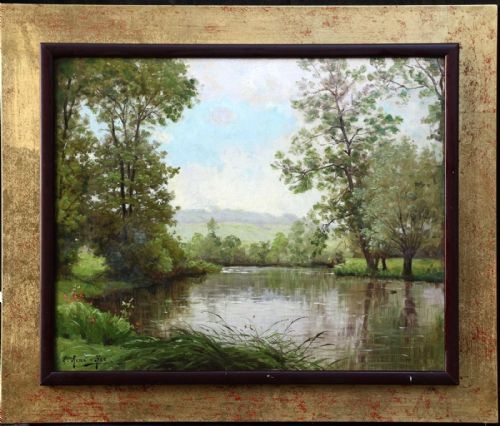


Woodland River Scene Paintings
Woodland river scene paintings capture flowing water beneath trees, offering buyers a serene piece of landscape history for their walls.
Woodland River Scene Paintings
These works portray natural waterways framed by trees, capturing landscape views through various historical periods. When searching for woodland river scene paintings, collectors encounter pieces spanning the nineteenth century into the mid-twentieth century.
Framed formats dominate the selection, often retaining original wooden and gilt mouldings with gold leaf or gesso details. Subjects range from tranquil summer streams to autumnal banks and cattle watering spots.
How they were made
Artists built these works using oil paint applied to stretched canvas or board, alongside watercolour pigments on paper. Canvas supports provide durability while watercolours achieve transparent atmospheric effects.
Frames incorporate wood finished with gesso and gold leaf or gilt surfaces to complement the artwork. These traditional framing methods protect the edges of the canvas and paper while adding weight and presence.
Listings feature works spanning the nineteenth century, the Victorian period, and the 1920s, utilising oil paint, watercolour, wood, and gold leaf.
What varies in quality
The handling of light and water separates standard topographical records from more accomplished artistic interpretations. Brushwork confidence and the subtlety of colour mixing determine the visual depth of foliage and river reflections.
The condition and originality of the surrounding frame contribute significantly to the overall integrity of the piece. Period frames with intact gesso and gold leaf enhance the presentation of the canvas.
Arthur Herbert Rigg·David Watts·Alfred Grey RHA·John Wright Oakes·Walter Follen Bishop·Charles Edward Holloway·George F Wetherbee·Benjamin Callow·Charles Edmond Rene His·William Mellor·Everett W Mellor·Charles Duval·George Neil·Rene His
The Woodland River Scene Paintings Glossary
- Gesso
- A plaster-like mixture applied to wood frames before gilding. It provides a smooth base for gold leaf application.
- Oil on Canvas
- Pigment mixed with drying oil applied to a woven fabric support. This technique allows for rich texture and blending.
- Watercolour Painting
- Pigments suspended in a water-soluble vehicle applied to paper. It yields luminous washes and delicate detail.
- Gold Leaf
- Gold beaten into extremely thin sheets used for gilding frames. It adds a warm metallic border to the artwork.
Woodland River Scene Paintings: Frequently Asked Questions
What periods do these paintings span?
The works stretch from the mid-nineteenth century through the Victorian era and into the mid-twentieth century. Artists recorded natural landscapes using styles ranging from realism to impressionism.
Most examples reflect nineteenth-century and early twentieth-century artistic movements. These dates correspond to the active years of the recorded painters.
Are the frames original?
Many pieces retain their period frames constructed from wood with gesso and gilt finishes. These surrounds often match the age of the artwork.
Frames vary in ornamentation, featuring gold leaf and moulded details characteristic of their respective decades.
What mediums are used?
The selection consists primarily of oil paint on canvas or board, alongside watercolour paintings on paper. Oil works provide heavier texture while watercolours offer lighter transparency.
Supports include stretched canvas and heavy paper, housed behind glass in watercolour examples or left open in oil paintings.
How should I hang them?
Display these landscape works away from direct sunlight to protect pigments and paper from fading. Stable indoor humidity preserves both the canvas and the wooden frames.
Ensure wall fixings match the weight of the framed oil or watercolour piece securely.