


Woodland Figure Oil Painting
A woodland figure oil painting brings pastoral stillness and human narrative onto canvas through layered oils.
Woodland Figure Oil Painting
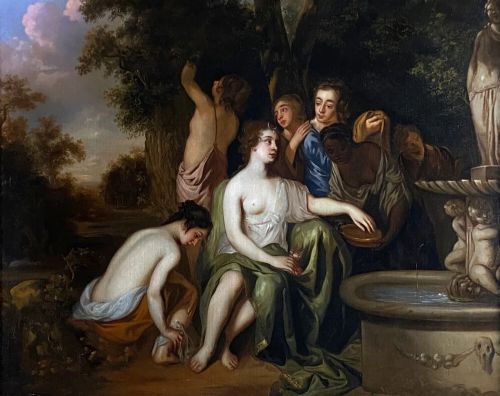
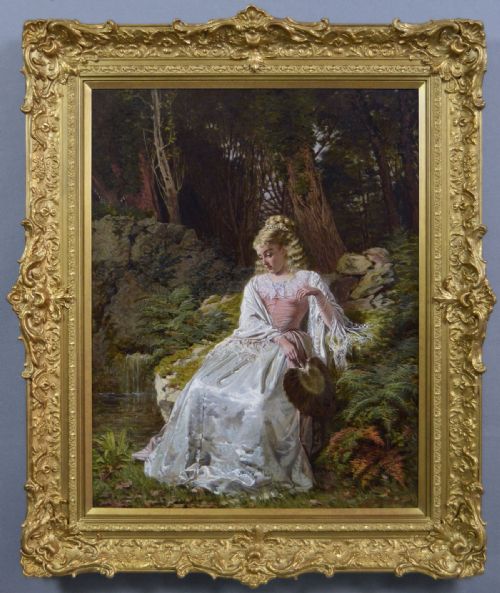
A woodland figure oil painting combines natural tree landscapes with human subjects, spanning periods from the seventeenth century to the mid-twentieth century. These works capture scenes ranging from classical mythology and Dutch landscapes to Victorian pastoral views.
The pieces on this page appear on canvas, wood panels, and board supports, framed in materials such as gold leaf gesso. Subjects include mythological figures, musicians, and travellers journeying through trees.
Makers and artists represented here include Thomas W Lascelles, Thomas Edward Roberts, Edward H. Holder, Lester Sutcliffe, Frederick Bartman, Ferdinand E Gröne, and John Westall. Their works demonstrate the shifting styles of Victorian naturalism, the Barbizon School, and Dutch Golden Age traditions.
Gradations in quality
Quality rests in the handling of light through the trees and the integration of the human figure into the natural setting. Stronger examples demonstrate confident brushwork that defines foliage and anatomy without stiffness.
The preservation of the original paint layer and the integrity of the canvas or wood panel dictate the enduring visual strength of the piece. Frames with original gold leaf gesso also contribute to the completeness of the object.
Materials recorded in the evidence include oil paint, canvas, wood panels, and gold leaf gesso frames.
Thomas W Lascelles·Thomas Edward Roberts·Edward H. Holder·Lester Sutcliffe·Frederick Bartman·Ferdinand E Gröne·John Westall
The Woodland Figure Oil Painting Glossary
- Oil paint
- A slow-drying paint made of pigment particles suspended in a drying oil, typically linseed oil. This medium allows artists to blend tones smoothly and build rich textures.
- Canvas
- A heavy woven fabric used as a surface for oil painting, usually stretched over a wooden frame. It provides a flexible and durable ground for brushwork.
- Gold leaf gesso
- A preparation of chalk or plaster mixed with glue, coated with thin leaves of beaten gold to form ornate picture frames. This technique creates a reflective surface around the painting.
- Barbizon School
- A mid-nineteenth-century French art movement focused on realist landscape painting inspired by direct observation of nature. Painters in this circle emphasised atmospheric effects and woodland terrain.
- Wood panel
- A flat wooden board utilised as a rigid support for oil paintings before and alongside stretched canvas. Panels offer a stable surface that preserves fine detail.
Woodland Figure Oil Painting: Frequently Asked Questions
What periods do these paintings cover?
The works span from the seventeenth-century Dutch school and classical compositions to nineteenth-century Victorian landscapes and mid-twentieth-century examples.
This broad timeline shows how artists continuously returned to the theme of human figures situated among trees.
What surfaces were used for these artworks?
Painters utilised stretched canvas, solid wood panels, and rigid board as supports for their oil pigments.
Each surface interacts differently with the oil medium, influencing how brushstrokes sit and how the final image ages.
How are the frames described?
Many pieces are presented in decorative plaster cast frames finished with gold leaf gesso.
These elaborate surrounds were designed to catch the light and enhance the depth of the oil painting within.
Which artistic styles appear in these works?
Styles range from Baroque and Dutch Golden Age traditions to Victorian realism, pastoral romanticism, and the Barbizon School.
These diverse movements reflect changing approaches to light, narrative, and natural scenery over the centuries.