





Wooden Whatnot Shelf
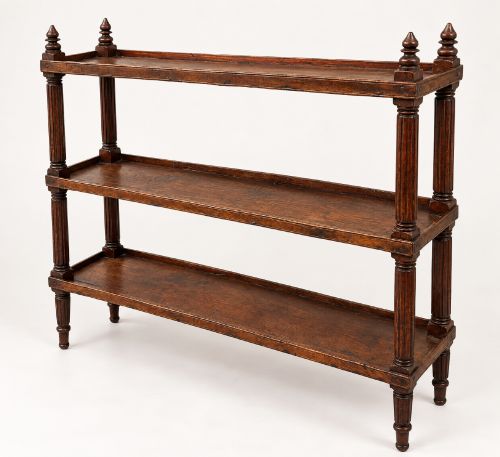
A wooden whatnot shelf organises curios and books across tiered platforms, offering vertical display without crowding a room.
Wooden Whatnot Shelf
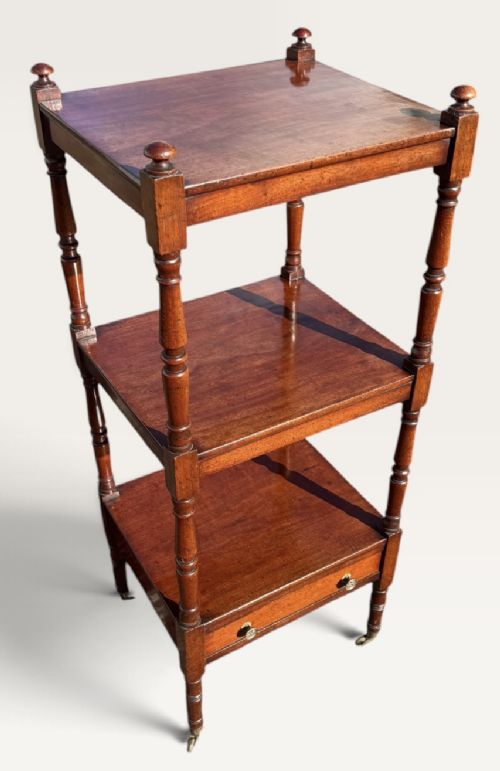
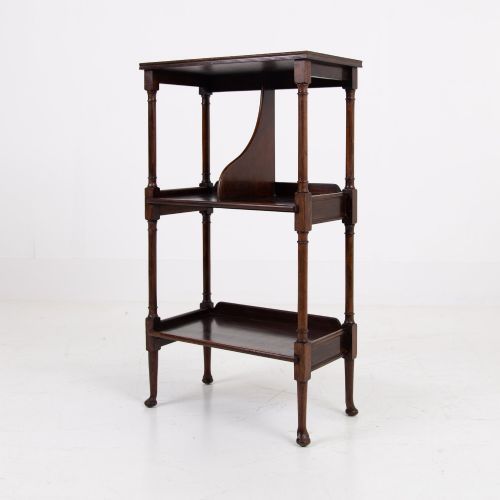
A wooden whatnot shelf is a multi-tiered open shelving unit designed to display small ornaments, books, and collections in domestic interiors. When searching for a wooden whatnot shelf, buyers encounter freestanding upright towers, corner units, and occasional pieces integrated with drawers, cupboards, or music cabinets.
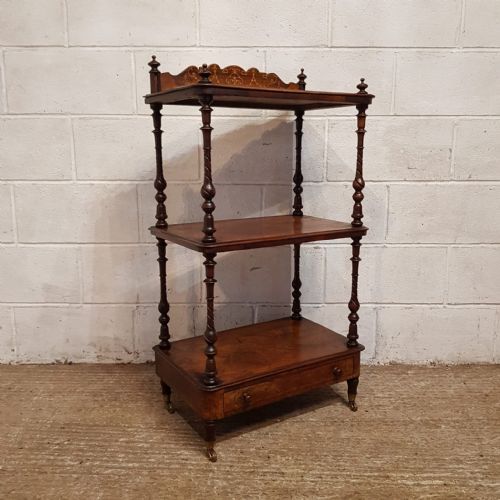
The pieces appearing here span the Georgian, Regency, and Victorian periods, with nineteenth-century examples dominating the selection. Forms range from simple three-tier open stands to elaborate constructions featuring mirrors, barley twist supports, and inlaid marquetry.
Mahogany and walnut serve as the primary woods, supplemented by burr walnut, rosewood, padauk, and satinwood. Makers adapted the form for specific domestic functions, yielding variants such as bedside night stands, music stands, and compact bow-fronted corner units.
How they were made
Cabinetmakers constructed these tiered units primarily using solid and veneered timbers such as mahogany, walnut, and rosewood, often selecting figured burr walnut or exotic padauk for display surfaces. Structural uprights frequently incorporated turned columns, slender spindle supports, or barley twist pillars to sustain the multiple tiers.
Joinery techniques included precise housing joints and rebated shelves secured to upright posts, whilst finer nineteenth-century examples featured intricate marquetry inlay, brass gallery rails, and fitted drawers with hand-cut dovetails. Surfaces were traditionally finished with shellac polishes or French polish to highlight the natural grain and colour of the timber.
Wooden Whatnot Shelf Retail Price Guide 2026
Typical asking prices for wooden whatnot shelf among the pieces listed under this phrase on Sellingantiques today, from the lower quarter to the upper quarter. They describe what is for sale here now, not the wider market.
One persistent Victorian model includes a hidden drawer tucked beneath the mirror, ideal for stashing love letters or spare keys.
What varies in quality
Construction rigidity distinguishes better pieces from simpler utilitarian stands, as multiple open shelves require sound joinery to prevent sway. Refined decorative elements, including finely carved mouldings, integrated mirrors, and working drawers with original hardware, elevate a standard shelving unit into a piece of fine cabinet-work.
The Wooden Whatnot Shelf Glossary
- Whatnot
- A multi-tiered piece of furniture designed for displaying ornaments, books, and small decorative objects. It developed in the eighteenth century and remained popular throughout the Victorian era.
- Etagere
- A French term for a tiered open shelving unit used for display. It is frequently used interchangeably with the English whatnot.
- Barley twist
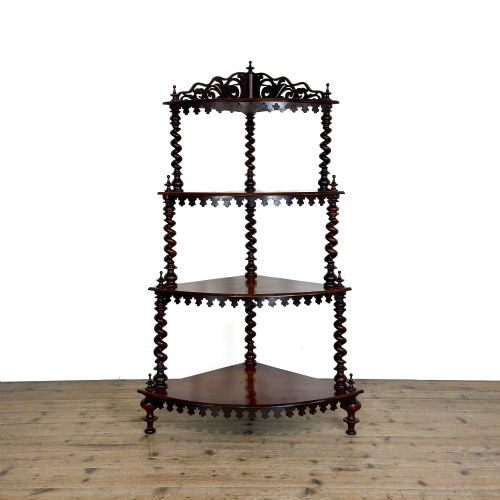
- A type of turning shaped like a spiral rope, commonly utilised for the vertical support columns on nineteenth-century stands and furniture.
- Marquetry
- Decorative veneer work forming pictures or patterns by assembling small pieces of wood, shell, or ivory. It appears frequently on Victorian burr walnut cabinets and tabletops.
- Cellarette
- A lockable compartment or container built into furniture for storing bottles. Some larger nineteenth-century tiered stands incorporate this feature within a lower cupboard base.
Wooden Whatnot Shelf: Frequently Asked Questions
What is a wooden whatnot shelf used for?
These tiered pieces were originally designed to hold small decorative items, ceramics, and books in drawing rooms and parlours. They provided vertical display space without dominating the floor plan of the room.
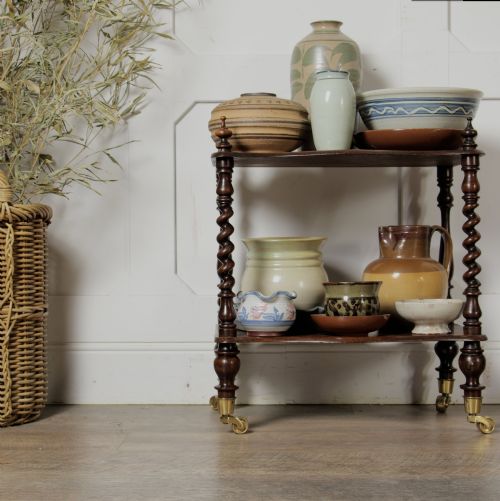
Today, they function similarly in modern homes as open display units for collections, houseplants, or bedside storage. Their narrow footprint allows them to fit easily into alcoves and corners.
How do I tell a Georgian whatnot from a Victorian one?
Georgian and Regency examples tend to feature restrained classical lines, simpler turned supports, and straight-grained mahogany construction. They emphasise proportion and architectural restraint over heavy ornamentation.
Victorian pieces often introduce richer timbers like burr walnut and rosewood, alongside more elaborate decorative elements such as mirrored backs, intricate marquetry inlay, and barley twist columns.
Where should I place a corner whatnot?
Corner units are specifically built with right-angled shelves designed to slot neatly into the unused junctions of a room. They make effective use of awkward spaces without obstructing walkways.
They work well in dining rooms for holding small tableware or in living spaces for displaying porcelain and framed photographs. Their triangular footprint provides surprising stability on solid floors.
Are all whatnot shelves freestanding?
Most traditional examples are entirely freestanding structures supported by four vertical posts or a sturdy A-frame chassis. This allows them to be positioned anywhere in a room.
Some specialised variants, particularly corner iterations, were occasionally designed to be secured against a wall for extra stability, though standard domestic models rest securely on their own feet.