




Wooden Revolving Bookstand
A wooden revolving bookstand gives you immediate access to a desktop library, turning smoothly to keep your volumes within reach.
Wooden Revolving Bookstand
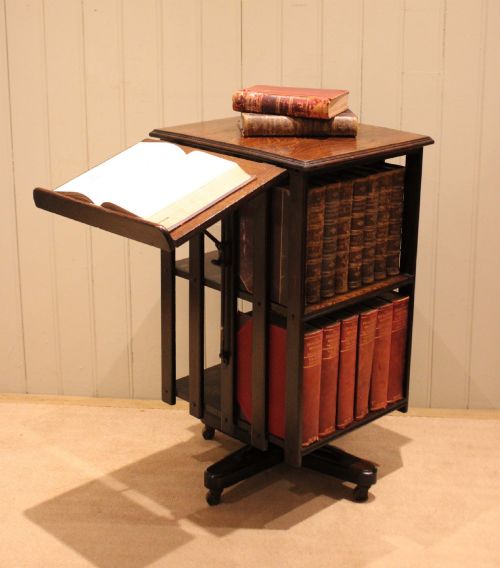
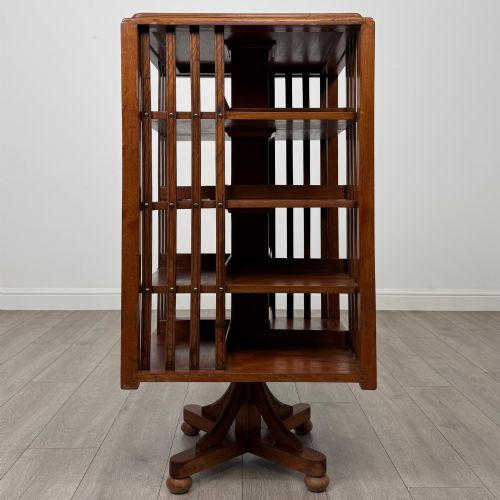
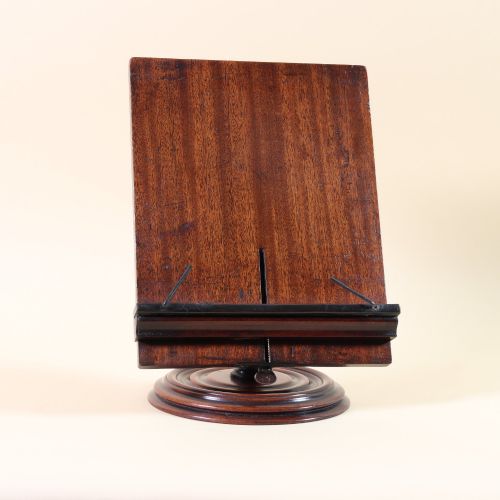
A wooden revolving bookstand sits on a desk or floor, holding multiple books upright in compartments that spin on a central axis. These pieces range from compact desk-top book rests to tall multi-tiered floor models designed for daily utility in a study or library.
Most examples you will encounter date from the Edwardian period or the late nineteenth century, constructed in traditional timber forms. They appear in styles such as Edwardian, Victorian, and Anglo-Indian, reflecting the domestic tastes of their eras.
You will find these stands configured as standard bookcases, four-tier towers, or specialised reading stands with adjustable elements. Oak and mahogany dominate the selection, often finished with inlay or contrasting details.
How they were made
Cabinetmakers built these revolving stands using solid hardwoods like oak and mahogany, frequently incorporating satinwood for decorative inlay work. The internal turning mechanism often relies on metal, iron, or brass components to ensure smooth rotation under the weight of heavy volumes.
Joinery techniques matched the functional demands of a piece designed for constant movement, joining sturdy timber frames to withstand the torque of spinning. Surface finishes were polished to highlight the natural grain of the wood, from deep red mahogany to golden oak.
Wooden Revolving Bookstand Retail Price Guide 2026
Typical asking prices for wooden revolving bookstand among the pieces listed under this phrase on Sellingantiques today, from the lower quarter to the upper quarter. They describe what is for sale here now, not the wider market.
Some models include a built-in reading stand at the very top, ready for the book you abandoned halfway through last night.
What varies in quality
The sophistication of the timber selection and decorative detail marks the distinction between standard production and superior examples. Fine pieces feature intricate satinwood inlay or well-figured mahogany and walnut grains, whereas utilitarian versions rely on plain oak.
Engineering of the revolving mechanism dictates the smoothness and stability of the rotation. A well-constructed pivot allows the tiers to turn effortlessly without listing or catching, while lesser examples may feel heavy or loose in their motion.
Maple and Co
The Wooden Revolving Bookstand Glossary
- Edwardian
- Pertaining to the reign of King Edward VII, spanning from 1901 to 1910. Pieces from this era often display lighter proportions and refined inlay work compared to earlier Victorian furniture.
- Inlay
- A decorative technique where contrasting woods or materials are set into the surface of a piece. Satinwood is frequently used for this purpose on dark mahogany bodies.
- Tier
- A single horizontal level or shelf within a stacking structure. Four-tier revolving bookcases provide substantial capacity within a compact footprint.
- Reading stand
- A specialised support designed to hold a book open at a readable angle. Some desk-top versions incorporate this feature directly into the revolving structure.
Wooden Revolving Bookstand: Frequently Asked Questions
How do these bookstands actually rotate?
The structure rests on a concealed internal pivot mechanism, frequently constructed with iron or brass components. This allows the entire wooden body to spin smoothly on a fixed base.
Users can simply turn the shelves by hand to access volumes from any angle without moving the stand itself.
Were they meant for desks or floors?
Both formats exist within the tradition, serving different domestic spaces. Smaller desk-top versions rest directly on writing tables to hold active reference books.
Taller multi-tiered models stand independently on the floor, designed to house small collections beside an armchair or desk.
How do I care for the wood and mechanism?
Keep the timber conditioned with traditional furniture wax to maintain the finish and prevent the wood from drying out. Avoid placing the stand in direct sunlight or near heat sources.
The internal pivot rarely requires attention, but keeping the surrounding floor clear ensures the rotation remains unimpeded.
How can I tell an Edwardian stand from a Victorian one?
Victorian pieces from the late nineteenth century tend to be heavier and darker in appearance, utilising dense mahogany or oak with robust proportions. Edwardian examples often feature lighter construction and decorative satinwood inlay.
The overall aesthetic shifted toward greater delicacy and brightness by the start of the twentieth century.