

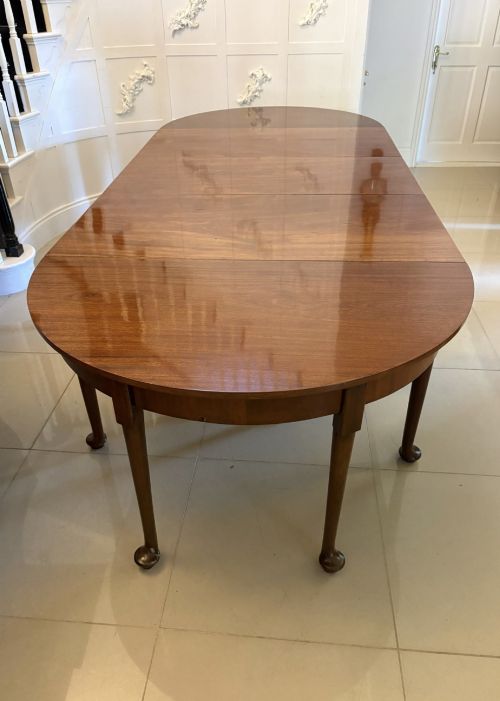
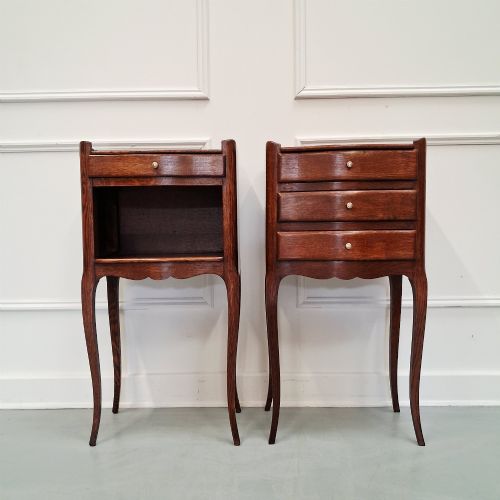
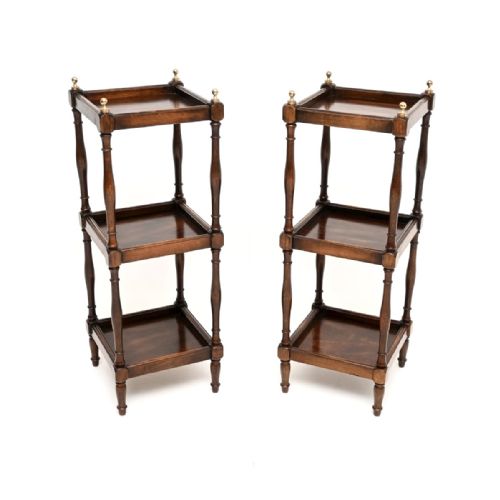
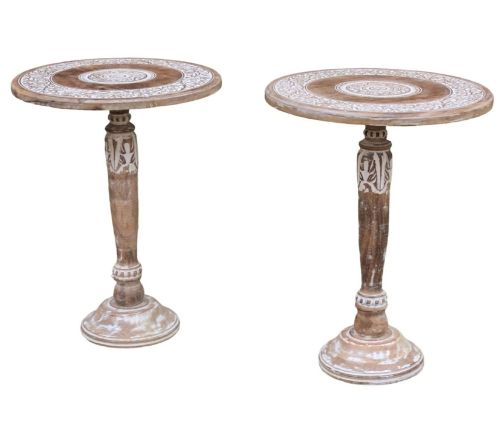
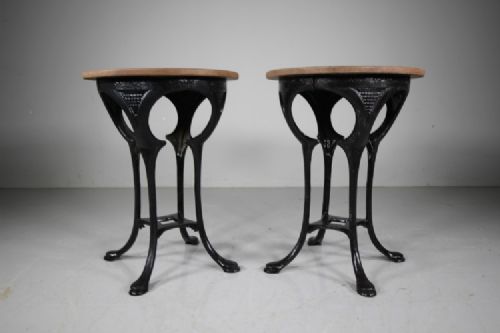
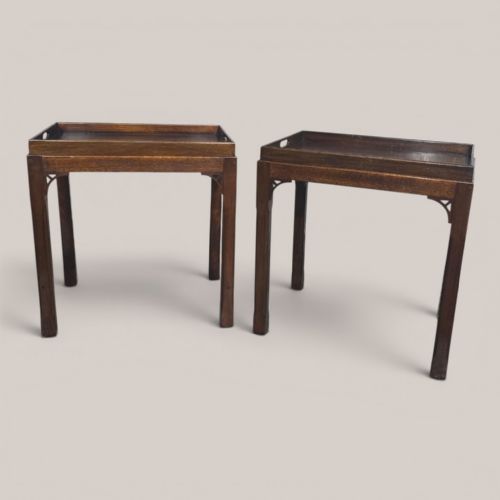
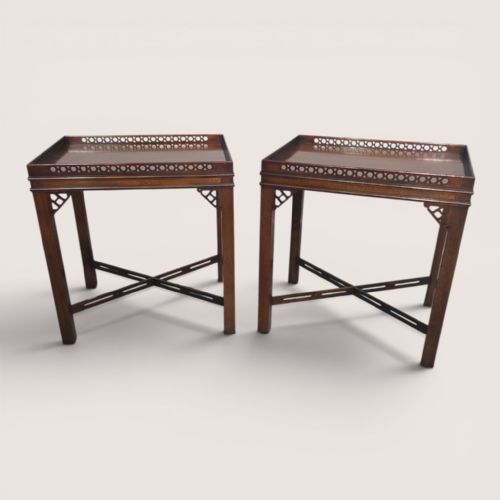
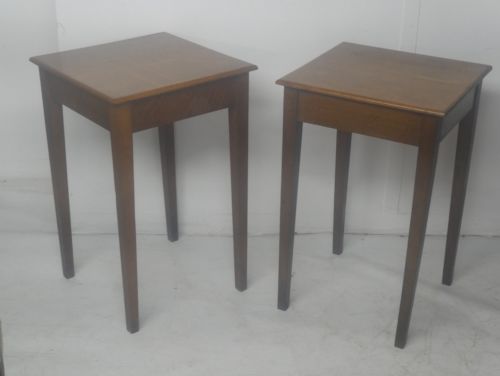
Wooden End Tables Pair
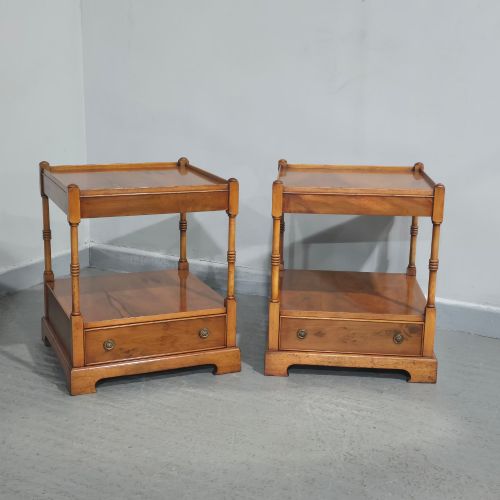
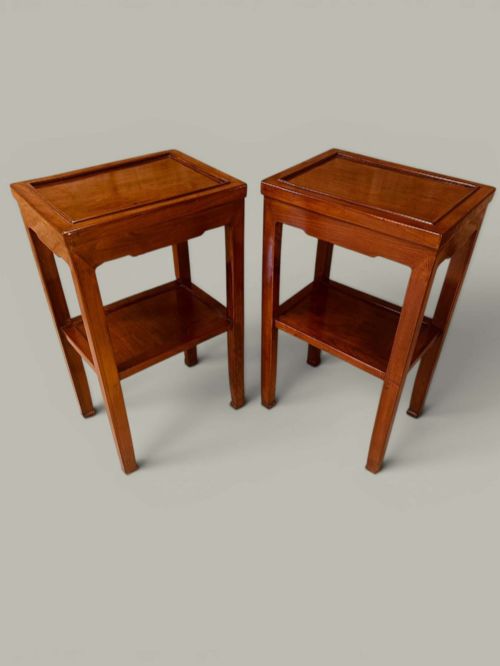
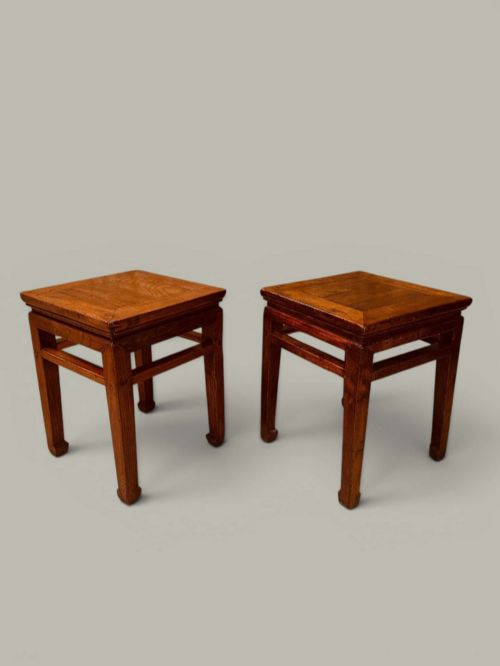
These wooden end tables pair options bring matched proportions and practical surface space to a room, offering dual utility beside seating or beds.
Wooden End Tables Pair
A wooden end tables pair comprises two matched or closely corresponding support surfaces designed for placement beside seating or beds, functioning as lamp tables, bedside tables, or low display surfaces. These pieces appear across diverse historical periods, stretching from the eighteenth century through the Edwardian era and into the Art Deco epoch.
The material palette of these duos leans heavily toward timbers such as mahogany, walnut, oak, elm, and burr elm, frequently complemented by brass hardware or marble tops. Workshops from English, French, Chinese, Anglo-Indian, and Swedish traditions contributed to the variety of forms available on the market.
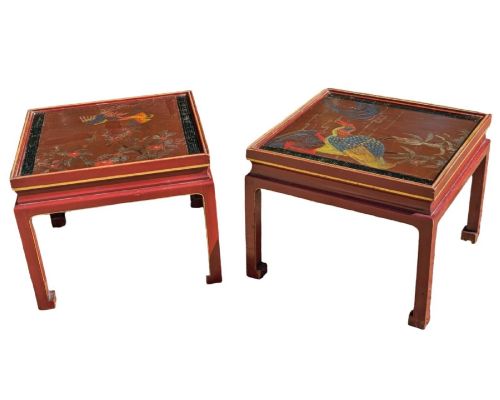
Buyers encounter distinct regional stylistic traits, ranging from Georgian and Chippendale mahogany designs to French provincial marquetry and Chinese lacquer low tables. Proportions vary from compact bedside nightstands to larger lamp tables and drop-leaf formats suited to specific interior layouts.
Materials and construction methods
Cabinetmakers utilised dense hardwoods like mahogany, walnut, and oak to build the primary structures, often selecting figured veneers or burr elm for visual depth on surface tops. Secondary woods provided internal framing stability while exterior faces received polish, lacquer, or paint finishes.
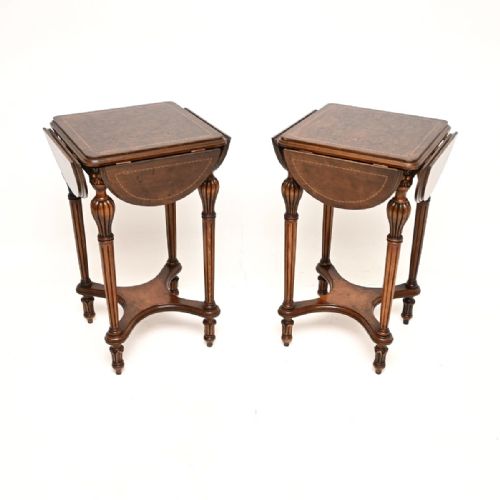
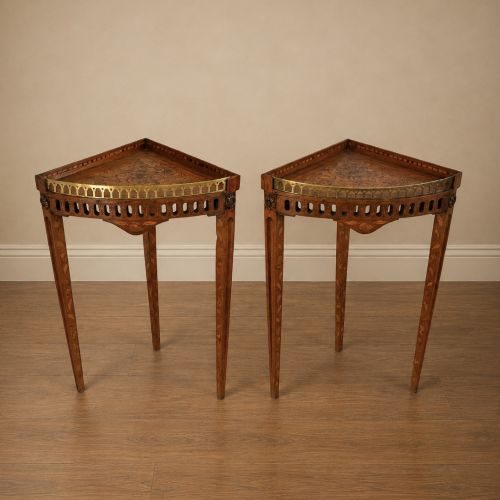
Decorative surface techniques include marquetry inlay, hand painting, and carved detailing executed on pedestal bases, gallery edges, and drop-leaf mechanisms. Metal components such as brass galleries, drop handles, and cast iron supports integrated structural utility with decorative accents.
Joinery methods varied according to the period and regional workshop origin, encompassing traditional cabinet construction alongside folding frames, tiered shelving tiers, and metamorphic dining-to-console configurations.
Wooden End Tables Pair Retail Price Guide 2026
Typical asking prices for wooden end tables pair among the pieces listed under this phrase on Sellingantiques today, from the lower quarter to the upper quarter. They describe what is for sale here now, not the wider market.
Camel tables from Anglo-Indian workshops bring exotic carved forms straight to the British drawing room.
Distinctions in craftsmanship and materials
The standard of timber selection divides utilitarian items from finer examples, with figured mahogany, burr elm, and well-matched grain patterns indicating superior workshop choices. The crispness of hand-carved details, intricate marquetry inlay, and painted decoration demonstrates the level of artisan skill involved in production.
Structural integrity depends upon precise joinery execution and the preservation of original brass fittings, galleries, and drop-leaf mechanisms. Consistency between the two items forming the pair, whether perfectly matched or assembled as a close matching pair, dictates the visual harmony of the set.
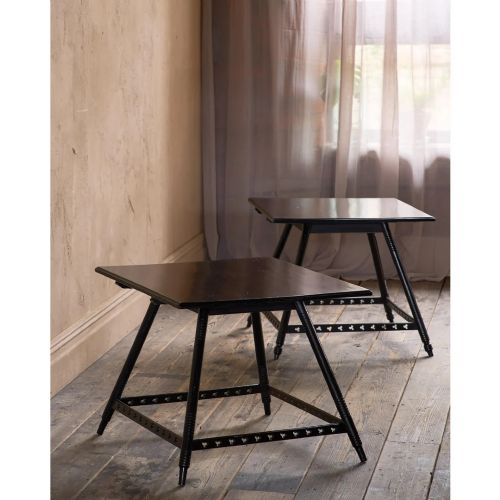
Archibald Knox·Gilbert Rohde
The Wooden End Tables Pair Glossary
- Marquetry
- Decorative veneer work arranged in geometric or pictorial patterns across a wooden surface. This technique employs contrasting wood species to create intricate designs on table tops.
- Brass gallery
- A low metal railing fitted around the perimeter of a table top to secure items from sliding off. These fixtures often feature in Georgian and later lamp table designs.
- Drop leaf
- A hinged table flap that can be raised to extend the surface area or lowered when space is constrained. This mechanism appears frequently on nineteenth and early twentieth century side tables.
- Tiered
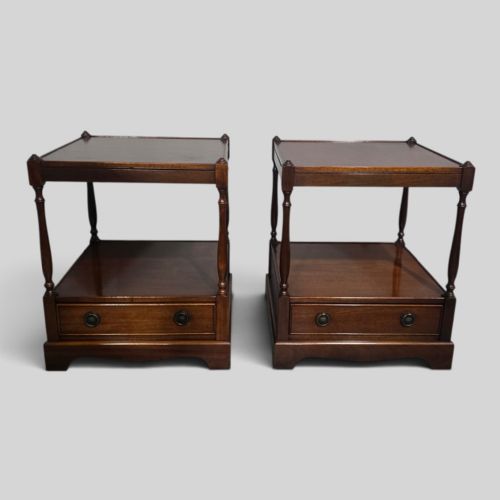
- Having multiple vertically stacked shelves supported by columns or legs. Three-tier tables maximise surface utility within a compact footprint.
- Metamorphic
- Describing furniture engineered to transform from one form or function into another, such as a console converting into a larger dining table.
Wooden End Tables Pair: Frequently Asked Questions
What defines a matched pair?
A matched pair consists of two tables created together with identical dimensions, timbers, and decorative schemes to flank a bed, sofa, or fireplace symmetrically.
In some instances, makers produced slightly variant pieces designed to correspond closely as a near pair, sharing period characteristics without identical detailing.
How were these tables used historically?
Historically, these items served multiple domestic functions in bedrooms, drawing rooms, and libraries as supports for oil lamps, reading materials, and decorative objects.
Compact variants functioned specifically as bedside nightstands or low tables for tea service, adapting to the spatial needs of period interiors.
How do I distinguish eighteenth century pieces?
Eighteenth century examples typically display Georgian or Chippendale design vocabularies, utilising solid figured mahogany, precise hand-cut joinery, and restrained classical carving.
Construction traits from this era prioritise structural integrity and timber quality over mass-produced uniformity, often bearing the marks of regional cabinet workshops.
Can I mix different wood tones?
Mixing wood tones allows interiors to incorporate varied periods and regional origins, such as pairing dark mahogany with warmer walnut or lighter oak.
Matching the scale and height of the tables matters more for visual balance than ensuring identical timber species across a room.