

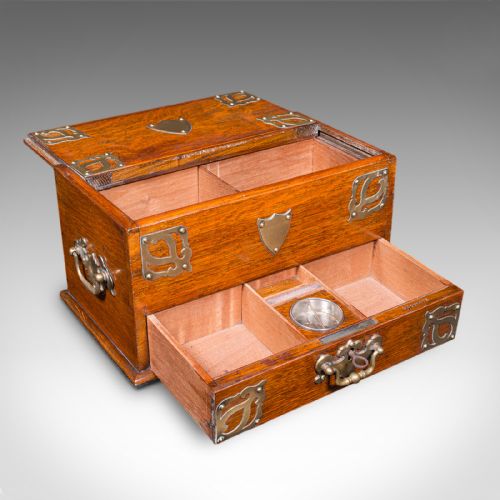


Wooden Cigar Cabinet
A wooden cigar cabinet holds your collection securely, bringing period craftsmanship and rich grain patterns straight to the desk or club lounge.
Wooden Cigar Cabinet
A wooden cigar cabinet serves as a dedicated storage piece for cigars and smoking accessories, appearing across periods from the Victorian era into the twentieth century. These pieces take several forms, including desktop humidors, wall cabinets, smoker's boxes, and larger tantalus combinations incorporating crystal decanters.
The versions most frequently met on this page include desktop cabinets with multiple internal drawers, tambour doors, and drop-front panels designed for domestic or club use. Their origins span English workshops, Anglo-Indian studios, and commercial display contexts, reflecting diverse nineteenth and twentieth-century social habits.
How they were made
Cabinetmakers utilised solid and veneered timbers, selecting durable woods such as oak, walnut, burr elm, and pollard oak to create stable structures. These surfaces often highlight complex natural burls and rich grain figures enhanced by polished finishes.
Interiors frequently incorporate cedar linings designed to preserve moisture alongside brass hardware, leather details, and glass panels. Master joiners employed tambour construction, fitted locking mechanisms, and multi-drawer layouts to organise smoking paraphernalia efficiently.
Wooden Cigar Cabinet Retail Price Guide 2026
Typical asking prices for wooden cigar cabinet among the pieces listed under this phrase on Sellingantiques today, from the lower quarter to the upper quarter. They describe what is for sale here now, not the wider market.
One exceptional smoker's cabinet takes the delightful form of a GWR coal wagon.
What varies in quality
Superior examples demonstrate meticulous timber selection, particularly in the matching of burr walnut and burr elm veneers across exterior surfaces. The integration of robust locking mechanisms and original brass fittings elevates the construction standard.
Finer pieces maintain internal cedar linings and precise drawer tolerances that ensure proper closure. The presence of specialised forms, such as tambour shutters or integrated decanter sections, distinguishes elevated production from simpler utility boxes.
Alfred Dunhill·H. Upmann
The Wooden Cigar Cabinet Glossary
- Humidor
- A specialised storage container designed to maintain a consistent internal humidity level for preserving cigars. These boxes often feature cedar wood interiors to regulate moisture.
- Tambour
- A flexible shutter door constructed from narrow strips of wood glued to a fabric backing, allowing it to slide smoothly around a curved track. This technique conceals internal compartments efficiently.
- Tantalus
- A locking beverage cabinet that displays decanters securely while preventing unauthorized access to the contents. They frequently appear combined with humidor compartments.
- Burr
- A tree growth that produces intricate, swirling grain patterns highly prized in decorative woodworking. Veneers sliced from these sections create striking cabinet facades.
Wooden Cigar Cabinet: Frequently Asked Questions
How do you use a vintage humidor?
Vintage humidors require careful inspection of their internal cedar linings and seals before storing cigars. Many older models serve well for display or dry storage of accessories.
Placing modern humidification elements inside can sometimes restore functionality to period boxes, though original mechanisms vary in airtight performance.
How old is an antique smoker box?
Antique smoker boxes on this page mostly date from the Victorian and Edwardian eras, spanning the late nineteenth into the early twentieth century. Stylistic clues help establish their production period.
Brass hardware, timber choices, and construction methods such as tambour doors point directly to these specific decades of manufacture.
Where were these cabinets placed?
These cabinets typically sat upon executive desks, club lounge tables, or dedicated smoking room sideboards. Their compact footprints suited domestic studies and gentlemen's clubs alike.
Some variations were manufactured as wall cabinets or shop display units, serving both decorative and commercial functions.