





Wooden Banjo Barometer
A wooden banjo barometer brings the refined weather-tracking of the nineteenth century directly to your wall.
Wooden Banjo Barometer
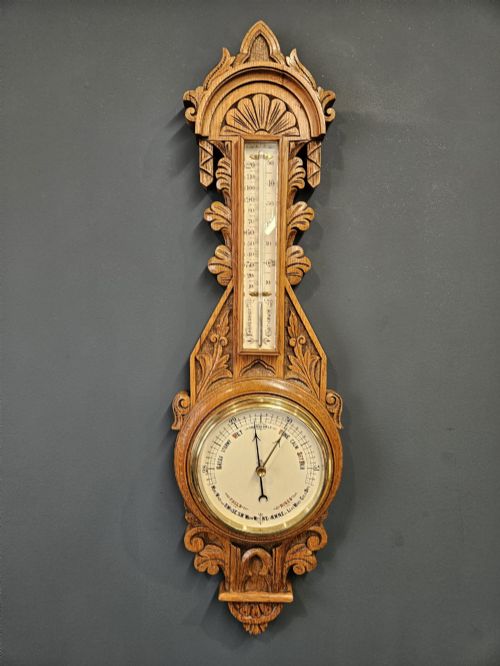
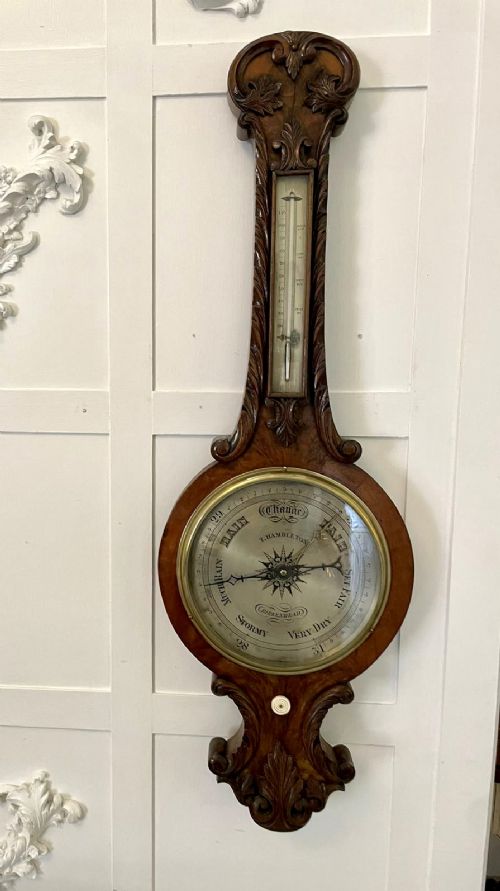
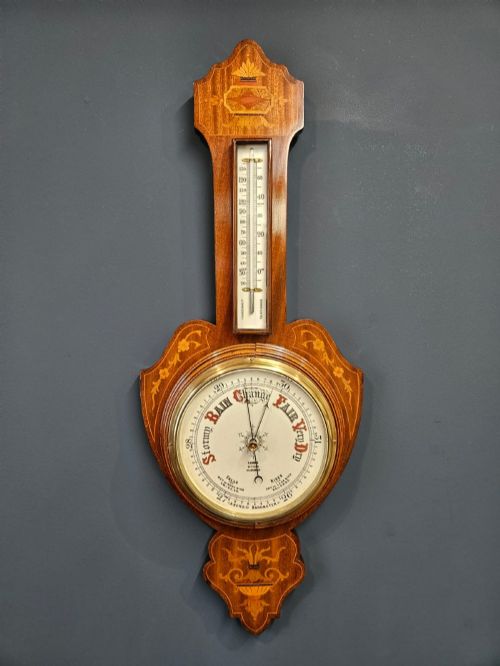
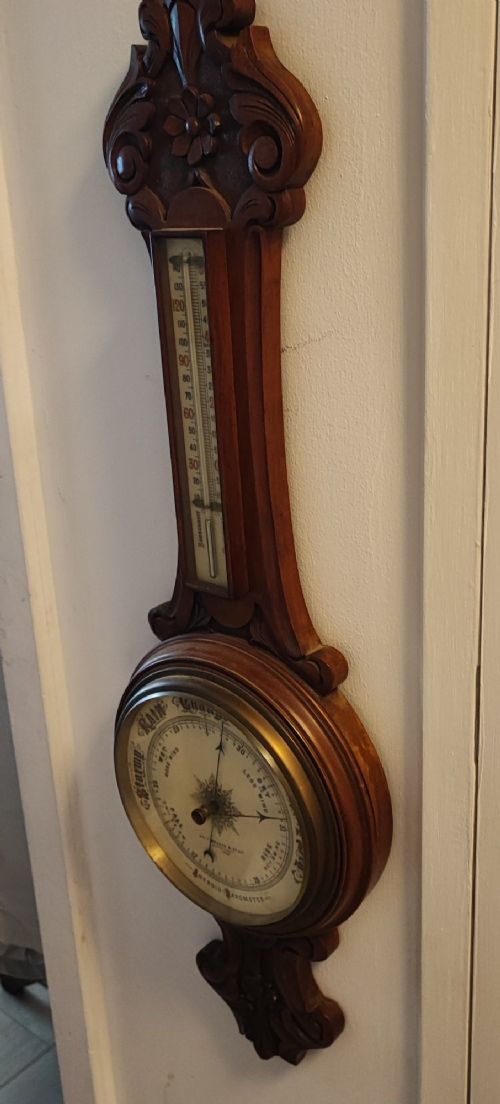
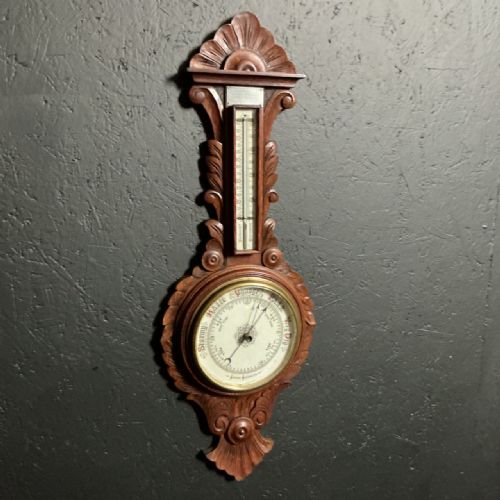
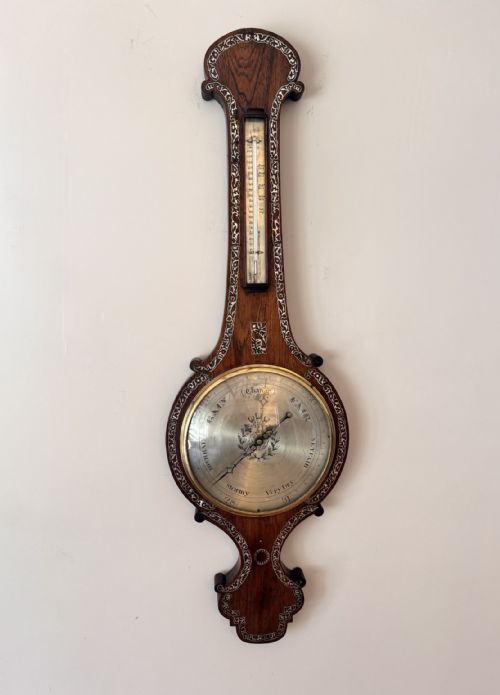
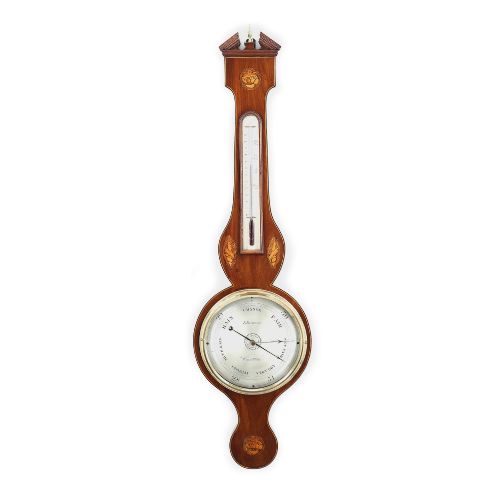
A wooden banjo barometer is a domestic weather glass housed within a distinctive, elongated wooden frame shaped much like the musical instrument. These instruments date from periods such as the Regency, Victorian, and Edwardian eras, combining scientific utility with domestic decorative arts. When you browse this page, you encounter wall-hanging examples spanning the nineteenth and early twentieth centuries.
The most common formats on this page feature rich hardwoods like mahogany and oak, often paired with accompanying thermometers and hygrometers. Victorian and Regency makers produced both mercury and aneroid versions, housing dials behind glass plates. Wall clocks occasionally appear combined within the same wooden banjo case.
Materials and Construction
Cabinet makers utilised dense hardwoods such as mahogany, walnut, burr walnut, rosewood, and oak to form the characteristic curved bodies. These cases frequently incorporate delicate stringing, marquetry, and mother of pearl inlay to decorate the long stems and circular heads. Brass bezels enclose the glass faces, protecting the delicate dials and indicators within.
Internal mechanisms rely upon sealed metal aneroid capsules or traditional glass tubes containing mercury to register atmospheric pressure changes. Artisans fitted these precision instruments by hand into carved or turned wooden housings, finishing the exteriors with polish to accentuate the grain of the timber.
Wooden Banjo Barometer Retail Price Guide 2026
Typical asking prices for wooden banjo barometer among the pieces listed under this phrase on Sellingantiques today, from the lower quarter to the upper quarter. They describe what is for sale here now, not the wider market.
Periods represented across the items include Regency, Victorian, Edwardian, and Georgian Revival.
Distinguishing Quality in Construction and Maker
The distinction between standard domestic instruments and superior examples rests in the crispness of the woodcarving, the complexity of the marquetry, and the selection of figured veneers like burr walnut or birds eye maple. Master cabinet makers and established opticians invested greater care in the joinery of the case and the legibility of the engraved brass scales.
Signed dials by recorded makers elevate an instrument beyond anonymous workshop production. The integration of secondary instruments, such as working thermometers and clock movements, also indicates a higher tier of original manufacture.
B Besozzi of Weymouth·Molton of Norwich·W Watson and Sons·Jenkins of Old Swindon·L Casatelli of Liverpool·W E Pain of Cambridge·Vecchio and Co of Shaftsbury·A Rivolta·J Groce York·F Salteri and Co Nottingham
The Wooden Banjo Barometer Glossary
- Aneroid barometer
- A barometer that measures atmospheric pressure through the expansion and contraction of a sealed metal capsule, without using liquid mercury.
- Wheel barometer
- A domestic weather glass utilising a float inside a siphon tube connected to a pulley and pointer, displaying pressure on a round dial.
- Marquetry
- Decorative woodwork where thin slices of various timbers and materials are fitted together to form pictorial or geometric patterns on the case surface.
- Stringing
- Fine, contrasting lines of inlaid wood used to outline the borders and edges of furniture and instrument cases.
- Bezel
- The brass or metal ring that holds the protective glass cover in place over the barometer dial.
Wooden Banjo Barometer: Frequently Asked Questions
How do I read a wooden banjo barometer?
The main circular dial shows pressure changes, often marked with weather descriptions like rain, change, and fair, which the needle points toward.
A smaller secondary dial at the top, known as the pointer or index hand, allows you to manually set a reference point to track whether pressure rises or falls.
Were these barometers used outdoors?
These instruments were strictly designed for interior domestic use within the principal rooms of nineteenth-century homes, such as hallways and libraries.
Exposure to damp conditions or direct sunlight damages the delicate wooden veneers, brass bezels, and internal mechanical movements.
What is the difference between mercury and aneroid?
Mercury versions rely on a traditional column of liquid metal inside a glass tube to register atmospheric weight directly.
Aneroid instruments operate through an internal flexible metal box that expands or contracts with air pressure changes, eliminating liquid entirely.
How do I date a wooden banjo barometer?
Dating relies upon stylistic clues, such as Regency brass work, Victorian carving depth, Edwardian inlay patterns, and the presence of maker signatures on the dial.
Aneroid mechanisms typically point toward a date from the mid-nineteenth century onward, while mercury tubes span across both Georgian and Victorian periods.