

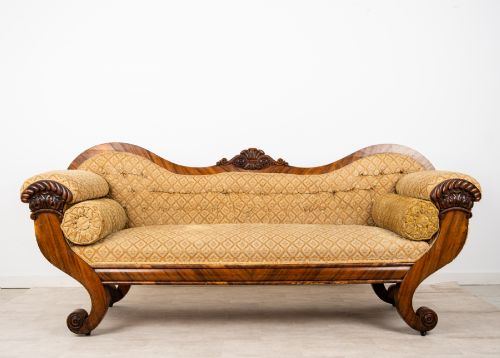


Wooden Arm Settee
A wooden arm settee brings substantial character to a room, offering enduring timber framing paired with traditional upholstery.
Wooden Arm Settee
When you search for a wooden arm settee, you are looking at domestic seating designed for multiple people, defined by exposed timber frameworks and arms alongside padded surfaces. These pieces emerge across periods from the early nineteenth century through the early twentieth century, spanning Georgian, Regency, Victorian, and Biedermeier styles.
The versions you are most likely to meet on this page include mahogany chair-back settees, rosewood scroll-end sofas, and bentwood designs. They take the form of settees, double-seat sofas, and chaise longues, bringing structural woodwork directly into the seating design.
Makers and workshops utilised specific regional preferences, creating everything from simple country house sofas to elaborate inlaid satinwood and mahogany creations. The underlying structure relies heavily on visible wood grains, polished surfaces, and defined arm supports that anchor the seating visually.
What varies in quality
The grade of timber selection distinguishes the construction, with burr-walnut, figured mahogany, and detailed satinwood inlay marking higher tiers of craftsmanship. Finer examples display crisper hand-carved details along the scroll ends, shield backs, and wooden arm supports.
Structural integrity and the retention of original surface polishes dictate the standing of a piece. Pieces that maintain their early upholstery materials alongside solid, unaltered frame joinery occupy the upper range of the selection.
Wooden Arm Settee Retail Price Guide 2026
Typical asking prices for wooden arm settee among the pieces listed under this phrase on Sellingantiques today, from the lower quarter to the upper quarter. They describe what is for sale here now, not the wider market.
The furniture styles represented across the inventory include Regency, Biedermeier, Hepplewhite, and Art Nouveau.
Thonet
The Wooden Arm Settee Glossary
- Chair-back settee
- A settee featuring a backrest constructed to resemble a row of connected chair backs, often seen in Hepplewhite and Georgian styles. This design highlights the exposed woodwork of the frame.
- Scroll end
- A rolled or curved wooden termination at the end of a settee arm or sofa side. It adds a sculptural silhouette derived from classical furniture traditions.
- Ebonised wood
- Timber treated with a dark finish to imitate expensive ebony. This technique was popular in nineteenth-century furniture to create stark contrast.
- Bentwood
- Wood softened through steaming and bent into curved structural forms. This technique produced light yet resilient frames characteristic of makers like Thonet.
- Chaise longue
- An elongated upholstered seat intended for reclining, combining a chair with an extended footrest. Many examples include a single raised wooden arm or back support.
Wooden Arm Settee: Frequently Asked Questions
What periods do these settees come from?
The pieces span the nineteenth and early twentieth centuries, covering Georgian, Regency, Victorian, and Edwardian eras. Each period introduced distinct proportions and decorative vocabulary to the wooden framework.
Craftsmen during these times adapted prevailing architectural and furniture trends, resulting in diverse styles ranging from severe Biedermeier lines to elaborate Victorian carved scroll ends.
What woods were used for the frames?
Makers utilised a variety of hardwoods, predominantly mahogany, walnut, maple, and rosewood. Some pieces feature ebonised finishes or delicate satinwood inlay work to enhance the visual appeal of the timber.
The choice of wood usually reflected the prevailing fashion of the maker's period, with figured grains displayed prominently on the arms, rails, and show-wood frames.
Where were wooden arm settees placed?
These settees served as formal seating in parlours, drawing rooms, and large reception halls. Their decorative wooden arms and exposed frames made them suitable for placement where the back and sides remained visible.
Smaller two-seater versions and chaise longues were also utilised in bedrooms or private sitting rooms for resting and reading.