

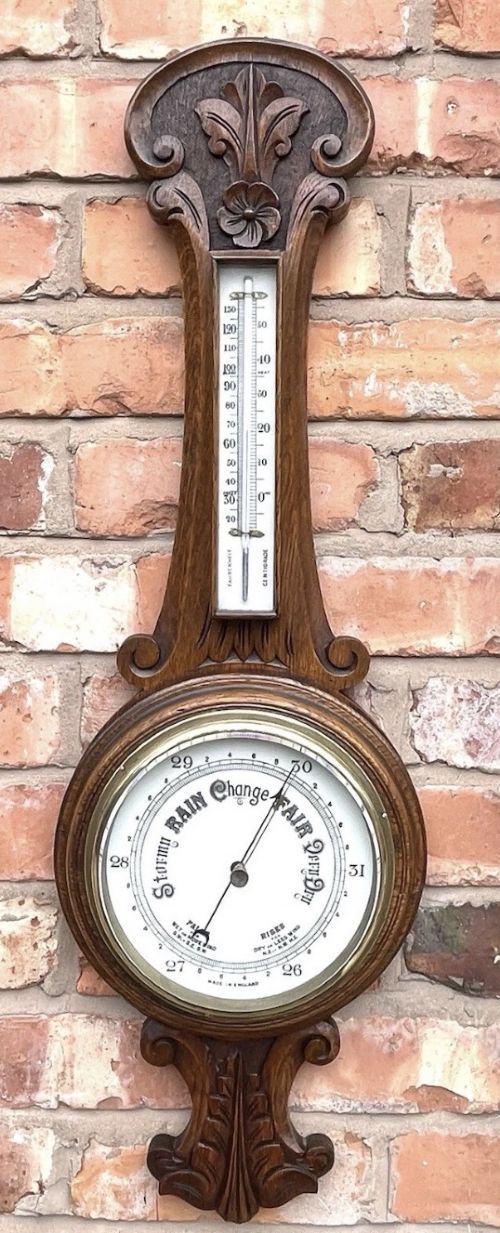


Wood Banjo Barometer
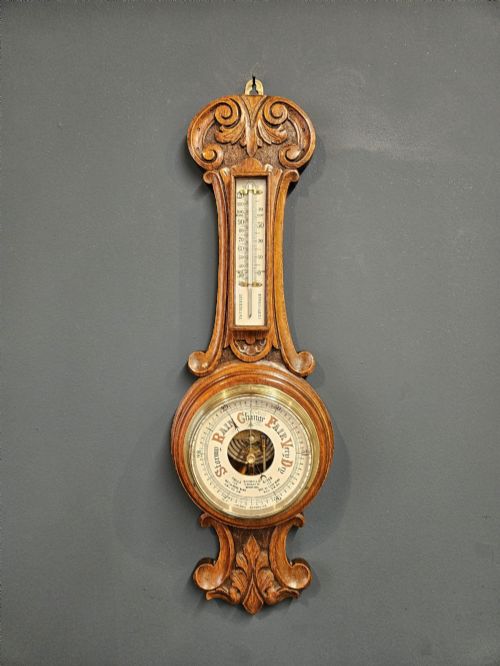
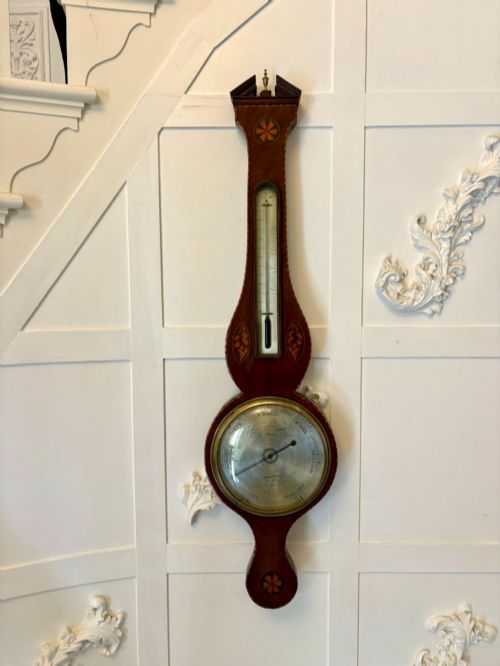
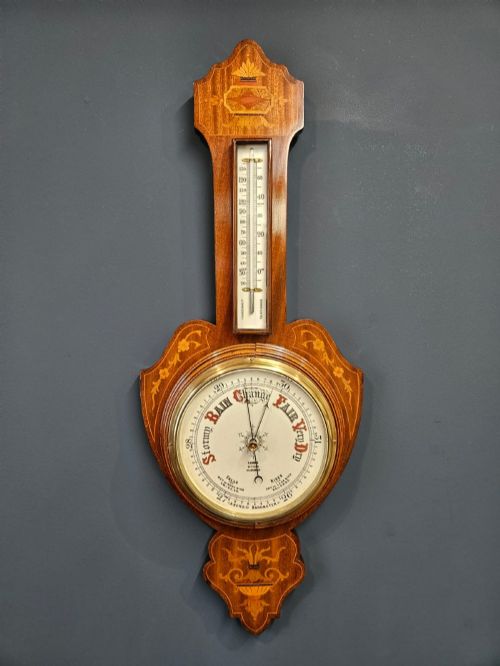
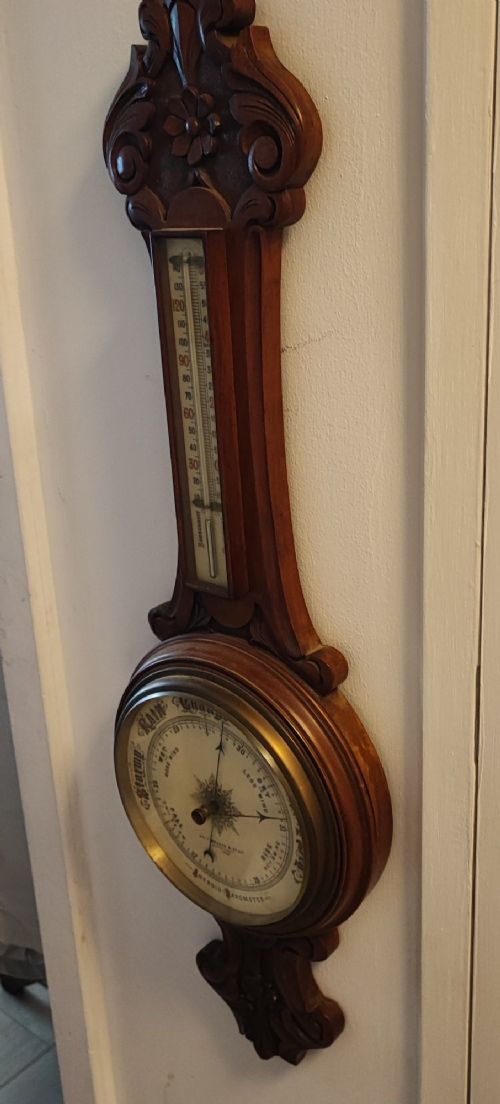
A wood banjo barometer is a domestic weather gauge with a distinctive bulbous outline that brings both period character and practical function to a wall.
Wood Banjo Barometer
When you search for a wood banjo barometer, you examine wall-hanging instruments shaped like the stringed musical instrument, combining weather dials with wooden cases. The forms found here span periods from the 18th century through the Victorian era to Edwardian times, originating from Georgian workshops, Victorian cabinet makers, and later makers.
Mahogany and rosewood dominate the earlier Georgian and 19th-century examples, frequently enhanced with shell inlay or mother of pearl. Oak and walnut emerge more prominently in Victorian and 1900 iterations, often carrying deeper carving alongside thermometers or clock components.
The versions you meet most frequently on this page are Victorian and 19th-century wheel barometers housed in rich mahogany or rosewood, though Neo-Classical marquetry pieces and Edwardian oak designs also appear regularly.
Materials and construction
Cabinet makers constructed the distinctive housings using dense timbers like mahogany, rosewood, oak, walnut, and satinwood, frequently shaping the grain to visual advantage. Carpenters often bent or carved the wood into the characteristic curved profile, incorporating string inlay, marquetry, or mother of pearl to ornament the facade.
Instrument makers fitted glass dials, brass bezels, and porcelain scales into the wooden bodies to display the barometric pressure and temperature. Internal mechanisms relied either on traditional mercury columns or later aneroid systems, sealed securely within the wooden frames.
Wood Banjo Barometer Retail Price Guide 2026
Typical asking prices for wood banjo barometer among the pieces listed under this phrase on Sellingantiques today, from the lower quarter to the upper quarter. They describe what is for sale here now, not the wider market.
Listings feature 19th century, Victorian, Edwardian, and 18th century periods, executed in mahogany, oak, rosewood, walnut, satinwood, brass, and glass.
Judging the range
The distinction between a standard production model and a finer piece rests on the refinement of the timber selection and the precision of the cabinet work. Sharper carving, more intricate shell or mother-of-pearl inlay, and balanced proportions elevate certain specimens above routine wall instruments.
The pedigree of the maker recorded on the dial or scale also shapes the standing of an instrument. Signed examples from established firms command greater interest than unsigned variants, reflecting the skill of the original workshop.
Fagioli of Clerkenwell London·W Watson & Sons·Jenkins Of Old Swindon·Roncoroni·W.E. Pain of Cambridge·Luisetti of London·Joseph Somalvico & Co·J C Moretti of King's Lynn·Negretti & Zambra·Maple & Co
The Wood Banjo Barometer Glossary
- Aneroid barometer
- A weather-measuring instrument that uses a flexible metal capsule rather than liquid mercury to register changes in atmospheric pressure. This mechanical design became common in later 19th-century and Edwardian models.
- Wheel barometer
- An instrument that translates the movement of mercury in a siphon tube via a pulley and weight to turn an indicator needle around a circular dial. This configuration creates the characteristic banjo silhouette.
- Mercury barometer
- A traditional device that measures atmospheric pressure through the rise and fall of liquid mercury in a glass tube. These sensitive instruments represent the earlier Georgian and Victorian traditions.
- Skeletonised movement
- A clock or barometer mechanism designed with cutaway plates that expose the inner working gears to view through a glass face. This specialised layout appears in select Victorian pieces.
- Onion top
- A rounded, bulbous upper pediment shape found on certain wooden barometer cases. This specific silhouette characterises particular regional and period styles.
Wood Banjo Barometer: Frequently Asked Questions
How do I hang a wood banjo barometer?
These instruments require a sturdy wall fixture that supports the weight of the timber case and internal glass components securely. Positioning them away from direct heat sources and heavy vibrations helps protect the sensitive mechanism inside.
Ensuring the case hangs plumb against the wall allows the mechanical linkages or mercury columns to operate correctly. Checking the security of the hanging ring on the reverse is essential before committing the piece to the wall.
What is the difference between mercury and aneroid barometers?
Mercury barometers rely on an open column of liquid metal to balance atmospheric pressure, representing the traditional method used across Georgian and early Victorian instruments. They require careful handling, particularly if moved.
Aneroid barometers use an internal sealed metal box that expands or contracts with pressure changes, moving a pointer via mechanical links. This design appeared later in the 19th century and made instruments more robust for domestic use.
How do I date a wood banjo barometer?
Dating relies on examining the timber species, the style of inlay, and the construction methods used in the wooden case. Georgian pieces often feature simpler mahogany frames with delicate shell inlay, while Victorian examples introduce heavier oak or walnut carving.
The signature on the dial or paper scale provides a definitive link to the maker's working period. The transition from mercury to aneroid dials also offers a reliable chronological marker between earlier and later 19th-century pieces.
Were these barometers used outdoors?
These instruments were strictly designed for interior domestic use within hallways, libraries, and principal rooms. The sensitive wood veneers, paper or porcelain dials, and glass faces would suffer damage from outdoor exposure.
Their decorative wooden cases served as important items of household furniture as well as scientific tools. Owners placed them where visitors and residents could consult the weather before stepping outside.