



Whitby Landscape Artwork
Whitby landscape artwork captures the Yorkshire coast through historical watercolours and oil paintings.
Whitby Landscape Artwork
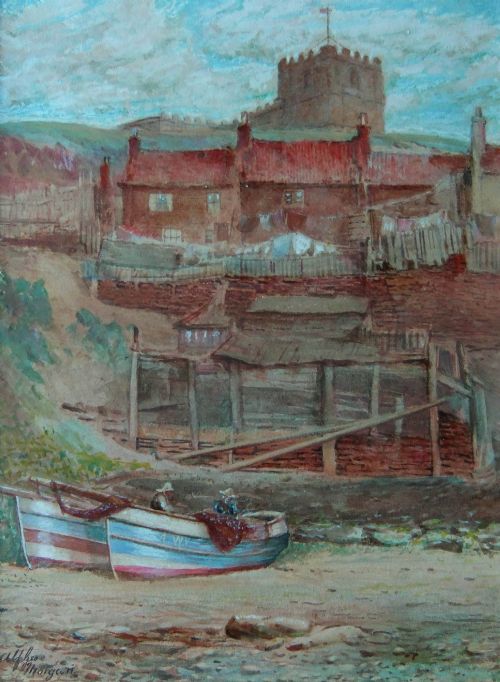
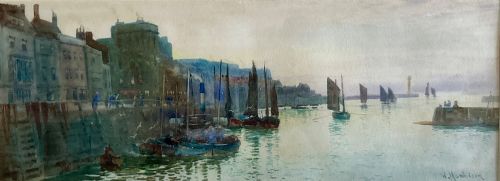
Whitby landscape artwork records the Yorkshire coast, harbour scenes, and the abbey through historical paintings. These pieces capture local landmarks including the harbour, the East Cliff, and Henrietta Street.
The works on this page appear primarily as watercolours and oil paintings on paper or canvas. Artists working across the nineteenth century, the Victorian period, and into the nineteen-thirties documented this specific coastal terrain.
How these pieces were created
Watercolour pigment applied to paper forms the basis of the majority of these coastal views. Artists utilised transparent washes alongside heavier bodycolour to describe the changing light over the harbour and the North Sea.
Oil paintings on canvas provide an alternative medium seen in this group. Pigment mixed with oil allowed painters to build heavier textures for evening scenes and moonlight views across the water.
Whitby Landscape Artwork Retail Price Guide 2026
Typical asking prices for whitby landscape artwork among the pieces listed under this phrase on Sellingantiques today, from the lower quarter to the upper quarter. They describe what is for sale here now, not the wider market.
Current listings feature watercolours and oil paintings dated across the nineteenth century, Edwardian period, and nineteen-thirties.
What distinguishes finer examples
Quality rests in the artist's command of atmospheric light and topographical accuracy. Works by established named painters demonstrate superior handling of maritime movement and architectural detail compared to anonymous sketches.
Condition of the paper and pigment integrity influence the character of each piece. Well-preserved works retain their original colour intensity without excessive fading from light exposure.
Alfred G. Morgan·William Matthison·Tom Clough·Fred Waugh·George Weatherill·George Hamilton Constantine·Frederick William Booty·Frederick Williamson·Albert Robert Quinton·William Samuel Horton·William Kay Blacklock·Rowland Henry Hill·Harry Wanless·H. Hadfield Cubley·John Sanderson Wells·Thomas Clavering Alder·Walter Emsley·Frank Rousse·John J. Hamer·Donald Wood·A.G.Stevens·R. J. S. Bertram
The Whitby Landscape Artwork Glossary
- Watercolour
- A painting method in which the paints are made of pigments suspended in a water-based solution. This medium creates transparent washes well-suited to coastal skies and marine views.
- Oil painting
- A work produced using pigments bound with a medium of drying oil. This technique allows for rich colour saturation and textured brushwork.
- Impressionism
- An art movement focused on capturing the visual impression of a moment, paying attention to light and its changing qualities. British variations of this style appear frequently in these regional landscapes.
- Marine realism
- A genre of art dedicated to depicting ships, coastal views, and the sea with close attention to nautical detail. Painters of this type recorded local boats and fishing dockyards accurately.
Whitby Landscape Artwork: Frequently Asked Questions
What subjects appear in whitby landscape artwork?
These works focus predominantly on the Yorkshire coastal town, featuring the harbour, Tate Hill Pier, and the abbey ruins. Scenes also record local streets such as Flowergate and Henrietta Street alongside fishing boats off the coast.
Artists across different decades returned to these specific viewpoints, documenting the changing appearance of the harbour and the surrounding landscape.
How do watercolours differ from oil paintings here?
Watercolour pieces utilise pigment on paper to create lighter, transparent depictions of atmospheric coastal weather. Oil paintings on canvas employ heavier layers of pigment to capture evening scenes and moonlight effects.
Both mediums were used by artists working in the area during the nineteenth and early twentieth centuries.
Which periods do these paintings date from?
The works span from the nineteenth century through the Edwardian era up to the nineteen-thirties. Victorian and Edwardian examples sit alongside pieces dated specifically to nineteen-ten, nineteen-twenty, and nineteen-thirty.
Styles range from traditional topographical views to British Impressionism.
How should I care for a watercolour painting?
Watercolour paintings require protection from direct sunlight to prevent the pigments from fading over time. Framing behind conservation glass helps shield the paper from humidity and environmental damage.
Displaying these works in stable indoor conditions preserves their material integrity.