


Welsh Mountain Art
Welsh mountain art captures the rugged drama of Snowdonia and rural river valleys through nineteenth-century oils and watercolours.
Welsh Mountain Art
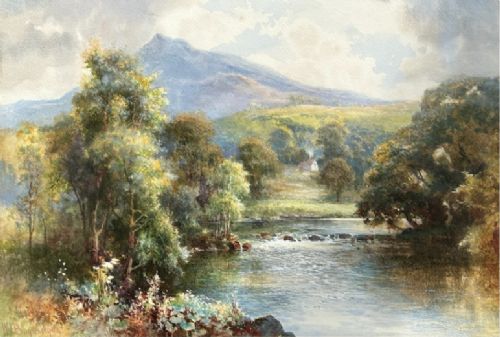
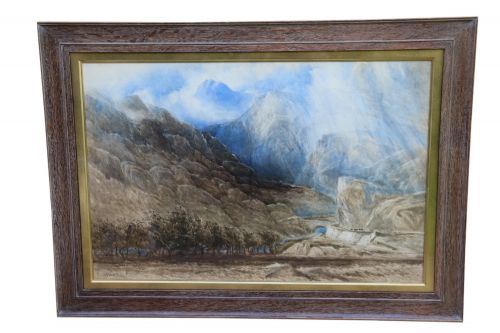
When you search for welsh mountain art, you encounter nineteenth-century and early twentieth-century paintings depicting landscape scenes across North Wales. These works focus on recognisable geography such as Snowdon, the Conwy river, and the passes of Llanberis and Ogwen.
The pieces on this page comprise oil paintings on canvas and watercolours on paper, capturing pastoral views, rivers, and mountain ranges. Victorian landscapes predominate, often rendered in traditional British realist or romantic styles.
Artists frequently set their compositions around familiar locations like Betws-y-coed, Dolgellau, and Beddgelert. These topographical scenes offer a direct view into the way Victorian painters interpreted the Welsh terrain.
Materials and construction
Painters used oil on canvas or watercolour on paper to record these mountain vistas. Many of the oil paintings retain their original giltwood and gesso frames, which provide a heavy, decorative boundary to the canvas.
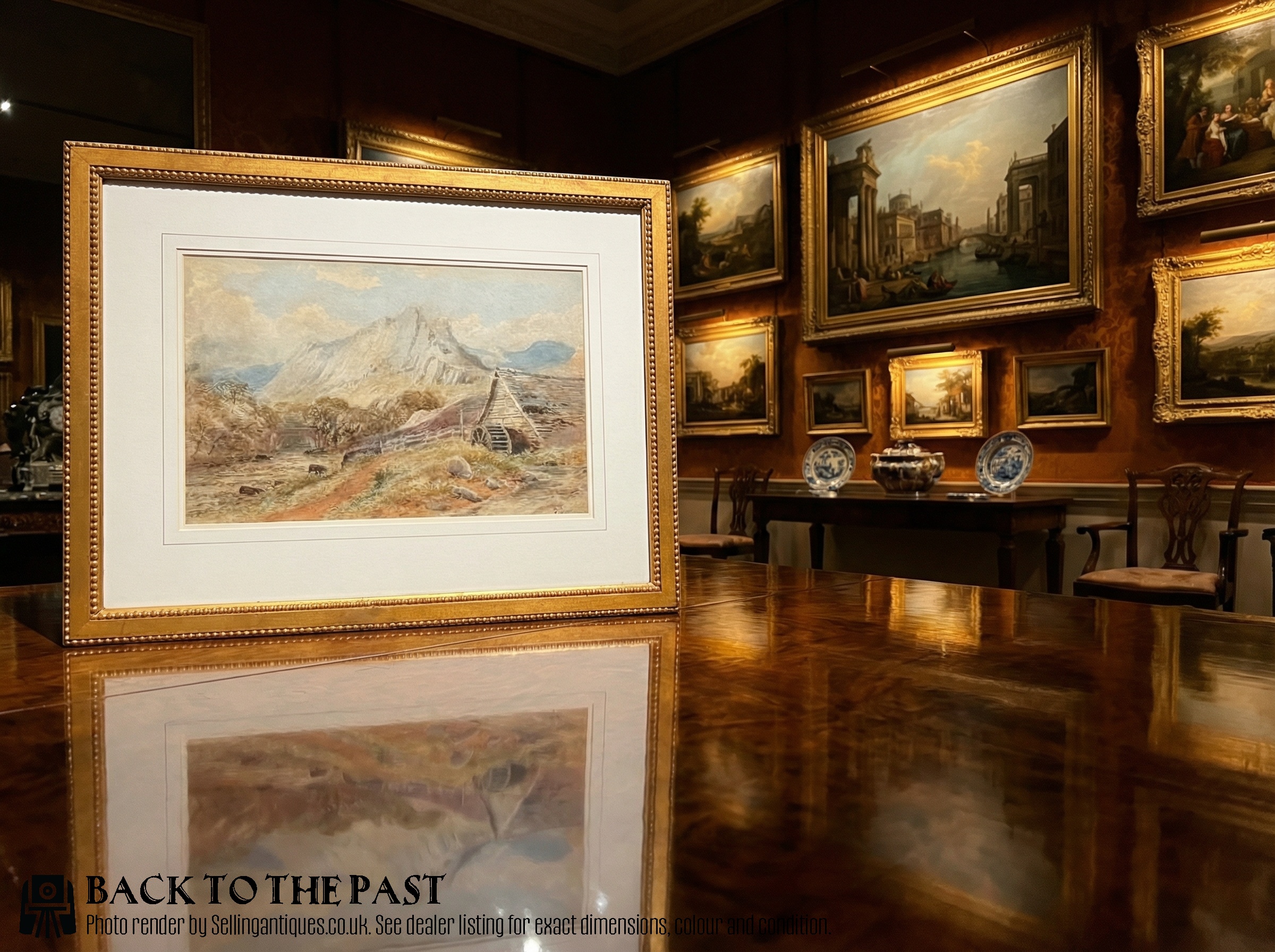
Watercolour works utilise paper supports to achieve lighter, more fluid atmospheric effects over mountain rivers and valleys. Both mediums rely on traditional pigments applied by hand to build depth in the landscape.
Listings span the nineteenth and early twentieth centuries, featuring oil on canvas and watercolour on paper framed in giltwood and gesso.
Quality and execution
The distinction between standard works and finer pieces rests on the handling of light, atmosphere, and scale. Stronger examples convey weather and distance with assured brushwork, whereas lesser works remain stiff and formulaic.
Frame condition and originality also influence the character of a piece. Works retained in their period gilt wood settings present a more cohesive historical object than those in later replacements.
Sidney Richard Percy·Alfred de Breanski·Benjamin Williams Leader·Henry Martin Pope·William Henry Mander
The Welsh Mountain Art Glossary
- Giltwood
- Wood carved and coated with gold leaf. This finish frames many of the oil paintings from the Victorian period.
- Gesso
- A plaster-like mixture applied to wooden frames before gilding. It provides a smooth base for intricate moulding.
- Watercolour
- A paint consisting of pigment suspended in a water-based solution. Artists applied it to paper to capture translucent mountain skies and rivers.
- Victorian Pastoral
- A style depicting idealised rural and agricultural life. These scenes often incorporate farm workers or travellers within a wider mountain setting.
Welsh Mountain Art: Frequently Asked Questions
Where are these scenes usually set?
The compositions focus heavily on North Wales, particularly the Snowdonia range, river valleys, and villages like Betws-y-coed and Beddgelert.
Artists returned repeatedly to these specific geographic landmarks because their topography offered dramatic contrasts of water, rock, and sky.
How do I date these paintings?
Dating relies on artist lifespans, stylistic conventions of the Victorian and Edwardian eras, and occasional inscriptions on the canvas or frame.
Many works carry signatures or period framing that help place their creation within the nineteenth or early twentieth century.
What is the difference between oil and watercolour here?
Oil paintings on canvas offer heavier impasto and deeper colour saturation, suited to dramatic mountain weather and large formats.
Watercolours on paper provide greater delicacy and transparency, often capturing subtle mists and river reflections across valleys.
How should I hang and care for these pieces?
Keep these artworks away from direct sunlight and damp environments to protect both the paper or canvas and the original gilt frames.
Display them on stable interior walls where temperature fluctuations remain minimal.