


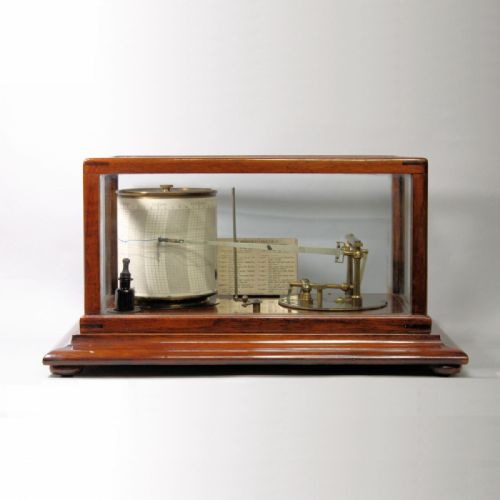


Weather Chart Recorder
These weather chart recorder instruments record barometric pressure continuously, bringing mechanical beauty and scientific history into a room.
Weather Chart Recorder
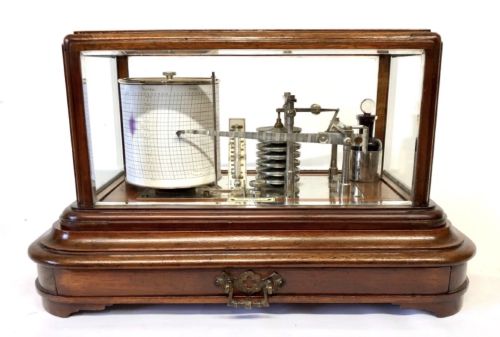
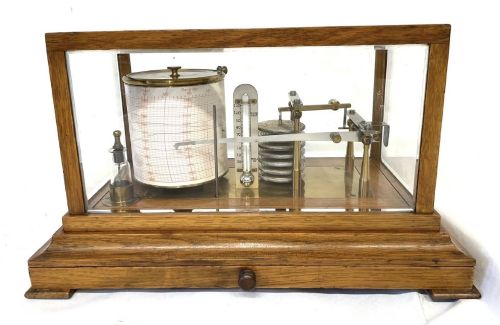
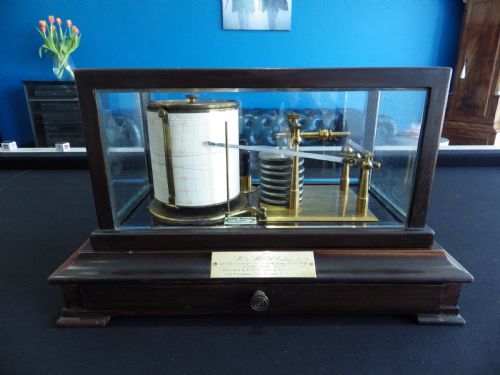
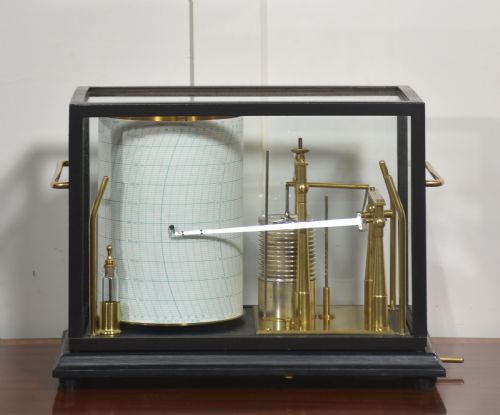
A weather chart recorder, frequently known as a barograph, plots atmospheric pressure over time onto a rotating drum holding a paper chart. You will most commonly encounter mahogany or oak cased examples featuring bevelled glass panels and integrated chart drawers.
The selection spans periods from the late Victorian era through the Edwardian years and into the 1930s and 1940s. Many incorporate supplementary thermometers or combined barometer dials alongside the main recording drum.
Scientific instrument makers of the early twentieth century produced these devices for domestic observation, office display, and specialised railway or maritime use.
Materials and construction
Cases utilise dense timbers like mahogany, oak, and walnut, often constructed with five glass panels to display the internal mechanics clearly. Brass and steel form the delicate levers, gear trains, and vacuum stack diaphragms that respond to atmospheric shifts.
Paper charts hold the ink trace recorded by a fine nib attached to the arm of the movement. Woodwork ranges from plain polished mahogany to inlaid Edwardian styles and brass-mounted scientific housings.
Weather Chart Recorder Retail Price Guide 2026
Typical asking prices for weather chart recorder among the pieces listed under this phrase on Sellingantiques today, from the lower quarter to the upper quarter. They describe what is for sale here now, not the wider market.
Quality and craftsmanship
Distinction across the range rests upon the precision of the mechanical movement and the reputation of the maker. Firmly established instrument houses produce mechanisms with crisper casting, finer adjustments, and smoother recording arms.
Cabinetwork quality differentiates standard production pieces from superior examples, visible in heavy timber mouldings, well-fitted chart drawers, and high-clarity bevelled glass panes.
Short and Mason·Negretti and Zambra·Casella London·Jules Richard·R Fuess
The Weather Chart Recorder Glossary
- Barograph
- A self-recording barometer that traces atmospheric pressure onto a paper chart. It uses an aneroid metal vacuum stack to drive the recording arm.
- Aneroid
- Operating without liquid. Aneroid barographs measure air pressure through the expansion and contraction of sealed metal capsules.
- Chart drawer
- A shallow compartment built into the base of the wooden case. It stores spare weekly paper recording sheets and spare ink bottles.
- Bevelled glass
- Glass panes with angled, polished edges fitted into the cabinet. This provides an ornamental finish typical of better quality scientific cases.
- Thermometer
- A temperature-measuring instrument mounted alongside the main barometer dial. Many cased recorders include one on the front bedplate.
Weather Chart Recorder: Frequently Asked Questions
How do I change the paper chart?
Lift the pen arm gently away from the drum using the small lever provided, then lift the brass drum off its spindle. Wind the clockwork movement inside the drum if necessary, wrap a fresh weekly chart around the cylinder, secure it with the clip, and lower the pen back onto the paper.
Ensure you apply only specialised slow-drying ink to the nib so the trace remains fine and legible without bleeding through the paper fibres.
How often should I wind the clockwork?
Most recording drums contain a weekly clockwork spring movement that requires attention every seven days. Match your chart replacement routine with the weekly winding to keep the cylinder turning at a steady rate.
Overwinding can damage the internal spring, so turn the key gently until you feel firm resistance.
Where should I place a barograph?
Position the instrument on a stable, level surface away from direct sunlight, radiators, and draughts that might cause artificial temperature fluctuations. A quiet study, hallway, or living room sideboard makes an ideal setting.
Avoid high-humidity areas like kitchens, as moisture can warp the wooden case and damage the delicate brass and steel mechanism.
How do I read the recorded trace?
The vertical axis on the paper chart shows atmospheric pressure measured in millibars or inches of mercury, while the horizontal lines mark the progression of days and hours. Rising lines indicate improving weather, whereas falling traces suggest approaching storms or rain.
Comparing the current position of the pen against historical traces from earlier in the week reveals local pressure trends at a glance.
Can these instruments still be calibrated?
Yes, a small adjustment screw attached to the aneroid stack allows you to set the pen height to match a reliable local mercury barometer reading. Changes in altitude and age mean occasional recalibration helps maintain accuracy.
Make small adjustments gradually, allowing the metal capsules time to settle after each turn of the screw.