

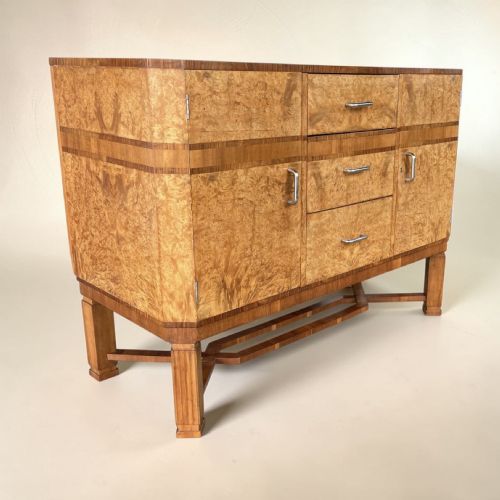


Walnut Veneer Sideboard
A walnut veneer sideboard brings rich timber grain and strong period character to a dining room or living space.
Walnut Veneer Sideboard
A walnut veneer sideboard provides substantial storage while showing off intricate wood grain across its flat surfaces. Buyers searching for a walnut veneer sideboard will find storage furniture spanning several decades and distinct design movements.
The selection here includes Art Deco pieces from nineteen-thirty, nineteenth-century cupboards, and Victorian cabinets. Forms range from cocktail cabinets and commodes to large credenzas and sideboards.
Art Deco examples from nineteen-thirty appear frequently alongside nineteenth-century pieces. These items serve practical storage needs while anchoring a room with decorative presence.
How they were made
Cabinet makers applied thin layers of walnut and burr walnut over hardwood carcases to create striking patterns on the exterior doors and drawers. This technique allowed workshops to display expensive and decorative timber figures efficiently.
Workshops incorporated contrasting materials such as marble for table tops, alongside brass, ormolu, chrome, and gilt metal mounts for hardware and structural accents. Glass panels also feature in specific cabinet doors and display sections.
Walnut Veneer Sideboard Retail Price Guide 2026
Typical asking prices for walnut veneer sideboard among the pieces listed under this phrase on Sellingantiques today, from the lower quarter to the upper quarter. They describe what is for sale here now, not the wider market.
Bowman Brothers made sure your gin stays safe in nineteen-thirty.
What varies in quality
Quality depends on the precision of the veneer matching and the depth of the timber figuring, particularly when burr walnut is utilised. Superior examples show careful grain alignment across multiple drawers and doors.
The choice of secondary materials, such as heavy marble tops or quality metal mounts like ormolu and chrome, elevates certain items above standard utility storage. Construction standard of the underlying hardwood carcase determines long-term stability.
Bowman Brothers
The Walnut Veneer Sideboard Glossary
- Veneer
- A thin slice of decorative wood adhered to a structural hardwood base. This method allows makers to utilise expensive timbers effectively.
- Burr walnut
- Wood grain taken from a tree growth that produces intricate, swirling patterns. It is prized for its ornamental appearance on cabinet doors.
- Ormolu
- Gilt bronze ornamentation applied to furniture. It provides metallic contrast against dark timber surfaces.
- Credenza
- A low dining room cabinet or sideboard used for serving and storage. Victorian examples often incorporate glass doors and metal mounts.
Walnut Veneer Sideboard: Frequently Asked Questions
What is a walnut veneer sideboard?
A walnut veneer sideboard is a storage cabinet surfaced with decorative timber slices over a sturdy hardwood base. These items combine practical interior shelving or drawers with a refined exterior finish.
They serve as focal points in dining rooms and living areas while providing enclosed space for tableware or household items.
How do I identify Art Deco pieces?
Art Deco sideboards from nineteen-thirty typically feature geometric lines, streamlined silhouettes, and striking burr walnut grain patterns. Makers often omitted heavy ornamentation in favour of sleek architectural shapes.
Chrome hardware and stepped cornices frequently accompany these twentieth-century designs.
Where should I place a side cabinet?
These cabinets suit dining rooms, hallways, or living spaces where surface display and concealed storage are both required. Marble-topped versions offer durable surfaces for lamps or decorative objects.
Ensure adequate floor space is available for doors and drawers to open fully without obstruction.
How do Victorian pieces differ from Art Deco?
Victorian furniture often includes gilt metal mounts, inlaid details, and curved French revival influences. Nineteenth-century pieces lean towards ornate craftsmanship and traditional silhouette shapes.
In contrast, nineteen-thirty Art Deco designs favour geometric symmetry and unadorned expanses of figured veneer.