

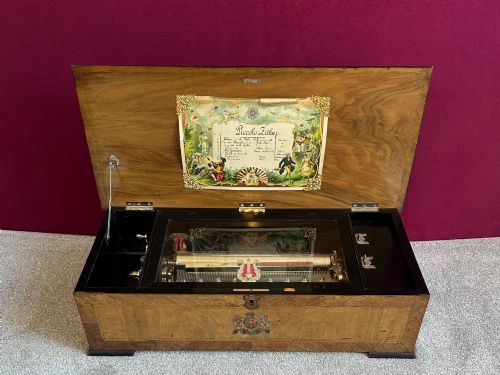


Walnut Swiss Music Box
A walnut swiss music box brings mechanical genius and deep timber warmth together into one room.
Walnut Swiss Music Box
When you search for a walnut swiss music box, you encounter nineteenth century cylinder mechanisms housed in figured wooden cases. These instruments span the Victorian and Edwardian eras, emerging from Swiss workshops during the height of mechanical musical innovation.
The most common pieces on this page are Victorian cylinder music boxes featuring marquetry inlay and walnut cases. Alongside standard rectangular boxes, the selection includes specialised forms such as musical chairs and mandolin variations.
Origins trace directly to Switzerland, where skilled makers assembled brass pins, steel combs, and revolving cylinders. Each piece plays a set number of airs, ranging from six tunes up to twelve or more.
How they were made
Cases combine solid walnut and burr walnut veneers, often enhanced with boxwood and ebonised wood stringing or detailed marquetry inlay. Glass lids frequently protect the internal mechanism while allowing a clear view of the working parts.
Internal mechanics rely on heavy brass beds supporting pinned steel cylinders that pluck tuned steel teeth on a comb. Brass components, steel springs, and hand-cranked or spring-driven motors complete the complex musical assembly.
Walnut Swiss Music Box Retail Price Guide 2026
Typical asking prices for walnut swiss music box among the pieces listed under this phrase on Sellingantiques today, from the lower quarter to the upper quarter. They describe what is for sale here now, not the wider market.
Some musical boxes double as furniture, hiding complex brass combs and pinned cylinders inside a sounding wooden chair.
What varies in quality
The richness of the timber and the precision of the marquetry inlay set individual pieces apart. Finer examples display beautifully figured burr walnut and crisp, intricate wood inlays on the lid and sides.
Mechanical execution dictates the upper tier of the range, marked by makers who signed their brass beds and cylinder assemblies. The complexity of the arrangement, such as mandolin attachments or multiple airs, also elevates the piece.
Langdorff And Fils·B A Bremond·Nicole Freres
The Walnut Swiss Music Box Glossary
- Air
- A distinct tune played by the cylinder on the comb. Boxes are often described by how many airs they can perform.
- Cylinder
- The rotating brass barrel set with hundreds of tiny pins. These pins strike the teeth of the steel comb to create the notes.
- Comb
- The tuned plate of steel with individual teeth plucked by the cylinder pins. The length and thickness of each tooth determine its pitch.
- Marquetry
- Decorative patterns formed by fitting small pieces of veneer into timber panels. Walnut and boxwood are typical materials for these designs.
- Mandolin
- An arrangement of tuned teeth struck rapidly to imitate the sound of plucked strings. This adds a shimmering effect to the musical performance.
Walnut Swiss Music Box: Frequently Asked Questions
How do these music boxes work?
A wound spring turns a pinned brass cylinder, which rotates against a tuned steel comb. Each pin strikes a specific tooth to produce a note in sequence.
Changing tunes involves a shifting mechanism that moves the cylinder slightly sideways to engage a fresh set of pins.
What is a cylinder box?
A cylinder box uses a revolving metal barrel rather than a paper roll or disc to store the musical arrangements. The pins on the cylinder act as a mechanical score for the comb.
Most nineteenth century Swiss instruments rely on this exact cylinder format to play their programmed repertoire.
How many tunes do they play?
The number of airs typically ranges from six up to twelve distinct melodies on standard surviving models. Each tune occupies a specific band around the rotating brass cylinder.
An indicator dial on the side often shows which air is currently playing or sets the box to repeat a tune.
Where were they made?
Production centred in Switzerland during the nineteenth century, where specialist workshops perfected precision mechanical engineering. Towns like Geneva and Sainte-Croix became major hubs for musical box manufacturing.
Export networks distributed these finished wooden instruments across Britain and Europe for domestic parlour entertainment.