
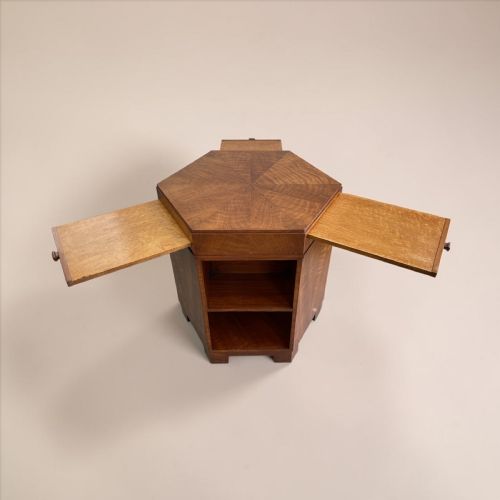
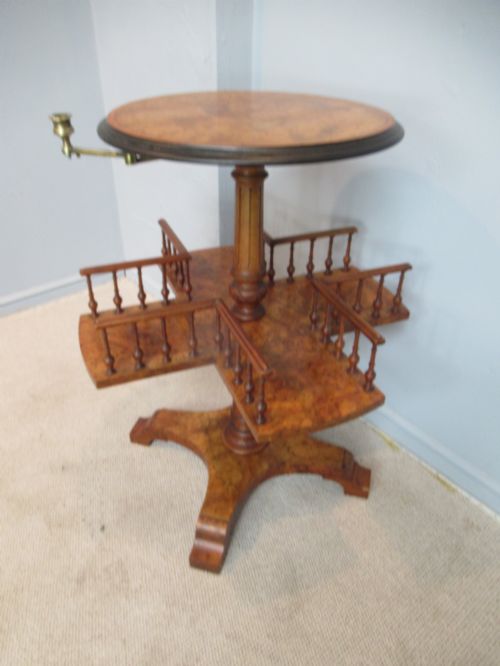
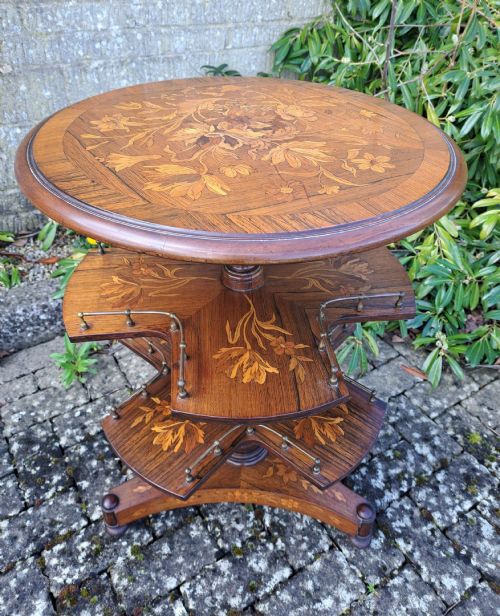


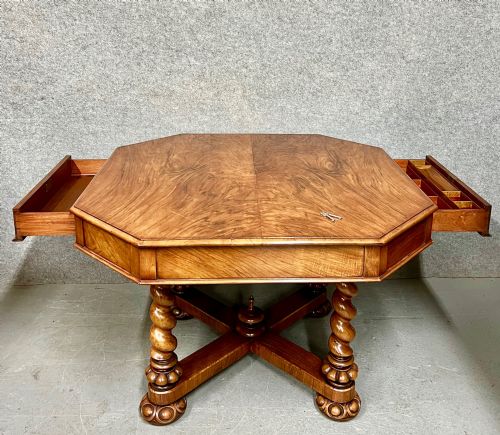

Walnut Revolving Table
A walnut revolving table turns smoothly on its axis, offering accessible books, drinks or desk accessories from a single central position.
Walnut Revolving Table
A walnut revolving table serves practical functions across several historic periods, most commonly appearing as Victorian and Edwardian book tables alongside earlier Georgian library pieces. These items combine timber construction with a rotating mechanism designed for easy selection of books or objects without moving the base.
The selection ranges from compact two-tier bookstands and occasional tables to larger drum tables and specialised dressing stools with swivel tops. Victorian examples frequently utilise burr veneers and inlaid details, while earlier eighteenth-century variants include tripod reading surfaces and marquetry dumb waiters.
Materials and Construction
Makers utilised solid walnut and decorative burr walnut veneers over secondary timbers like mahogany and fruitwood, adding brass hardware and occasional leather upholstery. Inlaid marquetry and parcel gilt decoration appear on select library and occasional forms.
The rotating action relies on concealed pivots and wooden or metal swivel mechanisms integrated beneath the tabletop or bookcase tiers. Joinery methods support weight distribution during rotation, maintaining stability across multi-tiered bookstands and drum tables.
Listings for walnut revolving table items span eight distinct periods, from the eighteenth century to nineteen thirty.
Assessing the Pieces
Quality rests upon the choice of burr veneer matching, the crispness of inlaid floral marquetry, and the smoothness of the revolving mechanism. Superior pieces maintain tight joints and balanced weight distribution when loaded with books or objects.
Construction details such as dovetailed drawers, carved gallery edges, and secondary wood selection distinguish standard production from finer cabinet work. The condition of the original timber finish and the precision of the turning action dictate the standing of an individual table.
The Walnut Revolving Table Glossary
- Drum table
- A circular library table with a deep top containing drawers, often mounted on a central pillar with tripod legs. These forms sometimes incorporate revolving mechanisms.
- Marquetry
- Decorative veneer work forming pictorial or geometric patterns using various coloured woods. Dutch floral examples appear within this selection.
- Dumb waiter
- A tiered serving table fitted with revolving shelves to hold dishes or books without servant assistance. Eighteenth-century versions demonstrate this form.
Walnut Revolving Table: Frequently Asked Questions
How do revolving book tables work?
A central pivot or internal spindle allows the upper tiers to turn independently from the fixed base. This design lets a reader access multiple shelves of books from a single seated position.
Most mechanisms operate smoothly with minimal friction, hidden beneath the top surface or between the rotating book compartments.
What periods do these tables come from?
The available selection spans from the eighteenth century through the Victorian and Edwardian eras into the Art Deco period of nineteen thirty. Victorian examples, particularly those utilising burr walnut, make up the largest share of the archive.
Earlier pieces show Georgian styling and marquetry inlay, whereas later twentieth-century items adopt streamlined Art Deco silhouettes.
Where were these tables used in a home?
Owners typically placed them beside armchairs in libraries, drawing rooms, or studies to hold current reading material and writing accessories. Smaller versions also served bedrooms and dressing rooms as specialised stools or vanity tables.
The rotating function made them practical for shared spaces where multiple people needed access to reference books.
How do I care for walnut veneer?
Keep the wood away from direct sunlight and heat sources to prevent the burr walnut veneer from drying out or splitting. Dust regularly with a soft, dry cloth and apply occasional wax polish suited for antique timber.
Avoid using silicone-based sprays or excessive moisture on the surface and around the rotating mechanism.