
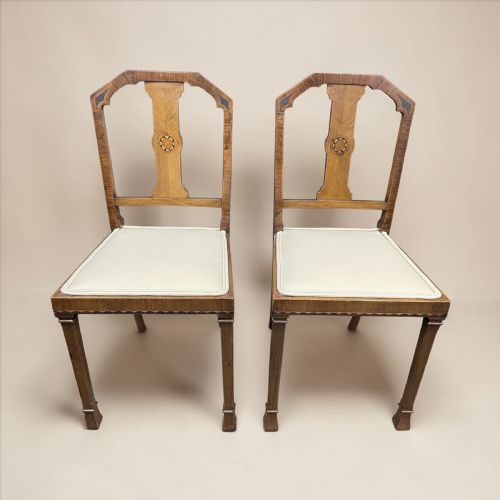


Walnut Marquetry Dining Chairs
Walnut marquetry dining chairs are timber seating pieces decorated with patterned wood veneers, offering rich floral or geometric detail for a formal interior.
Walnut Marquetry Dining Chairs
Walnut marquetry dining chairs combine sturdy timber frames with decorative surface veneer work. When you search for walnut marquetry dining chairs, you encounter forms ranging from high-back late eighteenth-century Dutch seating to Edwardian English suites and twentieth-century interpretations.
The evidence shows these pieces appear primarily as side chairs and armchairs, often in matched sets or pairs. Formats span George I designs, Dutch Baroque and Rococo styles, alongside later Victorian and Edwardian iterations.
Makers utilised walnut as the primary timber, enriched with contrasting woods for the inlaid patterns. Buyers meet single accent pieces as well as large dining sets seating up to twelve people.
How they were made
Cabinetmakers constructed the foundational frames using solid walnut, shaping structural elements into cabriole legs, splat backs or high upright supports. Timber selection dictated the strength of the joints and the stability of the overall form.
The distinctive surface decoration relies on veneer and fruitwood inlay applied to the backrests and seats. Craftsmen cut thin slices of contrasting woods, including fruitwood, to form floral and foliate marquetry patterns before gluing and scraping them flush.
An eighteenth-century Swiss musical chair hides mechanical tunes within its walnut frame.
What varies in quality
The precision of the marquetry cutting and the subtlety of the fruitwood shading define the upper tier of these chairs. Finer examples display crisp botanical motifs with tight joints between the contrasting veneer pieces, whereas simpler versions rely on heavier, less detailed inlay.
The structural integrity of the walnut frame and the authenticity of the period construction dictate long-term durability. Original timber surfaces with deep patination hold more visual cohesion than heavily restored or later altered examples.
Shoolbred
The Walnut Marquetry Dining Chairs Glossary
- Marquetry
- Decorative veneer work forming pictures or patterns by fitting together small pieces of wood. This technique creates the floral and geometric surfaces seen across the backs and seats.
- Veneer
- A thin layer of fine wood applied to a coarser timber base. Walnut veneer provides the primary background tone for the inlaid marquetry designs.
- Fruitwood inlay
- Contrasting light and dark wood details harvested from fruit-bearing trees. Craftsmen used these timbers to give tonal depth to the floral marquetry motifs.
- Cabriole leg
- A furniture leg that bends outward and then tapers inward. This curved form appears frequently on eighteenth-century seating styles within the evidence.
Walnut Marquetry Dining Chairs: Frequently Asked Questions
How do I date walnut marquetry dining chairs?
Dating relies on examining the structural joinery, timber thickness, and stylistic markers such as high backs or cabriole legs. Eighteenth-century examples often feature distinct hand-cut construction methods compared to Edwardian or later revivals.
Matching the decorative motifs and veneer types to documented periods helps confirm the era of manufacture. Comparing the hardware and secondary woods provides further clues to the exact age.
Can I use these chairs for daily dining?
Many of these pieces function well for everyday dining provided the frames remain structurally tight and stable. Period seating requires careful consideration of weight limits and gentle daily use to preserve the aged joints.
Upholstered seats in leather, fabric, or velvet can be maintained or updated for comfort. Regular dusting and occasional wax care keep the walnut and inlay protected from wear.
Are large sets difficult to find?
Complete sets seating six, eight, or twelve appear less frequently than isolated pairs or single side chairs. Most surviving examples from the eighteenth century survive in smaller groupings or scattered single items.
Larger suites often combine antique chairs with complementary tables or represent Edwardian and later reproductions. Buyers seeking matching dining sets must often look to twentieth-century productions.
What is the difference between Dutch and English styles?
Dutch pieces frequently showcase exuberant floral marquetry on high, shaped backrests with elaborate scrolling details. English versions from periods like George I or the Edwardian era tend toward more restrained proportions and simpler veneer borders.
Regional differences also appear in the choice of secondary woods and the curvature of the legs. Both traditions relied heavily on walnut as the primary structural and visual medium.