
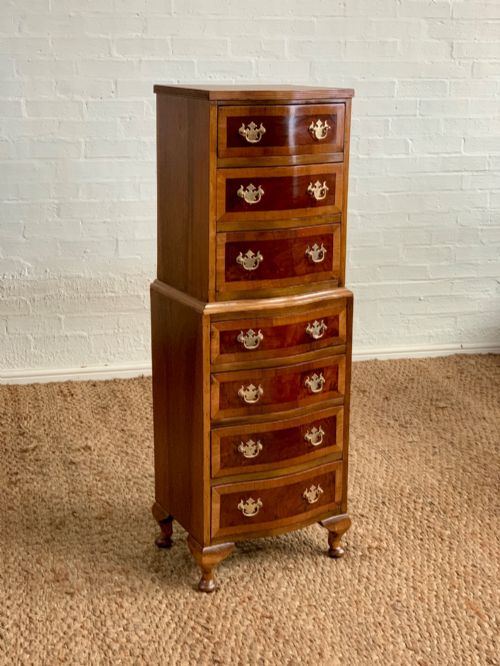


Walnut Bow Front Chest
When you want a walnut bow front chest, you are looking for a curved silhouette paired with rich timber grain.
Walnut Bow Front Chest
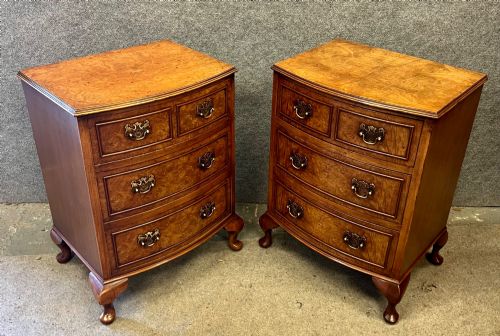
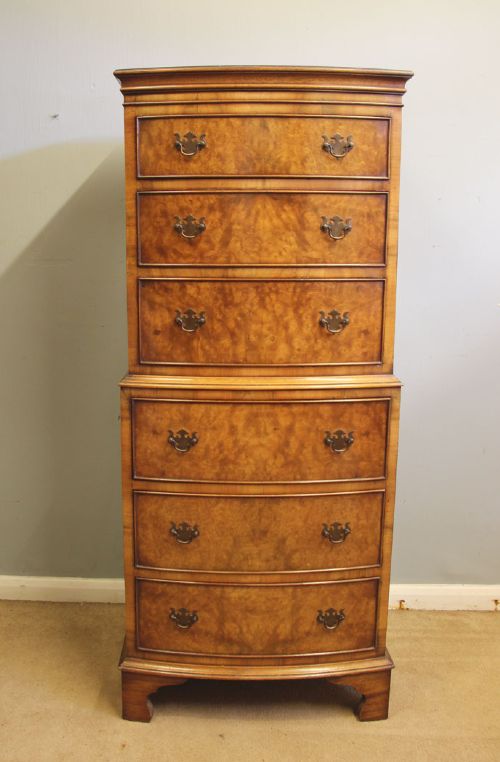
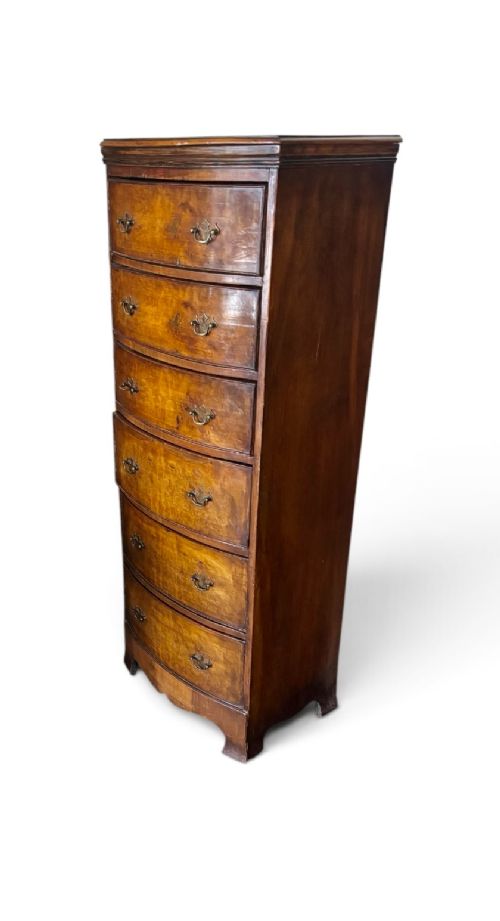
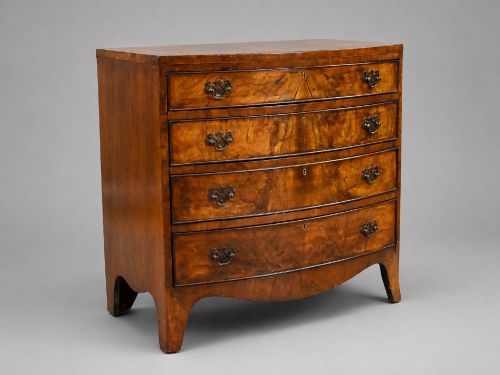
A walnut bow front chest brings a distinct curved front profile to a traditional drawer unit, offering generous storage alongside decorative presence. Pieces appearing under this search span compact bedside formats, standard multi-drawer chests, tallboys, and two-piece chests on chest.
Most examples you will encounter date from the early twentieth century or the nineteen-thirties, alongside select eighteenth-century French provincial commodes. These items utilise styles ranging from Georgian and Queen Anne revivals to distinct early twentieth-century interpretations.
Materials and construction
Cabinet makers utilised solid timber frameworks combined with decorative veneers like burr and figured walnut to achieve rich surface patterns across the curved drawer fronts. Oak frequently appears in internal drawer linings and secondary structural elements.
Brass hardware such as handles and escutcheons complements the dark timber tones, whilst certain painted wood variants introduce contrasting surface finishes alongside natural wood grains.
Listings feature walnut, burr walnut, figured walnut, oak, brass, and painted wood across eighteenth-century and twentieth-century periods.
Distinguishing quality across pieces
The visual strength of the timber grain dictates much of the distinction between standard items and superior examples, particularly where highly figured burr walnut veneers wrap smoothly around the curved drawer fronts. The crispness of period revival detailing, such as carved cabriole legs or cornices on tallboys, further separates ordinary pieces from finer work.
Proportion also defines the hierarchy, with smaller dwarf chests and petite bedside formats often demonstrating careful scaling of the curved facade that larger utility chests lack.
The Walnut Bow Front Chest Glossary
- Bow front
- A convex curved cabinet front that projects outward in an arc. This curved profile softens the linear geometry of a standard bedroom chest.
- Burr walnut
- Timber taken from a tree growth or wart, producing intricate, swirling grain patterns. Cabinet makers prized these veneers for decorative drawer fronts.
- Tallboy
- A tall chest of drawers, often constructed as a chest on chest or a single towering unit. These pieces maximise vertical storage space.
- Commode
- A low chest of drawers or cabinet originating in France. These decorative furniture pieces often served formal bedroom or parlour spaces.
Walnut Bow Front Chest: Frequently Asked Questions
How do I date a walnut bow front chest?
Dating relies on stylistic clues, construction methods, and timber choice. Pieces on this page predominantly point to early twentieth-century revivals and nineteen-thirty production, alongside eighteenth-century French provincial examples.
Hardware and internal secondary timbers like oak also offer chronological markers. Comparing the veneer work to documented archive pieces helps confirm the era.
What is the difference between a tallboy and a chest on chest?
A tallboy generally refers to a tall single carcass or a stacked unit designed for elevated vertical storage. A chest on chest specifically splits into two distinct modular sections placed one atop the other.
Both forms frequently incorporate the curved bow front profile in walnut. They provide substantial drawer capacity whilst occupying a modest floor footprint.
Where should I place a bow front chest at home?
These chests suit bedrooms, hallways, or living spaces where the curved silhouette can be appreciated without obstructing pathways. Smaller dwarf and bedside variations fit neatly into tighter corners.
Positioning the piece away from direct sunlight protects the delicate walnut veneer and burr patterns from fading. Ensuring stable room humidity preserves the timber and prevents warping.