







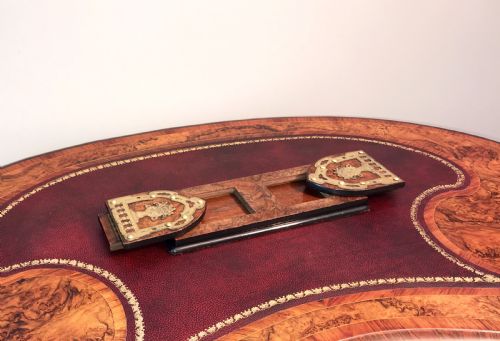
Walnut Book Rack
These walnut book rack selections offer practical desktop organisation and rich timber grain, bringing period character directly to your workspace.
Walnut Book Rack
A walnut book rack encompasses expandable book slides, desk accessories, and library book holders designed to keep volumes upright and accessible. These pieces emerge primarily from the Victorian, Edwardian, and early twentieth century periods, reflecting the domestic habits of past eras.
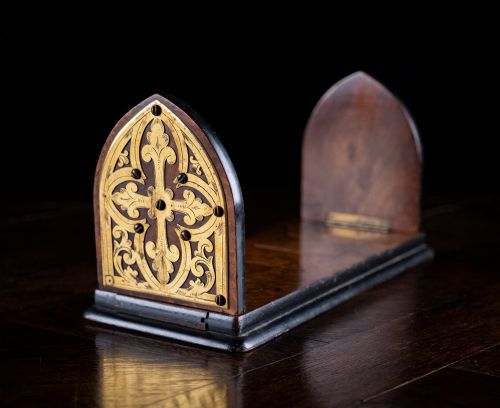
You are most likely to encounter sliding bookends and book slides on this page, often featuring expandable actions operated by wooden tracks and brass linkages. These configurations allowed owners to adjust the length of the channel as their collection of texts grew.
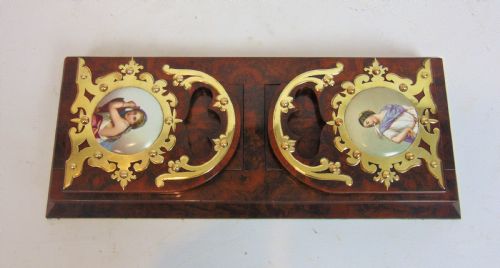
Makers utilised rich timbers, occasionally incorporating porcelain plaques, ormolu mounts, and Tunbridge decoration to elevate simple desk accessories into ornamental objects. The forms range from plain architectural framing to elaborate Gothic Revival and French Chateau designs.
Materials and construction methods
Cabinet makers built these pieces using solid walnut and burr walnut veneer, selected for deep figuring and warm tone. Artisans frequently paired the timber with cast brass mounts, hinges, and expanding actions to reinforce stress points.
Surface decoration involved marquetry, ebonised wood highlights, and hand-painted porcelain plaques set flush into the timber housing. Rotary actions and sliding mechanisms relied on precision metal fittings let into the wooden base.
Walnut Book Rack Retail Price Guide 2026
Typical asking prices for walnut book rack among the pieces listed under this phrase on Sellingantiques today, from the lower quarter to the upper quarter. They describe what is for sale here now, not the wider market.
Victorian desk accessories occasionally featured secret compartments for storing postage stamps or visiting cards out of sight.
Distinctions in craftsmanship
The division between standard production and superior work lies in the choice of veneer and the integration of decorative elements. Finely figured burr walnut and hand-painted porcelain plaques indicate a higher tier of manufacture.
Mechanism fluidity separates well-engineered examples from simpler variants, as smooth sliding actions require careful alignment of wooden channels and brass components. The crispness of carved mouldings and the quality of brass mounts further distinguish finer pieces.
The Walnut Book Rack Glossary
- Burr walnut
- A veneer taken from the burl growth of the walnut tree, prized for its swirling, knotted grain patterns. This material appears on decorative library pieces and fine furniture.
- Book slide
- An extendable desk accessory designed to hold volumes between two upright ends. The central base expands or contracts to accommodate varying numbers of books.
- Ormolu
- Gilt bronze mounted onto furniture or decorative objects. It provides bright metallic contrast against dark timbers like walnut.
- Tunbridge ware
- Small wooden objects decorated with mosaic patterns created from tiny pieces of naturally coloured woods. This technique produces detailed geometric or pictorial designs.
- Gothic Revival
- An architectural and decorative style drawing inspiration from medieval forms. Pieces often feature pointed arches, heavy moulding, and structural solemnity.
Walnut Book Rack: Frequently Asked Questions
How do expanding book slides work?
Expanding book slides utilise a system of interlocking wooden channels or tracks that slide past one another to alter the overall length of the base. This mechanical design allows the upright ends to move inward or outward smoothly.
Users adjust the span manually to fit a specific group of volumes between the bookends. Metal hinges and brass mounts frequently support the moving parts to ensure stability during adjustment.
Where were these pieces typically used?
These items found primary placement on library desks, study tables, and occasional furniture within Victorian and Edwardian homes. They kept working reference books close at hand while maintaining an orderly surface.
Wealthy households positioned decorative examples in drawing rooms where ornamental porcelain plaques and brass mounts could be displayed. The compact size allowed owners to move them easily between rooms.
How should I care for walnut wood?
Maintain walnut surfaces by dusting regularly with a soft cloth and avoiding placement near direct heat sources or strong sunlight. Excessive warmth causes timber to dry and split.
Apply occasional appropriate wax polish to nourish the grain and protect the finish from moisture. Avoid chemical cleaning sprays that can damage historic polishes and veneers.
How do I identify the period of a piece?
Dating relies upon examining the stylistic clues, construction techniques, and decorative motifs present in the object. Victorian examples often display Gothic Revival influences or heavy brass mounts, while Edwardian pieces lean towards lighter proportions.
Patent marks and maker inscriptions provide definitive chronological markers when present. The evolution of mechanical fittings also helps establish the era of manufacture.