


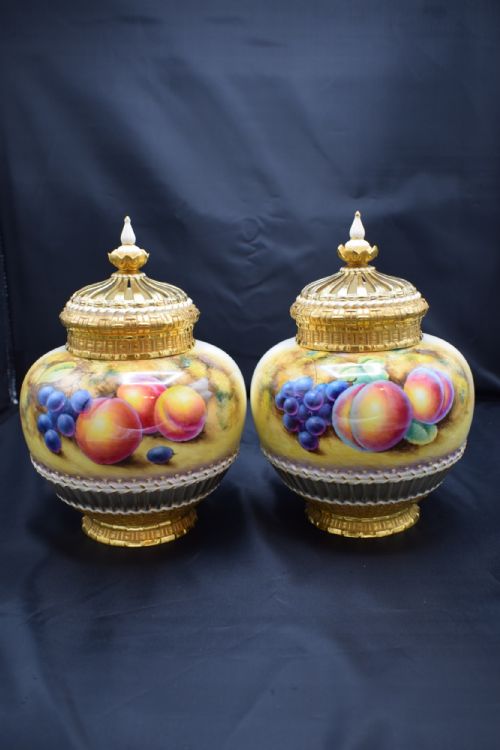


Vintage Worcester Ceramic Jar
These vintage worcester ceramic jar examples bring together delicate English porcelain and hand-painted fruit scenes that collectors prize.
Vintage Worcester Ceramic Jar
When you search for a vintage worcester ceramic jar, you encounter a selection spanning the eighteenth century to the mid-twentieth century. The objects on this page largely comprise pot pourri vases, covered ginger jars, and rose jars alongside standard sugar bowls and decorative urns.
The prevailing aesthetic draws heavily on traditional English porcelain and Edwardian decorative styles. Pieces from the nineteen-fifties and nineteen-sixties often feature hand-painted fruit details signed by artists, while earlier nineteenth-century and eighteenth-century examples reflect Georgian and Victorian sensibilities.
Forms vary from lidded ginger jars to elaborate crown-top pot pourri vessels and stinton bow vases. Collectors frequently find blush ivory finishes alongside heavily gilded surfaces and enamel decoration.
Materials and manufacture
Makers utilised fine bone china, standard bone china, porcelain, and soft-paste porcelain as the primary ceramic bodies. These materials provided a smooth white surface suitable for detailed overglaze enamel painting and intricate modelling.
Decoration relied heavily on applied gold leaf, standard gilding, and rich enamel palettes. Artisans painted naturalistic fruit, floral sprays, and landscapes by hand before firing the pieces to fix the colours and metallic accents.
Vintage Worcester Ceramic Jar Retail Price Guide 2026
Typical asking prices for vintage worcester ceramic jar among the pieces listed under this phrase on Sellingantiques today, from the lower quarter to the upper quarter. They describe what is for sale here now, not the wider market.
Many lidded pots were designed simply to smell like dried roses, proving that Victorian air freshener was essentially a piece of fine art.
Judging quality and execution
The distinction between standard items and superior examples rests on the identity of the artist and the complexity of the painted scene. Signed pieces by established painters command greater attention than unsigned factory output.
Quality also shows in the crispness of the moulding, the density of the gold leaf or gilding, and the preservation of the enamel colours. Finer pots display precise botanical or fruit detailing without blurring or fading across the glazed body.
Royal Worcester
The Vintage Worcester Ceramic Jar Glossary
- Pot pourri vase
- A lidded vessel pierced with small holes designed to diffuse dried scented flower petals into a room. These often feature inner covers to keep the contents secure.
- Soft-paste porcelain
- An artificial porcelain composition fired at lower temperatures than hard-paste, common in eighteenth-century English factories. It yields a warm, slightly creamy body ideal for soft enamel absorption.
- Blush ivory
- A tinted matte ivory ground finish developed by Worcester during the late nineteenth century. It typically serves as a subtle backdrop for raised gold work and hand-painted floral motifs.
- Ginger jar
- A wide-mouthed storage vessel with a domed lid, originally intended for spices. Later ceramic versions serve purely decorative purposes on mantelpieces and tables.
- Flight period
- The era of Worcester porcelain production under the management of Martin Flight during the late eighteenth century. Pieces from this time often bear distinct crescent or script factory marks.
Vintage Worcester Ceramic Jar: Frequently Asked Questions
How do I date a Worcester jar?
Dating relies on factory date codes stamped or painted on the underside, alongside stylistic cues such as Victorian blush ivory or mid-century painted fruit.
Examining the paste, gilding style, and any artist signatures also helps place the piece within periods ranging from the eighteenth century to the nineteen-sixties.
Are all Worcester jars signed by artists?
Not all pieces feature artist signatures, as many standard decorative jars left the factory without individual attribution.
Signed examples by painters such as Stinton, Freeman, or John Smith generally indicate higher artistic ambition and specific mid-twentieth-century production.
What was a pot pourri jar used for?
These vessels held dried botanical mixtures scented with essential oils to freshen and perfume historic domestic interiors.
The pierced covers allowed the fragrance to circulate while keeping the dried plant matter neatly contained inside the ceramic body.