



Vintage Table Snuff Box
These vintage table snuff box pieces are substantial lidded containers designed to hold tobacco, bringing tactile history and period craftsmanship straight to any room.
Vintage Table Snuff Box
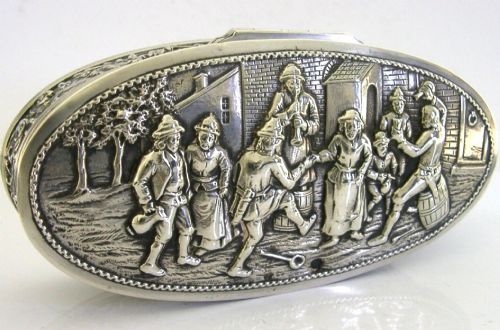
A vintage table snuff box serves as a desktop or tabletop container for powdered tobacco, though many now function as decorative trinket boxes. When you search for a vintage table snuff box, you encounter forms ranging from heavy desk boxes to oval walnut containers and cast castle top pieces.
The pieces on this page span several centuries, drawing on Georgian, Victorian, Art Deco, and Rococo Revival styles. You are most likely to meet solid silver and brass examples, alongside occasional porcelain and walnut pieces reflecting Dutch, French, and Italian origins.
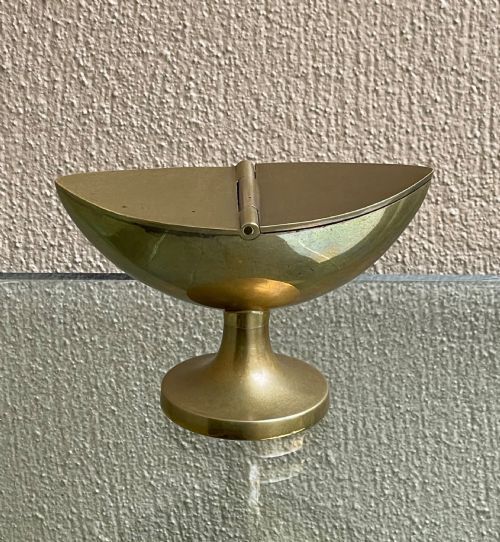
Formats vary considerably, taking in navette shapes, large desk boxes, and pill boxes intended for surface display rather than pocket use. Each object displays the distinct decorative idioms of its period, from neoclassical restraint to elaborate pictorial casting.
Materials and construction methods
Makers utilised sterling silver, solid silver, and brass as primary metals, often combining them with vermeil highlights or niello inlay for contrast. Walnut provides a warm timber alternative, whilst porcelain appears in moulded European vessels.
Techniques range from pictorial castle top casting and detailed niello work to traditional timber turning and fine metal fabrication. These methods create substantial lidded receptacles built to withstand daily desktop handling.
Vintage Table Snuff Box Retail Price Guide 2026
Typical asking prices for vintage table snuff box among the pieces listed under this phrase on Sellingantiques today, from the lower quarter to the upper quarter. They describe what is for sale here now, not the wider market.
Listings feature items spanning the eighteenth, nineteenth, and early twentieth centuries, constructed from solid silver, brass, walnut, and porcelain.
Assessing quality in vintage table snuff boxes
Quality rests upon the crispness of surface decoration, particularly in cast pictorial scenes and intricate niello work. Heavier gauge silver and substantial timber walls demonstrate superior material investment.
The precision of the lid fit and the integrity of the hinge mechanism separate standard utility containers from finer desk pieces. Well-executed revival styles show careful adherence to period proportions rather than lazy imitation.
The Vintage Table Snuff Box Glossary
- Navette
- A boat-shaped vessel with pointed ends, typical of late eighteenth-century design. This profile provides an elongated, elegant footprint for a desk.
- Niello
- A black metallic alloy used as an inlay on engraved metal, commonly silver. It produces sharp linear designs against a dark ground.
- Castle Top
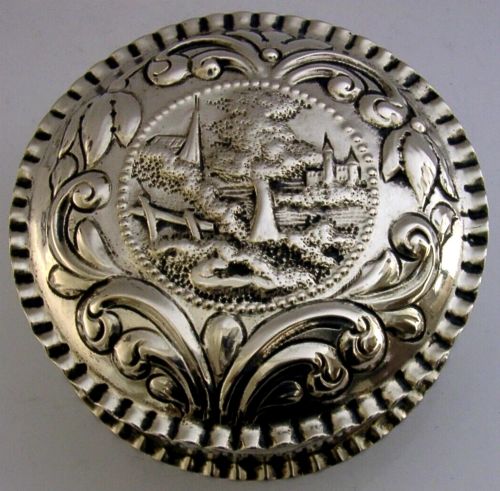
- A pictorial metal lid featuring a detailed relief of a specific building or landscape. These heavy cast panels represent a high point of nineteenth-century box making.
- Vermeil
- Sterling silver plated with a thin layer of gold. This finish adds warmth and protects the underlying silver from tarnishing.
- Capodimonte
- An Italian porcelain tradition known for modelled figures and decorative relief work. Pieces utilise soft-paste porcelain techniques developed in Naples.
Vintage Table Snuff Box: Frequently Asked Questions
What is a vintage table snuff box?
It is a lidded container originally built to hold dry snuff for communal use on a desk or dining table. Unlike pocket boxes, these larger pieces remained stationary as room furnishings.
Today, collectors use them to store small items, display on side tables, or appreciate as miniature sculptures in silver, brass, wood, and porcelain.
How do I date a table snuff box?
Dating relies on hallmarks, material choice, and decorative style rather than a single rule. Georgian pieces favour neoclassical lines, whilst nineteenth-century examples often display revival motifs or pictorial casting.
Examining the construction of the hinge and the depth of the metalwork helps place the piece within its correct stylistic era.
Where were these boxes made?
Production centres spanned Britain, France, Italy, the Netherlands, and wider Europe. Each region applied local material preferences, such as Dutch silverwork or Italian porcelain.
Trade and local manufacturing traditions dictated whether a workshop turned walnut or cast heavy silver.
Can I use these boxes for storage today?
Yes, many people place them on desks or dressing tables to hold modern items like cufflinks, pills, or small keepsakes. The sturdy construction of metal and timber boxes suits everyday use.
Care should be taken with delicate niello inlay or porcelain surfaces to preserve the historical finish.