

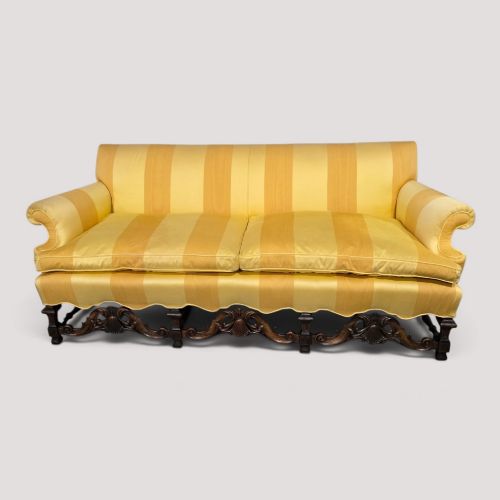


Vintage Striped Settee
A vintage striped settee brings pattern and character to a room, offering comfortable seating with distinct period charm.
Vintage Striped Settee
A vintage striped settee provides compact seating with classic lines, drawing from periods such as the Edwardian era, the Regency period, and the 1930s. These pieces include scroll arm sofas, window seats, and triple back settees.
Makers and workshops range from standard cabinet makers to high-end houses like Howard & Sons, alongside French painted fruitwood designs and Biedermeier models. Buyers will find variations from simple oak frames to grander mahogany and walnut structures.
The forms encompass traditional two-seater and three-seater sofas, often upholstered in fabric or velvet, with historical ties ranging from country houses to ocean liners.
Materials and construction
Frames are constructed from hardwoods including mahogany, walnut, oak, fruitwood, and simulated rosewood, sometimes featuring painted wood finishes or brass details.
Upholstery uses traditional techniques and fabrics, incorporating velvet, fabric, and original ticking upholstery over sturdy wooden frames.
Vintage Striped Settee Retail Price Guide 2026
Typical asking prices for vintage striped settee among the pieces listed under this phrase on Sellingantiques today, from the lower quarter to the upper quarter. They describe what is for sale here now, not the wider market.
The listings span multiple eras, featuring pieces from the Regency period, the Edwardian years, and the 1930s.
Judging quality and craftsmanship
The distinction between standard and superior pieces rests on the precision of the timber frame carving, the integrity of the joinery, and the provenance of the maker.
Finer examples retain original upholstery details, such as authentic ticking, and exhibit superior proportions in styles ranging from Baroque Revival to English Country House.
Howard & Sons
The Vintage Striped Settee Glossary
- Directoire
- A transitional French style bridging Louis XVI and Empire periods, characterised by neoclassical restraint and clean lines.
- Biedermeier
- A Central European style from the mid-nineteenth century focusing on utilitarian comfort and minimalist aesthetic using domestic woods.
- Ticking
- A tightly woven heavy cotton or linen fabric traditionally used to cover mattress springs and interior upholstery stuffing.
- Scroll arm
- A curved armrest rolling outward in a spiral scroll, frequently seen on nineteenth-century country house seating.
Vintage Striped Settee: Frequently Asked Questions
How do I date a settee?
Dating relies on examining the timber frame construction, the joinery methods, and stylistic cues characteristic of periods like the Regency era or the Edwardian years.
Secondary indicators include the materials used, such as mahogany versus painted fruitwood, and any maker stamps or historical provenance.
Are these settees comfortable for daily use?
Many of these pieces were built for formal drawing rooms or country houses, so seating comfort depends on the internal padding and upholstery condition.
Settees from the Edwardian period or the 1930s often offer softer sprung seating compared to rigid nineteenth-century wooden frames.
What is simulated rosewood?
Simulated rosewood is a painted or stained finish applied to a more common timber, usually mahogany or beech, to imitate the rich grain of genuine rosewood.
This technique was common in the Regency period to achieve an expensive aesthetic using accessible materials.
How should I clean a vintage settee?
Maintenance depends entirely on the upholstery material, requiring gentle vacuuming for sturdy fabrics and specialised professional cleaning for delicate velvet.
Wooden frames should be dusted regularly and treated sparingly with appropriate wax to preserve the finish.