






Vintage Stemware Pair
These vintage stemware pair selections bring authentic drinking vessels from the Victorian, Edwardian, and Georgian eras straight to your table.
Vintage Stemware Pair
When you search for a vintage stemware pair, you encounter matched sets of drinking vessels intended for wine, champagne, beer, or cordials. These pieces span periods from the Georgian era through the Victorian and Edwardian decades up to the nineteen-twenties.
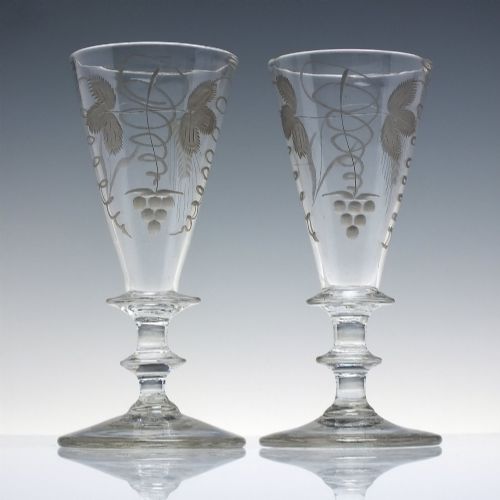
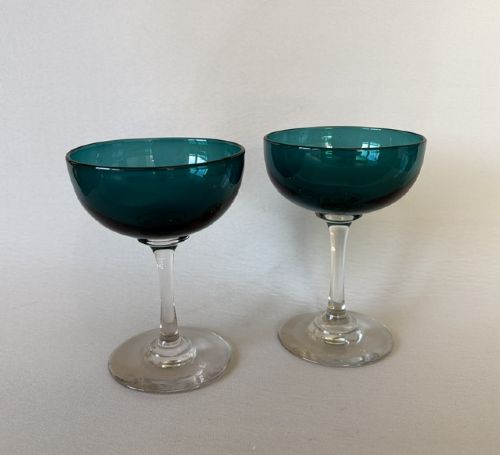
The selections on this page encompass specific forms such as champagne coupes, hock glasses, wine glasses, champagne flutes, liqueur glasses, and beer or ale vessels alongside decorative vases. Many of these double items originate from English makers or continental European workshops.
Green, aqua, cranberry, red, and blue coloured glass appear frequently alongside clear lead crystal. Matched pairs provide practical utility for dining or display while retaining the craftsmanship of their respective centuries.
How they were made
Makers utilised lead crystal, heavy lead glass, and cased or over-crystal methods where a layer of coloured glass covers a clear core. Artisans then cut, engraved, or acid-etched through the coloured surface to reveal the clear crystal underneath.
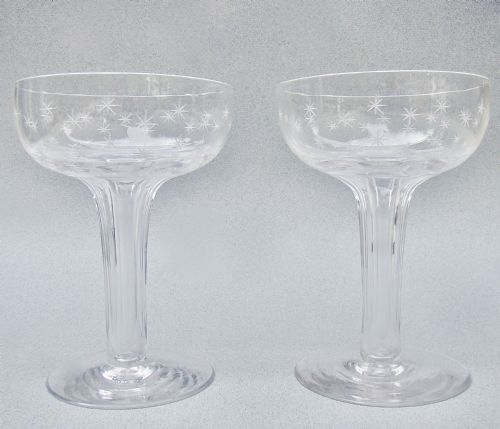
Techniques such as star-etching, cameo cutting, enameling, and wheel engraving decorated the bowls and stems of these glasses. Individual pieces display hand-blown characteristics, polished pontil marks, and precise facet cutting across the lead glass.
Vintage Stemware Pair Retail Price Guide 2026
Typical asking prices for vintage stemware pair among the pieces listed under this phrase on Sellingantiques today, from the lower quarter to the upper quarter. They describe what is for sale here now, not the wider market.
Some Victorian champagne glasses feature hollow stems designed to watch bubbles rise continuously through the liquid.
What varies in quality
The depth and crispness of the wheel engraving or acid cutting distinguish finer vessels from simpler production pieces. Sharp, clean facets on lead crystal reflect light distinctly compared to softer moulded alternatives.
The quality of cased glass depends on the evenness of the colour layer and the precision with which the exterior glass is removed during etching or cutting. Maker attributions to houses like Baccarat, Stevens & Williams, Moser, or Salviati also influence the standing of a pair.
Baccarat·Stevens and Williams·Theresienthal·Moser·Salviati
The Vintage Stemware Pair Glossary
- Cased glass
- Glass made with two or more distinct layers of different colours, often clear crystal encased in a coloured outer layer. This technique allows artisans to cut through the outer skin to create contrasting patterns.
- Pontil mark
- The rough scar left on the base of a blown glass vessel where the pontil rod was attached during manufacture. Skilled makers often polished these marks smooth.
- Hock glass
- A traditional tall-stemmed glass originally used for German hock or white wine. These frequently feature coloured bowls and elaborate stem cuttings.
- Champagne coupe
- A shallow, broad-bowled stemmed glass designed for sparkling wines and champagne. Victorian examples often display deep wheel engraving or hollow stems.
- Acid cut cameo
- A method where glass layered in different colours is partially dissolved using acid stencilling to produce relief designs. This technique achieved intricate multi-layered floral and geometric motifs.
Vintage Stemware Pair: Frequently Asked Questions
What drinks were these historic glasses used for?
These vessels served various alcoholic beverages including barley wine, ale, dessert wine, hock, champagne, and liqueurs.
Specific forms like champagne coupes and tall hock glasses were tailored to the carbonation and style of specific drinks.
How do I identify Victorian stemware?
Victorian pieces often feature heavy lead glass construction with deep wheel cutting, star-etched bases, or vibrant coloured bowls.
Many examples from this period date between eighteen-fifty and eighteen-eighty, displaying characteristic nineteenth-century decorative motifs.
Can I use antique stemware for special occasions?
These matched pairs can certainly grace a dining table for toasts and celebrations, provided they receive careful handling.
Hand washing in warm water without harsh detergents preserves the lead crystal and delicate engraved surfaces.
What is cased glass?
Cased glass involves fusing a layer of coloured glass over a clear crystal base during the blowing process.
Artisans then cut away portions of the outer colour to reveal the contrasting clear glass underneath.