
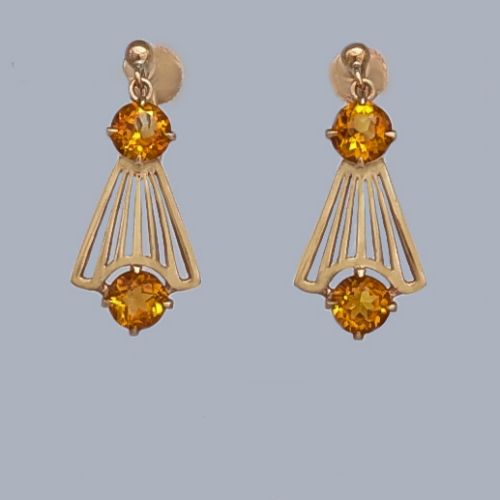
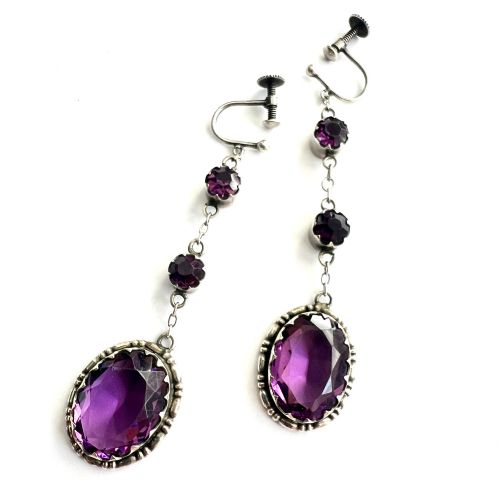


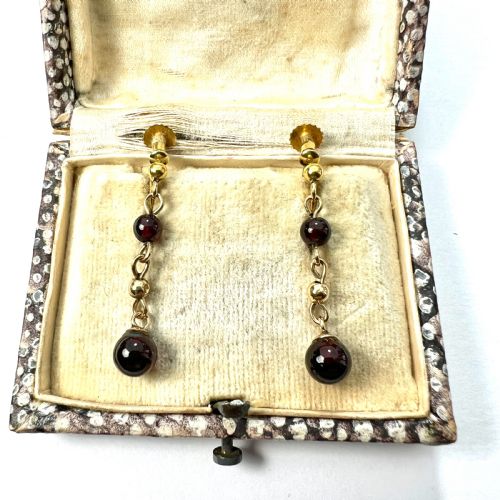


Vintage Screwback Drop Earrings
Vintage screwback drop earrings offer secure, non-pierced wear alongside the distinct character of past periods.
Vintage Screwback Drop Earrings
When buyers search for vintage screwback drop earrings, they seek non-pierced drop jewellery spanning multiple historical periods. The selection here ranges from the intricate metalwork of the Victorian and Edwardian eras to the geometric lines of the Art Deco period and later Mid-Century designs.
The pieces appearing most frequently combine precious metals like nine-carat gold or silver with distinct gemstones and glass pastes. Forms vary from simple dangle drops to elaborate cluster sunbursts and chain drops.
Origins in the evidence stretch from the nineteenth century through the 1930s up to mid-century modern pieces. Each era brings specific motifs, such as oak leaves, paste stones, and geometric drops.
How they were made
Maker construction relies on precious metals including nine-carat gold and silver to form the screwback mechanisms and drop settings. Artisans mounted stones into these frames using traditional prong and bezel settings.
Decorative elements involve materials such as citrine, black onyx, agate, moonstone, tourmaline, garnet, and coloured glass pastes. Enamel work and marcasite accents also appear across the nineteenth-century and Art Deco examples.
Current listings feature pieces spanning the Victorian, Edwardian, and Art Deco periods, alongside items from the 1920s, 1930s, and 1960s.
What varies in quality
Quality depends upon the precision of the metalwork and the complexity of the design, such as hand-cut gemstones versus moulded glass paste. Superior examples display refined engraving, secure stone settings, and fully functioning screw mechanisms.
The choice of materials also divides the range, with solid nine-carat gold and natural stones sitting apart from silver-mounted paste or enamel pieces. The depth of period detail, from Aesthetic movement motifs to Arts and Crafts hand-wrought styles, defines the finer tiers.
The Vintage Screwback Drop Earrings Glossary
- Screwback
- A mechanical earring finding that uses a threaded post and a small paddle to tighten against the earlobe without a piercing. This design was standard for non-pierced earrings before clip-on styles became common.
- Paste
- Hand-cut and polished lead glass used to imitate gemstones. In antique jewellery, paste stones are prized for their individual optical properties and distinct colour.
- Marcasite
- Small faceted pieces of iron pyrite set closely into silver to create a sparkling, metallic border. This technique is particularly characteristic of Art Deco design.
- Cushion-cut
- A gemstone cut with rounded corners and large facets, resembling a pillow shape. This historic cut enhances the soft lustre of coloured stones like citrine.
- Sunburst
- A decorative motif radiating outwards from a central point. It appears frequently in Victorian and later cluster designs.
Vintage Screwback Drop Earrings: Frequently Asked Questions
How do screwback earrings work?
Screwback earrings feature a threaded screw mechanism attached to a small paddle plate. Turning the screw adjusts the distance between the paddle and the front setting to hold the earlobe gently.
This design allows the wearer to control the pressure precisely for secure, comfortable wear without requiring pierced ears.
Are these earrings for pierced ears?
No, these pieces are specifically designed for non-pierced ears. The screw mechanism fastens directly onto the lobe.
Collectors who prefer not to wear clip-on styles often choose screwbacks for their adjustable fit.
How do I date these earrings?
Dating relies on identifying stylistic markers, metal purity hallmarks, and the types of gemstones used. Victorian pieces often feature natural motifs like oak leaves, while Art Deco items show geometric forms and marcasite.
Materials such as nine-carat gold and specific paste cuts also help align pieces with periods like the Edwardian era or the 1930s.
What metals are used in these pieces?
The listings show items made primarily from nine-carat gold and sterling silver. These precious metals form both the visible drop settings and the functional screwback mechanisms.
Some pieces combine the metal base with enamel or marcasite detailing for added visual texture.
What stones are common in vintage drop earrings?
Common stones include citrine, black onyx, agate, moonstone, garnet, and tourmaline. Coloured glass pastes also appear frequently in place of precious gems.
These materials reflect the preferences of distinct eras, from Victorian quartz varieties to Art Deco paste creations.