



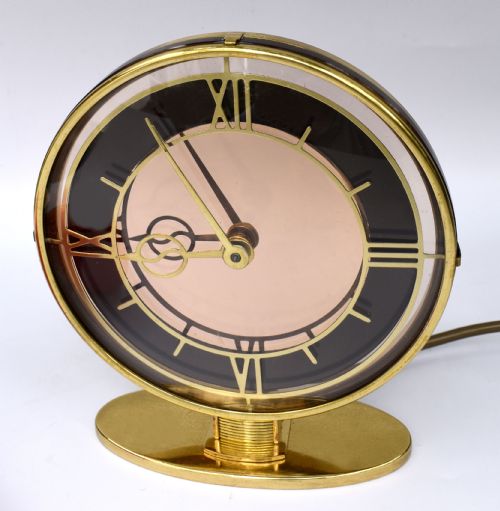

Vintage Round Timepiece
These vintage round timepiece examples offer circular faces and classic movement styles from the Victorian era through the mid-twentieth century, bringing reliable utility and period character to any wall or desk.
Vintage Round Timepiece
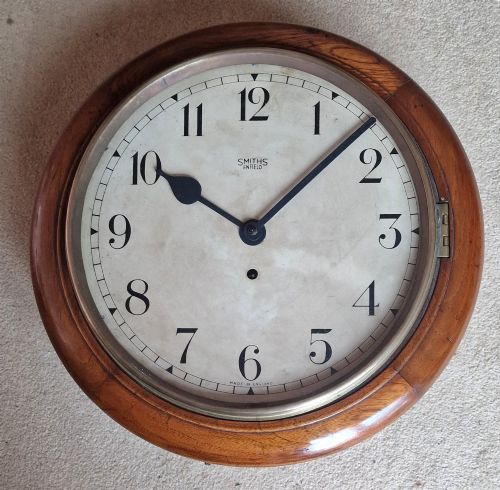
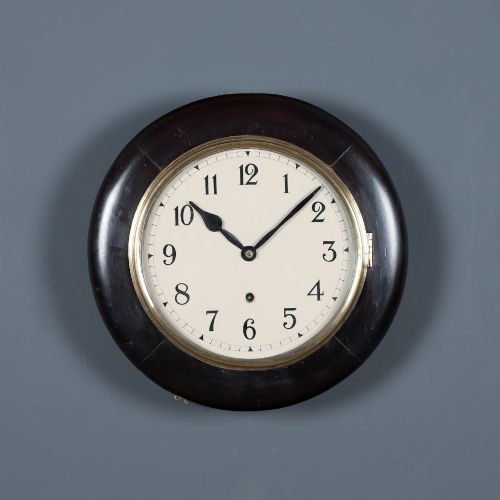
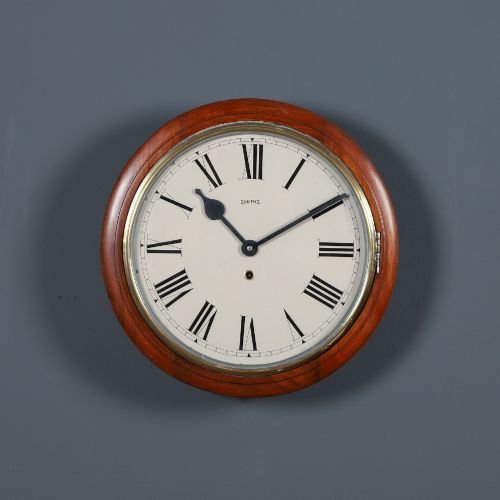
A vintage round timepiece groups together circular clocks and watches spanning from the Victorian period up to the 1960s. The selection on this page relies heavily on wall-hung school and station designs, alongside mantel and desk formats.
Buyers seeking a vintage round timepiece will frequently encounter mahogany or oak wall dials driven by fusee movements, alongside brass desk pieces and mid-century modern variations. These objects functioned as practical timekeepers in public spaces and private homes alike.
The assortment reaches from nineteenth-century fusee clocks to mid-century Swiss Atmos mechanisms and Art Deco brass pieces. Each version maintains a distinct circular geometry that defines its utility and visual presence.
How they were made
Cases utilise solid timbers such as mahogany, oak, and walnut, frequently turned or carved to form circular bezels and surrounds. Brass and gilt brass provide the structural housing for desk and Atmos variants, often paired with glass dials.
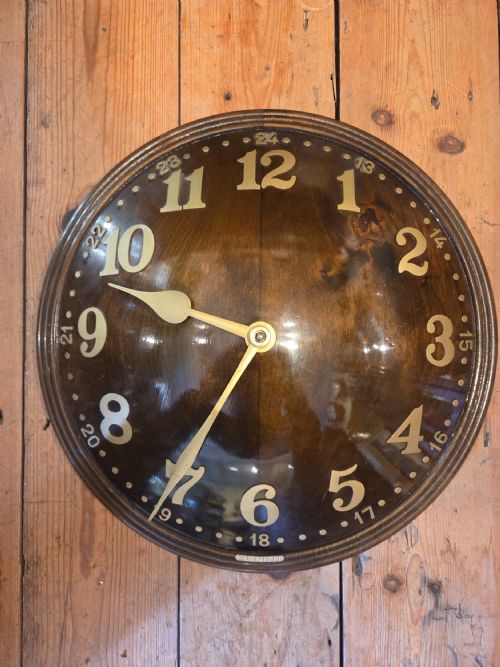
Movements incorporate traditional fusee mechanisms or jewelled configurations, such as fifteen-jewel systems found in desk models. Dials feature convex glass, painted numerals, and specialised markings like twenty-four-hour scales.
Vintage Round Timepiece Retail Price Guide 2026
Typical asking prices for vintage round timepiece among the pieces listed under this phrase on Sellingantiques today, from the lower quarter to the upper quarter. They describe what is for sale here now, not the wider market.
The temporal span extends from nineteenth-century Victorian pieces through Edwardian formats to mid-century modern designs from the nineteen-sixties.
What varies in quality
The sophistication of the internal movement distinguishes examples, with eight-day and fusee mechanisms representing traditional horological standards. Material selection for the outer case, from richly grained mahogany to cast brass, shifts the weight and presence of the piece.
Zenith·Imhof·John Walker·Harrods·Smiths·Anglo Swiss Watch Co·Balbiani Brookley·Payne of Tunbridge Wells·Palmer and Co·Jaeger·Jaeger Le Coultre
The Vintage Round Timepiece Glossary
- Fusee
- A conical pulley connected to the mainspring by a chain or cord, designed to equalise the torque as the spring unwinds. This mechanism is frequently encountered in Victorian wall clocks.
- Convex dial
- A clock face that curves outward toward the viewer, often protected by curved glass. This design reduces glare and improves legibility from various angles.
- Station clock
- A robust circular wall clock designed for railway platforms or public buildings, typically featuring clear black numerals on a white background. These pieces prioritise immediate readability.
- Atmos clock
- A mechanical clock that runs by sensing changes in atmospheric temperature and pressure, eliminating the need for manual winding. These sophisticated units often feature circular glass housings.
- Mantel clock
- A freestanding clock designed to sit on the shelf above a fireplace. They appear in styles ranging from Art Deco brass to traditional wood.
Vintage Round Timepiece: Frequently Asked Questions
How do I wind a fusee wall clock?
A fusee clock requires a matching winding key inserted into the dial aperture to tension the mainspring via the fusee cone.
Care must be taken not to over-wind the mechanism, ensuring the movement continues to keep accurate time.
Where should I hang a station clock?
A large wooden dial clock suits a kitchen, hallway, or living space where its bold circular format can serve as a central focal point.
Solid wall fixings are essential to support the weight of timber-cased wall clocks safely.
What is an Atmos clock?
An Atmos clock is a hermetically sealed timepiece driven entirely by thermal expansion and contraction of gas within a bellows.
This self-winding system allows the clock to operate continuously without batteries or manual intervention.
How do I identify a Victorian dial clock?
Victorian examples often feature mahogany cases, fusee movements, and painted wooden or metal dials enclosed by brass bezels.
Their construction reflects nineteenth-century joinery and traditional horological methods.