



Vintage Revolving Shelves
Vintage revolving shelves turn smoothly on their bases, offering instant access to books and games while saving floor space.
Vintage Revolving Shelves
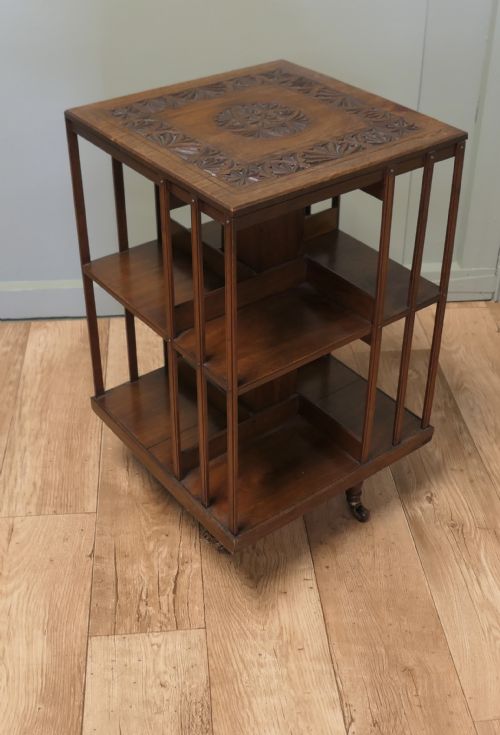
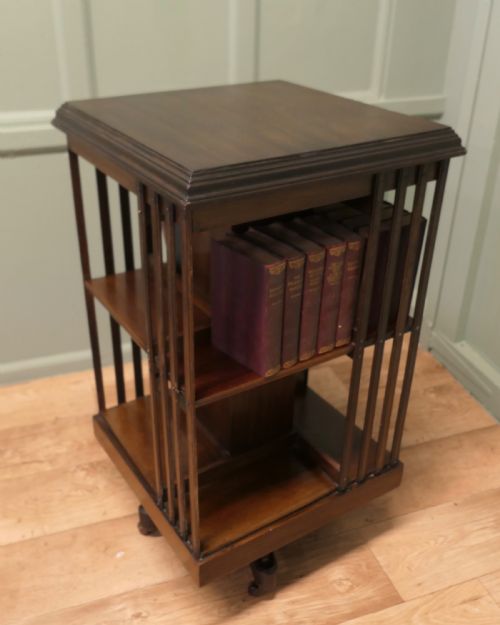
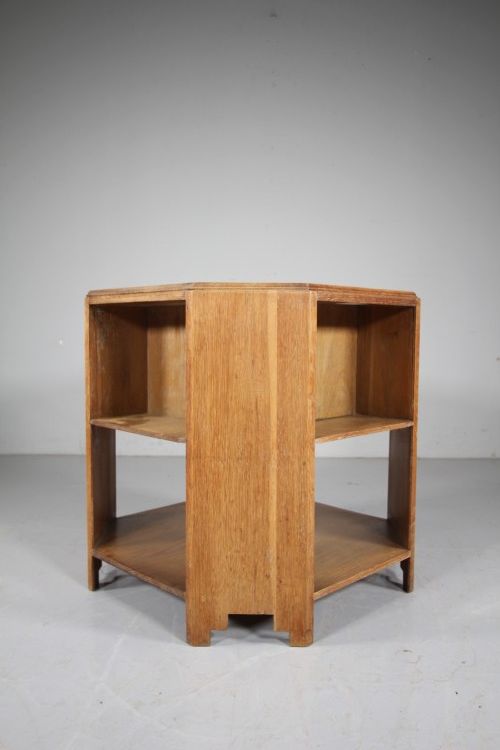
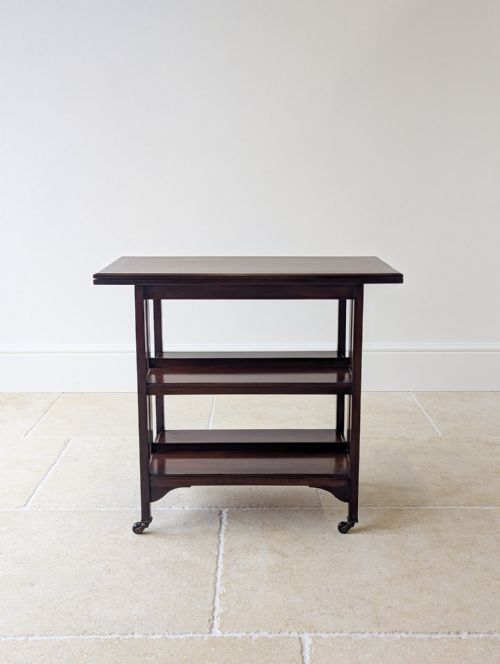
Vintage revolving shelves primarily take the form of revolving bookcases and occasional tables with bookshelf bases designed to sit beside a chair or desk. Buyers searching for vintage revolving shelves encounter freestanding circular or square pieces that rotate effortlessly on a concealed spindle mechanism.
The pieces on this page span the Victorian, Edwardian, and 1930s periods, showing styles from French Provincial to Art Deco. Mahogany and oak dominate the selection, often enriched with brass fittings, satinwood inlay, or carved wooden details across two to four tiers.
How they were made
Cabinetmakers built these rotating tiers using solid oak and mahogany, frequently applying figured veneers to the outer surfaces of the shelves and top panels. Satinwood inlay and intricate carving provide decorative contrast on Edwardian examples.
Internal structures rely on sturdy wooden framing combined with metal and brass pivot mechanisms to support the weight of heavy books while maintaining a balanced, smooth rotation.
Vintage Revolving Shelves Retail Price Guide 2026
Typical asking prices for vintage revolving shelves among the pieces listed under this phrase on Sellingantiques today, from the lower quarter to the upper quarter. They describe what is for sale here now, not the wider market.
A revolving bookcase lets you spin your entire library in search of a volume while sitting entirely still.
What varies in quality
The distinction between standard examples and superior pieces rests on the crispness of the woodwork, the choice of timber figurations, and the smoothness of the turning action. Finer specimens feature detailed inlay, substantial mahogany or quarter-sawn oak, and stable tiered construction that avoids wobbling during rotation.
Makers such as Heals demonstrate a higher design ambition in their 1930s oak bookcase tables, while Victorian and Edwardian iterations rely on proportion and decorative banding to elevate their presence in a room.
Heals
The Vintage Revolving Shelves Glossary
- Tier
- A single level of shelving within a stacked bookcase structure. Multiple tiers allow for the organised storage of books within a compact footprint.
- Inlay
- A decorative technique where contrasting woods such as satinwood are inserted into recesses in the primary mahogany or oak surface. This method creates geometric or floral patterns.
- Spindle
- The central vertical axis around which the revolving shelves rotate. A well-engineered spindle ensures balanced movement.
Vintage Revolving Shelves: Frequently Asked Questions
How do revolving bookcases work?
These pieces rest on a concealed internal base fitted with a central spindle and ball bearings or wooden pivots. This mechanism allows the entire upper tiered structure to spin freely with a gentle push.
Such a design gives users immediate access to books from a seated position without needing to walk around a static piece of furniture.
Are these shelves sturdy enough for heavy books?
Most antique revolving bookcases are constructed from dense hardwoods like solid oak and mahogany, making them robust enough to hold standard volumes. The multi-tiered design actually helps distribute weight evenly across the central pivot.
Larger four-tier versions provide substantial storage capacity while maintaining stability on a flat floor.
Where should I place a revolving bookcase?
These pieces excel beside armchairs, near desks, or in corners where a traditional bookcase might block access or light. Because they rotate, they do not need to be pushed against a wall and can stand freely in the room.
Their compact footprint makes them particularly useful in studies or living rooms with limited wall space.
How do I identify an Edwardian revolving bookcase?
Edwardian examples often feature lighter timbers, particularly mahogany enhanced with satinwood inlay or delicate stringing. They frequently span two to four tiers and exhibit refined proportions typical of the early twentieth century.
Comparing the timber grain and decorative banding helps distinguish these pieces from heavier Victorian or later 1930s variants.