
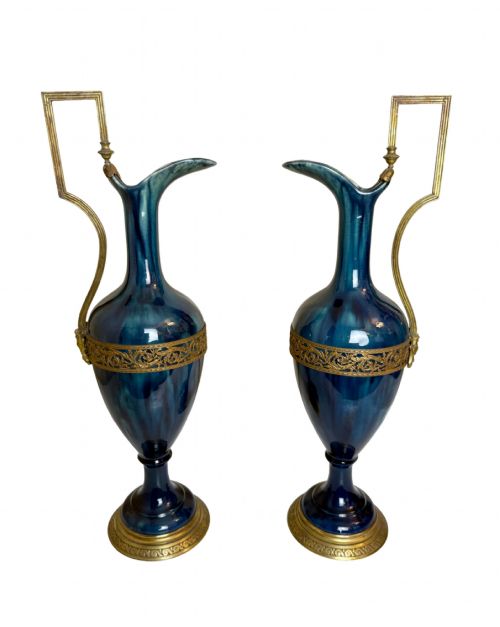


Vintage Porcelain Decorative Ewers
These vintage porcelain decorative ewers are ornamental pouring vessels shaped for display rather than service, prized for their painted surfaces and gilt mounts.
Vintage Porcelain Decorative Ewers
When you search for vintage porcelain decorative ewers, you are looking at ornamental vessels that descend from practical washing pitchers. The listings here present pieces primarily from the Victorian and Edwardian eras, spanning from the late nineteenth century into the early twentieth century. These items take the form of decorative ewers, jugs, and washstand sets alongside related jug-vases.
The most frequent examples you will encounter on this page date from the eighteen-eighties through the nineteen-tens. Makers such as Royal Worcester and Doulton Burslem dominate the selection, often rendered in traditional or neoclassical styles. Forms range from solitary hand-painted display pieces to paired decorative urns fitted with gilt bronze trim.
Construction and materials
The pieces listed on this page rely on porcelain bodies shaped into classical and revivalist forms. Artisans applied coloured glazes and detailed hand painting directly to the ceramic surface to create botanical and pictorial scenes.
Many examples incorporate gold leaf, gilding, or gilt elements to accent handles, rims, and bases. Certain larger compositions also feature cast gilt bronze trim to secure and frame the ceramic body.
Several ewers bear the specific surnames of the artists who painted them by hand a century ago.
Judging quality in porcelain ewers
Quality rests upon the fineness of the ceramic body and the precision of the hand-painted decoration. Works bearing specific artist signatures or originating from established potteries display a higher level of artistic ambition than unmarked commercial wares.
The integration of secondary materials such as gilt bronze mounts also separates standard production items from more substantial display pieces. Heavier gilding and careful application of enamel work indicate a higher grade of manufacture.
Royal Worcester·Doulton Burslem
The Vintage Porcelain Decorative Ewers Glossary
- Ewer
- A large jug with a wide spout and a curved handle, traditionally used for washing but adapted in these listings as a purely decorative object. These vessels derive their shape from historical metal prototypes.
- Gilding
- The application of gold leaf or gold paint to the surface of porcelain or metal mounts. This technique adds reflective highlights and creates contrast against the glazed ceramic body.
- Washstand set
- A matching group comprising a large ewer and a corresponding bowl, intended originally for bedroom ablutions. Surviving sets are frequently split up or displayed together for visual impact.
- Neoclassical
- A decorative style inspired by the art of classical antiquity, focusing on symmetry, restraint, and classical motifs. This aesthetic appears frequently in the nineteenth and twentieth-century pieces shown here.
Vintage Porcelain Decorative Ewers: Frequently Asked Questions
What is a decorative ewer?
A decorative ewer is a pouring vessel designed purely for display rather than functional use. These objects draw inspiration from historical water jugs.
Makers shaped them to sit on mantelpieces, pedestals, or sideboards as ornamental centerpieces.
How do I date these ewers?
Dating relies on maker marks, ceramic bodies, and stylistic indicators such as Victorian revival forms or Edwardian neoclassical details.
Porteries often stamped their wares with specific ciphers that narrow the production window to a particular decade.
Were these ewers used for water?
While the form originates from functional washing vessels, many examples in this category were made solely as ornaments. Pieces paired with basins served bedroom washstands.
Others featuring delicate gilding and bronze mounts were strictly intended for decorative display.
How do I display a porcelain ewer?
These pieces require stable surfaces away from high-traffic areas due to their delicate handles and painted glazes. Placing them on sturdy sideboards or mantels allows the painted details to catch the light.
Pairs look effective when flanking a central mirror or clock.