

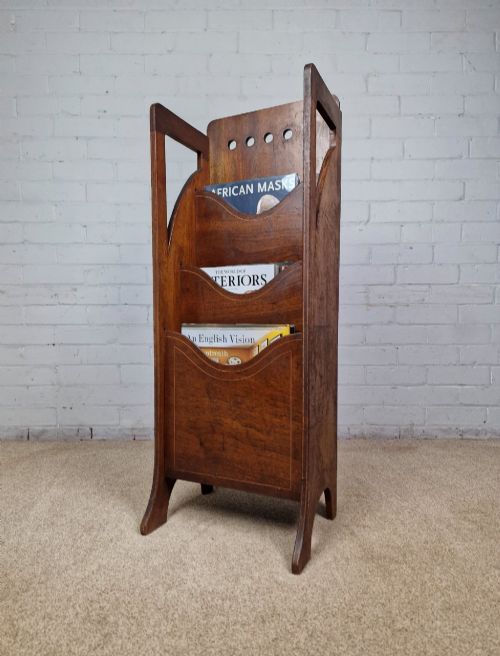


Vintage Periodical Stand
These vintage periodical stand options keep daily papers and weekly journals close at hand with genuine period charm.
Vintage Periodical Stand
A vintage periodical stand brings domestic order to the papers, magazines and journals that accumulate in a sitting room. These items appear in forms such as magazine racks, revolving stands and traditional canterburys.
Makers and designers of the past produced these stands to sit beside armchairs, desks or reading tables. They range from simple wooden troughs to rotating brass and mahogany designs.
How they were made
Cabinet makers utilised solid timbers like mahogany, oak and rosewood alongside decorative veneers and boxwood inlay. These woods were carved, polished and joined to create sturdy frames capable of supporting heavy volumes and newspapers.
Metal components in tubular brass and metal wire appeared frequently, particularly in revolving stands and Edwardian designs. Carved details such as Prince of Wales feathers added formal decoration to early nineteenth-century pieces.
Vintage Periodical Stand Retail Price Guide 2026
Typical asking prices for vintage periodical stand among the pieces listed under this phrase on Sellingantiques today, from the lower quarter to the upper quarter. They describe what is for sale here now, not the wider market.
Listings feature items spanning the nineteenth century, the Edwardian period, nineteen-ten and nineteen-thirty, utilising mahogany, oak, rosewood and brass.
What varies in quality
Quality rests upon the selection of timber and the crispness of any carving or inlay work. A piece built from finely figured mahogany or richly grained oak with precise boxwood stringing sits at the upper end of the range.
The mechanical action of revolving models and the sturdiness of brass frames dictate daily usability. Superior examples demonstrate smooth rotation and solid joinery that withstands regular handling.
Finnigans
The Vintage Periodical Stand Glossary
- Canterbury
- A low wooden stand fitted with partitions for holding sheet music, books or periodicals, often featuring a small drawer below. Originating in the late eighteenth century, this form remained popular through the Victorian and Edwardian periods.
- Revolving bookcase
- A rotating stand designed to hold books and magazines accessibly within arm reach. These pieces typically combine a timber superstructure with a sturdy brass or metal base.
- Boxwood inlay
- A decorative technique involving contrasting light boxwood fitted into dark wood surfaces to create geometric or floral patterns. This ornamentation is characteristic of finer Edwardian cabinetry.
- Prince of Wales feathers
- A carved motif depicting three ostrich feathers emerging from a coronet. It appears as a decorative flourish on Regency and nineteenth-century pieces.
Vintage Periodical Stand: Frequently Asked Questions
How do I date a periodical stand?
Dating relies upon timber choice, decorative styles and construction methods. Nineteenth-century examples often feature solid mahogany and carved details, while Edwardian pieces frequently showcase inlaid boxwood and lighter woods.
Revolving stands utilising tubular brass became particularly common towards the end of the nineteenth century and into the early twentieth century.
Where should I place a revolving stand?
A revolving stand suits placement beside an armchair or reading desk where easy access from multiple angles is useful. Their compact footprint allows them to sit comfortably in corners or beside side tables.
Ensure adequate clearance around the base so the upper tiers rotate freely without striking adjacent furniture.
Are these stands suitable for modern magazines?
Most vintage racks and canterburys accommodate modern periodicals, though very wide formats may require specific compartment layouts. Standard widths comfortably hold weekly journals and daily newspapers.
Measuring the vertical clearance of fixed dividers helps ensure taller modern publications fit without bending.