

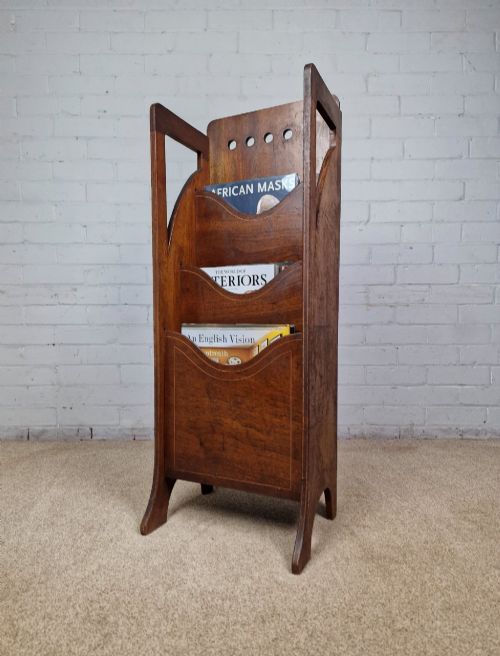


Vintage Periodical Holder
A vintage periodical holder keeps daily journals and weekly newspapers orderly, combining functional timber or brass design with practical charm.
Vintage Periodical Holder
A vintage periodical holder takes the form of magazine racks, newspaper stands, and canterburys designed to keep reading materials tidy. These pieces range from upright wooden compartments to revolving brass stands.
Common configurations include stationary floor racks, chairside stands, and wheeled or stationary canterburys. Many incorporate divided sections specifically sized for folded papers and bound journals.
Materials and construction
Cabinetmakers utilised solid timbers such as mahogany and oak, often enhancing surfaces with boxwood inlay, satinwood, and delicate carved details like Prince of Wales feathers. These woods provided both structural rigidity and decorative warmth.
Metal components involved tubular brass and wirework, particularly in revolving stands and magazine racks. These brass elements offered durability and contrast against the dark hardwood frames.
Vintage Periodical Holder Retail Price Guide 2026
Typical asking prices for vintage periodical holder among the pieces listed under this phrase on Sellingantiques today, from the lower quarter to the upper quarter. They describe what is for sale here now, not the wider market.
Carved Prince of Wales feathers give eighteenth-century elegance to a humble newspaper rack.
Assessing quality
Quality rests upon the selection of timber and the crispness of decorative additions such as boxwood inlay or carved wood details. Finer pieces demonstrate careful joinery and substantial brass elements rather than thin wirework.
The sophistication of the mechanism in revolving stands and the integration of brass fittings with timber frames separate standard storage items from finer examples of period craftsmanship.
Finnigans
The Vintage Periodical Holder Glossary
- Canterbury
- A low stand featuring slatted partitions, originally designed for holding sheet music and later utilised for newspapers and magazines. These pieces often sit on small legs or castors.
- Inlay
- A decorative technique where contrasting woods like boxwood or satinwood are inserted into recesses in a primary timber surface. This creates crisp geometric or botanical patterns.
- Revolving stand
- A rotating framework mounted on a stable base that allows easy access to multiple compartments. These stands frequently combine brass uprights with wooden bases.
- Arts and Crafts
- A design movement emphasising plain, honest construction and the inherent qualities of materials like oak. Pieces from this aesthetic avoid excessive ornamentation in favour of solid craftsmanship.
Vintage Periodical Holder: Frequently Asked Questions
What is a canterbury?
A canterbury is a low, partitioned stand originally built for sheet music that functions well for holding newspapers and magazines.
These pieces typically feature upright divisions and may include a low drawer at the base.
How do revolving stands work?
Revolving stands use a central pivot mechanism that allows the compartments to turn smoothly in a circle.
This design lets a reader access different periodicals without moving the entire heavy brass and wood structure.
Where were these stands used?
Periodical holders were placed beside armchairs and in libraries to keep daily papers and weekly journals close at hand.
They provided a designated spot for reading materials in formal Victorian and Edwardian sitting rooms.
How do I care for wood and brass?
Maintain timber surfaces with appropriate wax polish to nourish the mahogany, oak, or rosewood grain.
Brass elements can be gently cleaned with a soft cloth to preserve their metallic sheen without harsh abrasives.