


Vintage Milk Glass Lamp
These vintage milk glass lamps bring a soft, diffused glow to a room, spanning Victorian oil lamps to industrial pendants.
Vintage Milk Glass Lamp
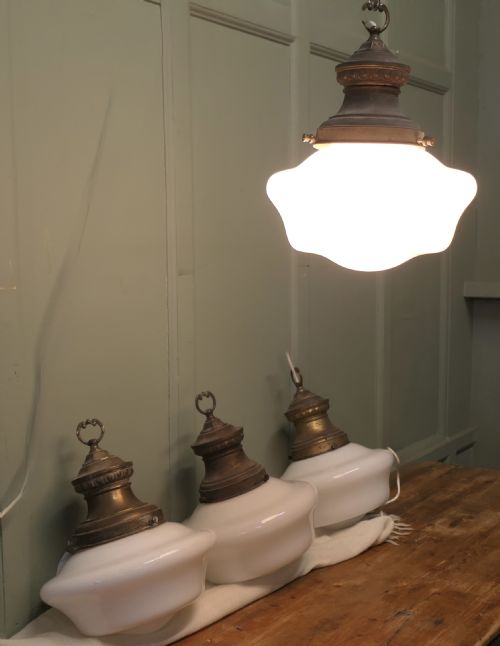
A vintage milk glass lamp combines opaque white or opaline glass shades and bases with various mounting fixtures, appearing in forms ranging from traditional oil lamps to industrial ceiling pendants. When searching for a vintage milk glass lamp, buyers encounter pieces traversing the Victorian era, the Edwardian period, and the Art Deco style.
The selection on this page includes table lamps, hanging pendant lights, and oil lamps with glass globes or shades. Materials such as brass, chrome, and ceramic frequently accompany the glass components across different periods.
Earlier examples lean towards ornate Victorian oil lamps with brass and black glass bases, whilst later 1930s items favour clean lines in pendant and ceiling lighting.
How they were made
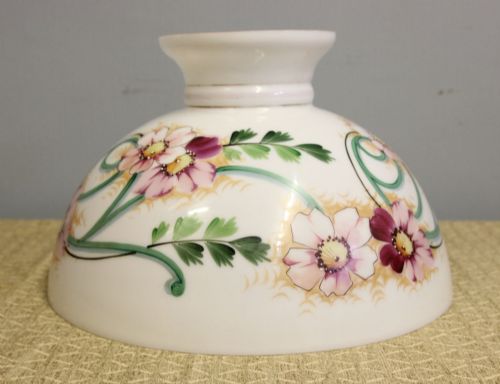
Makers utilised opaque opaline and milk glass, shaping them into pear, conical, and reeded forms, sometimes incorporating hand-painted motifs or enamel work. These glass elements were mouth-blown or moulded before being fitted to metal components.
Metalwork in brass and chrome provides the structural support and collars for the lamps, with gilt brass appearing on table lamps and sturdy brass rings securing oil lamp shades. Ceramic and black glass bases anchor the heavier Victorian designs.
Pineapple lamps bring a touch of tropical Victoriana to the shelf.
What varies in quality
Quality shows in the weight and consistency of the glass, where even opacities and refined moulding distinguish superior pieces from standard production. Hand-painted details and fine enamel work also mark out the more accomplished examples.
The integration of materials dictates the overall calibre, seen in how cleanly brass collars meet the glass shade and the crispness of reeded or patterned surfaces on pendants and table lamps.
The Vintage Milk Glass Lamp Glossary
- Milk glass
- Opaque white glass first popularised in Venice and later widely produced in the nineteenth and twentieth centuries. It creates a diffused light suitable for domestic illumination.
- Opaline glass
- A translucent glass that displays a delicate opalescence, often shifting in tone between white and soft blue or pink. This material appears frequently in French and English pendant shades.
- Oil lamp
- A lighting device that burns liquid fuel via a wick, usually featuring a glass font and a removable shade or globe. Many Victorian examples are later converted for electrical use.
- Pendant light
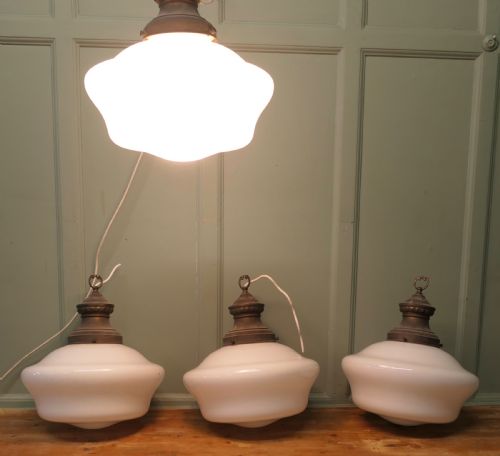
- A single light fixture suspended from the ceiling by a cord, chain, or metal rod. These often utilise conical or spherical glass shades to direct light downwards.
- Reeded design
- A pattern of parallel convex mouldings applied to the surface of the glass shade. This technique adds texture and scatters the light more evenly.
Vintage Milk Glass Lamp: Frequently Asked Questions
Are these lamps converted for electricity?
Many older oil lamps and pendant fixtures undergo conversion for modern electrical wiring to suit contemporary homes.
Buyers should check individual listings to confirm the current wiring status and compatibility with standard household fittings.
How do I date a milk glass lamp?
Dating relies on stylistic clues such as the brass mounts, the shape of the glass shade, and the manufacturing technique. Victorian pieces often feature heavier brass bases, whilst 1930s items display streamlined Art Deco or industrial traits.
Archival records and historical design markers help narrow down the decade of production.
Can I find matching pairs?
Pairs do appear among the pendant lights and smaller shades, though many items are sold as single pieces.
Industrial ceiling lights sometimes come in small sets of matching fixtures.
How do I clean milk glass?
Gentle washing with warm soapy water removes dust and grime without harming the opaque surface.
Harsh abrasives should be avoided to protect any hand-painted enamel details or gilt brass fittings.