


Vintage Luggage Rack Hooks
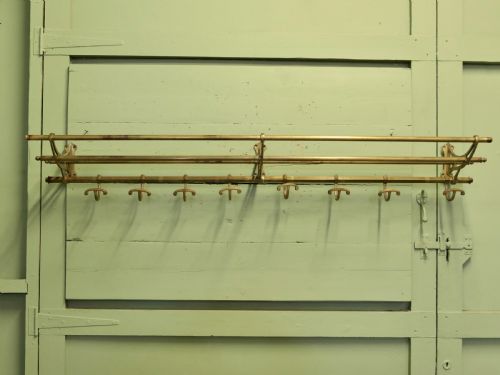
These vintage luggage rack hooks are robust wall-mounted brass and nickel fittings designed to hold hats, coats and travel bags in hallways and bedrooms.
Vintage Luggage Rack Hooks
Vintage luggage rack hooks encompass sturdy brass, nickel-plated metal, and chrome wall fixtures originating from the late nineteenth century through to the Art Deco period. Buyers searching this phrase typically encounter heavy portmanteaus, mirrored coat stands, and triple-bracket wall units combining luggage storage shelves with hanging hooks.
The pieces on offer span Victorian, French Bistro, French Chateau, and French Art Deco styles, with origins frequently traceable to continental workshops. Brass and polished mahogany feature prominently alongside nickel plating, demonstrating the utilitarian elegance demanded by period travel.
Most examples combine horizontal luggage rails with lower hanging hooks, often accompanied by original mirror plates in Edwardian and late Victorian iterations. These fixtures range from chunky single-purpose brass plates to five-foot long assemblies designed for substantial entrance halls.
How they were made
Construction relies heavily on cast brass, nickel-plated metal, and chrome over steel, often mounted to backplates of solid mahogany or other hardwoods. Metalwork involves sand casting for mounting plates and brackets, yielding thick sections and robust structural integrity.
Finishes range from polished brass and chrome to nickel plating, paired with turned wooden components and bevelled mirror glass secured within wooden frames. Assembly typically utilises heavy screws and robust joints to support the weight of luggage and garments.
The listings span the late nineteenth century through to the 1930s, incorporating Victorian, French Bistro, and Art Deco design vocabularies.
What varies in quality
Quality rests in the casting weight and the crispness of detail on mounting plates and brackets, distinguishing heavy portmanteaus from lighter domestic hardware. Substantial brass thickness and deeply cast decorative elements elevate a piece above standard utilitarian production.
The presence of original mirror plates and intact finishes, whether polished mahogany, nickel, or chrome, marks superior examples. Structural scale also plays a role, with longer triple-bracket configurations and super long formats representing more ambitious period manufacturing.
The Vintage Luggage Rack Hooks Glossary
- Portmanteau
- A combination luggage rack and coat hook unit, often featuring a shelf for bags and lower hooks for garments. These large wall-mounted fixtures were essential in grand entrance halls and railway hotels.
- Nickel-plated
- A protective metal coating applied to brass or steel to provide a bright, corrosion-resistant silver finish. This technique gained popularity during the late nineteenth and early twentieth centuries for domestic hardware.
- Bevelled plate
- Mirror glass with an angled, polished edge cut around the perimeter. This detail reflects light cleanly and indicates higher quality glazing on period mirrored coat racks.
- Art Deco
- A design style spanning the 1920s and 1930s characterised by streamlined geometric forms and polished metallic surfaces. In luggage racks, this translates to clean lines and chrome or nickel finishes.
Vintage Luggage Rack Hooks: Frequently Asked Questions
How were luggage rack hooks used?
These fixtures served travellers and homeowners by providing an overhead luggage platform combined with lower hooks for coats and hats. They were commonly installed in hallways, bedrooms, and railway carriages.
Heavier portmanteau models often incorporated mirrors and multiple support brackets to handle the weight of leather suitcases and heavy winter garments.
What materials are typical for these racks?
The primary materials include cast brass, nickel-plated metal, chrome, and steel, frequently mounted on solid mahogany backplates. Glass is also found on mirrored wall units.
Metals were either polished to a bright finish or coated in nickel and chrome to prevent tarnishing and match contemporary interior hardware.
How do I identify an Art Deco rack?
Art Deco racks from the 1920s and 1930s display geometric forms, streamlined brackets, and extensive use of nickel plating or chrome. They discard the ornate flourishes of Victorian and earlier French Provincial styles.
These pieces prioritise clean metallic lines and functional simplicity, reflecting the modern design ethos of the interwar period.
Are these racks suitable for modern walls?
Because many period portmanteaus and brass racks are heavy and substantial in construction, they require secure fixing into solid masonry or studwork. Proper wall anchors are essential to support the weight of the metalwork and any items placed upon them.
Their robust design ensures they function effectively in contemporary hallways when correctly mounted.