



Vintage Locking Decanter
These vintage locking decanter pieces, commonly known as tantalus sets, secure your spirits under lock and key while displaying cut glass for the drawing room.
Vintage Locking Decanter
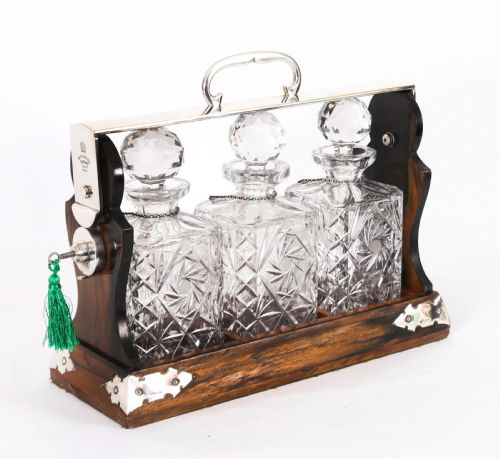
A vintage locking decanter, known in trade terms as a tantalus, is a barware container designed to secure bottles of liquor from unauthorized access. The mechanism uses a wooden or metal bar locking down across the stoppers, operated by a small key that releases the decanters from their wooden frame.
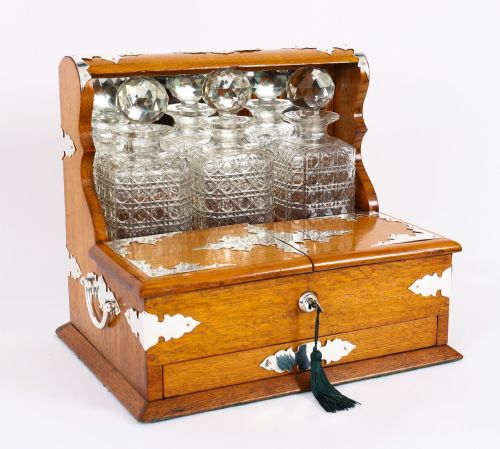
Most examples found here date from the Victorian and Edwardian eras through to the Art Deco period, constructed to sit upon sideboards or inside games compendiums. You are most likely to meet oak or coromandel wood frames fitted with brass mounts and holding two or three crystal decanters.
The form spans straightforward spirit holders holding two bottles up to elaborate tantalus dry bar combinations incorporating games compendiums. The defining feature remains the locking mechanism that frustrates the thirsty guest while displaying the cut glass contents.
Materials and construction
Frames are constructed from dense hardwoods like oak and exotic coromandel, often shaped and polished to highlight the natural grain. These wooden chassis provide the heavy base and upright pillars necessary to anchor the locking mechanism securely.
Metalwork relies on cast brass mounts, silver plating, and sterling silver components that form the locking bars, hinges, and corner brackets. The glass decanters themselves feature heavy cut glass patterns designed to catch the light and withstand daily handling in domestic bars.
Vintage Locking Decanter Retail Price Guide 2026
Typical asking prices for vintage locking decanter among the pieces listed under this phrase on Sellingantiques today, from the lower quarter to the upper quarter. They describe what is for sale here now, not the wider market.
The entire apparatus is named after a mythical king who spent eternity reaching for things that stayed just out of grasp.
Assessing quality and craftsmanship
Quality reveals itself in the complexity of the locking mechanism and the precision of the cabinetwork. Fine pieces operate smoothly with integrated spring-loaded bars and retain their original working keys stamped by reputable makers.
The choice of materials sets the hierarchy, moving from plain oak with basic brass to coromandel wood mounted with sterling silver hardware and matched crystal decanters. Superior examples often combine the locking spirit service with games compendiums or extra storage compartments.
Betjemann·Hukin and Heath
The Vintage Locking Decanter Glossary
- Tantalus
- A locking drink cabinet or frame that holds decanters securely in place while leaving them visible, named after the mythological figure Tantalus who was doomed to stand in water just out of reach.
- Coromandel wood
- A heavy, dense exotic hardwood from Southeast Asia featuring striking dark brown and black grain patterns. It was frequently utilised by top-tier makers for luxury Victorian boxes and tantalus frames.
- Games compendium
- A multi-use box containing equipment for various parlour games such as cards, chess, and backgammon. These are sometimes built directly into the base of larger tantalus units.
- Silver plate
- A layer of pure silver bonded to a base metal such as copper or nickel silver. It provides the bright finish on many tantalus mounts without the full cost of solid sterling silver.
Vintage Locking Decanter: Frequently Asked Questions
What is a tantalus?
A tantalus is a locking barware stand that holds decanters securely beneath a metal bar to prevent servants or guests from helping themselves to the spirits.
The name derives from Greek mythology, as the bottles remain visible behind the lock but just out of reach.
How do the locks work?
Turning the key in the side or top of the frame releases a vertical or horizontal metal bar, allowing it to lift clear of the glass stoppers.
When the bar is lowered back into position and locked, the stoppers cannot be removed and the decanters stay trapped in the wooden base.
What woods were used?
Victorian and Edwardian makers relied primarily on oak for standard domestic models, finished with brass carrying handles and mounts.
More luxurious pieces utilised exotic coromandel wood paired with sterling silver hardware and heavy cut crystal.
How do I date these pieces?
Dating relies on stylistic clues like the geometric lines of Art Deco pieces from the nineteen-thirties compared to the heavy Victorian brass mounts of the late nineteenth century.
Silver hallmarks on the mounts or locking bars provide the most precise date by recording the exact year of assay.