
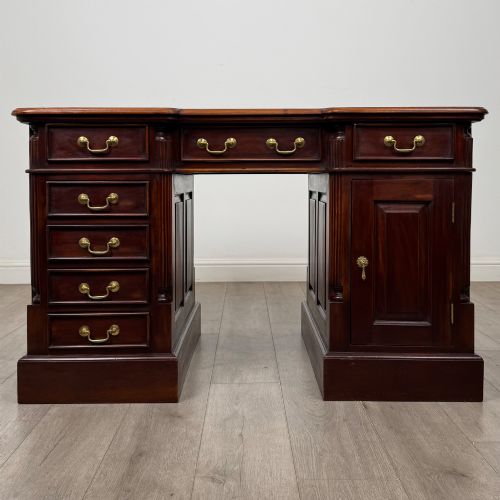
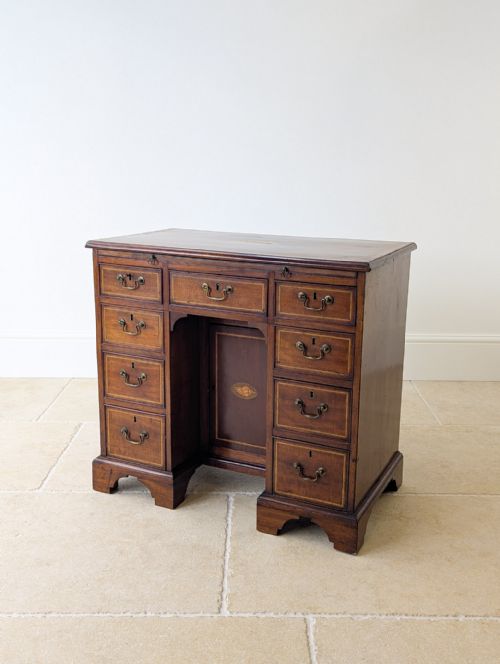


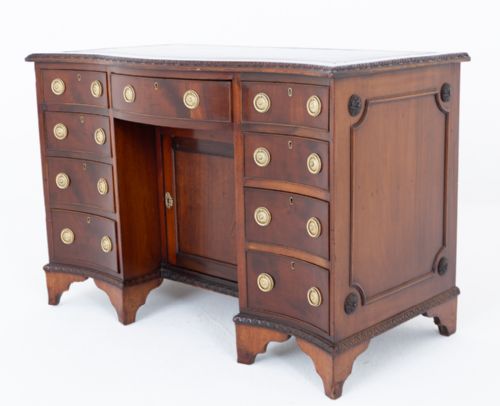


Vintage Kneehole Cupboard Desk
These vintage kneehole cupboard desk pieces are compact writing tables with central recessed cupboards, offering traditional storage and fine timber construction for the study.
Vintage Kneehole Cupboard Desk
A vintage kneehole cupboard desk combines a central recessed cupboard flanked by banks of drawers, creating a compact and formal writing station. This page shows examples ranging from eighteenth-century pieces to later Edwardian and Victorian iterations, executed in rich hardwoods.
The most common form on this page uses mahogany, often displaying figured grain or serpentine fronts. Buyers encounter both pedestal proportions and traditional cabinet dimensions across Georgian and later periods.
How they were made
Carpenters constructed these desks using solid timbers like mahogany, oak, and pine, frequently applying finely figured veneers such as burr walnut or detailed marquetry inlay to the primary surfaces. Carcases relied on traditional joinery methods to house the drawers and central cupboard door securely.
Hardware played an essential role in the finishing, incorporating cast brass handles and escutcheons alongside leather writing inserts. Simulated paint finishes also appeared on regional pine examples to emulate more costly timbers.
Some secretive kneehole desks conceal tiny hidden compartments behind the central cupboard for storing confidential letters.
What varies in quality
Quality rests in the selection of the timber and the crispness of the cabinetwork. Finer examples display carefully matched flame mahogany or burr walnut veneers across the drawer fronts and cupboard doors, maintaining grain continuity.
Construction detail defines the upper tier, seen in the smooth operation of the drawers and the structural integrity of the internal recessed cupboard. Lesser pieces rely on simpler secondary woods and plainer, unfigured stock.
Johnstone & Jeanes
The Vintage Kneehole Cupboard Desk Glossary
- Kneehole
- A recessed space beneath the centre of a desk designed to accommodate the sitter's legs. This arrangement allows banks of drawers or a cupboard to sit on either side.
- Serpentine
- A curved outline featuring a convex centre flanked by concave wings. This contour appears on advanced cabinet fronts of the Georgian period.
- Marquetry
- The art of applying pieces of veneer to a structure to form decorative patterns. Craftsmen utilised various exotic woods to create floral or geometric designs.
- Escutcheon
- A flat plate surrounding a keyhole to protect the surrounding wood. They are commonly cast in brass and styled to match the period handles.
Vintage Kneehole Cupboard Desk: Frequently Asked Questions
What is a kneehole desk?
A kneehole desk is a formal writing table featuring a central recessed cupboard or open space beneath the top, flanked by vertical stacks of drawers. This layout provides ample storage while maintaining a compact footprint for domestic studies.
Historically constructed from timbers such as mahogany and oak, these desks served as private writing spaces in period homes. The central cupboard often conceals small internal drawers or shelving.
How do I date a kneehole desk?
Dating relies on examining the construction methods, timber choices, and hardware styles. Earlier eighteenth-century pieces often feature solid mahogany and fine dovetailing, while Victorian and Edwardian examples may show machine-sawn elements.
Stylistic markers such as bracket feet, cockbeaded drawer edges, and brass handle design also indicate specific eras like the Georgian or Regency periods.
Where should I place it?
These desks suit studies, libraries, or living rooms where their finished backs and compact proportions allow for flexible placement. Many examples feature polished backs, enabling them to sit away from walls.
Ensure the room maintains stable humidity levels to protect antique veneers and solid hardwood surfaces from splitting or warping over time.
Are they suitable for daily work?
These pieces accommodate modern writing tasks and laptop use while offering traditional drawer storage for stationery and documents. Their smaller surface area requires careful measurement against contemporary office equipment.
Leather writing inserts provide a durable surface for daily tasks, though historic surfaces benefit from protective blotters during heavy use.