



Vintage Howard Settee
A vintage howard settee brings unmatched English country house comfort to a room.
Vintage Howard Settee
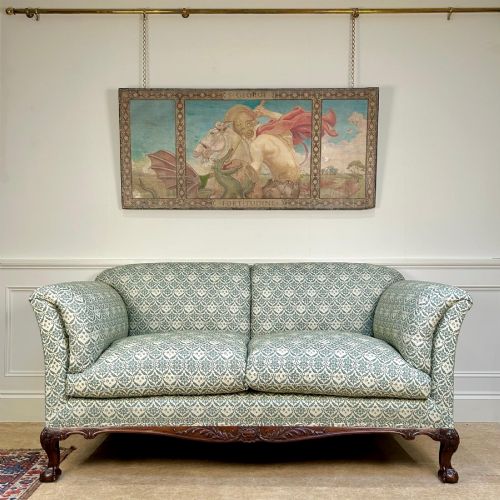
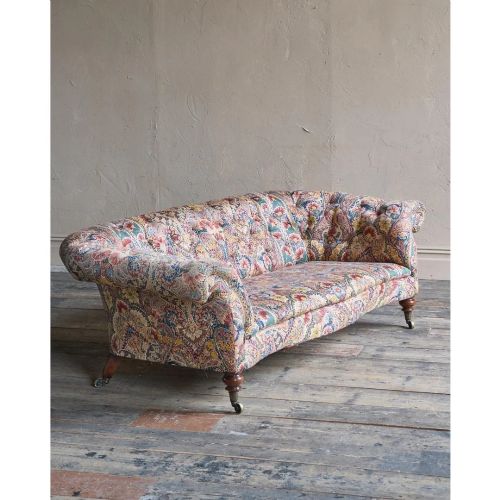
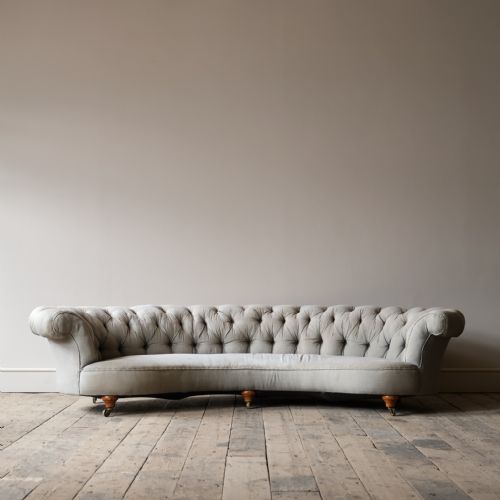
A vintage howard settee represents the pinnacle of upholstered seating originating from nineteenth and early twentieth century English workshops. When you search for a vintage howard settee, you encounter deep seated Chesterfields, scroll arm designs, and occasional pieces bearing the maker's stamp or characteristic castors.
The pieces on this page span the Victorian and Edwardian eras through to the 1930s, alongside later interpretations in the English Country style. Most examples you meet combine generous proportions with sturdy hardwood frames built for longevity.
Formations range from standard sofas to large Portarlington models and crescent shapes. You will find both fully upholstered iterations in calico or ticking and finished pieces dressed in leather, chintz, or patterned fabric.
How they were made
Makers constructed these settees using solid hardwood frames, typically utilising beech, mahogany, or walnut for structural integrity. Brass components appear primarily on castors, often stamped with serial numbers or maker details.
Upholstery techniques relied on high quality springs and stuffing encased in calico or original ticking before final decorative covering. Frames incorporated exposed wooden elements in legs and feet, featuring styles from plain turned supports to claw and ball motifs.
Vintage Howard Settee Retail Price Guide 2026
Typical asking prices for vintage howard settee among the pieces listed under this phrase on Sellingantiques today, from the lower quarter to the upper quarter. They describe what is for sale here now, not the wider market.
Materials recorded across the inventory include brass, hardwood, mahogany, beech, walnut, calico, and leather.
What varies in quality
Quality in these settees rests upon the retention of original framing, authentic upholstery foundations, and maker attribution. Pieces retaining their original stamped brass castors and ticking upholstery command stronger interest from purists.
The refinement of the woodwork also distinguishes examples, from simple turned beech legs to elaborate mahogany or walnut supports. Proportion and depth of the seat influence the overall comfort and visual balance of the finished sofa.
Howard and Sons
The Vintage Howard Settee Glossary
- Chesterfield
- A deep buttoned or padded sofa characterised by arms and back of the same height. This form provides formal upright support while maintaining generous seating depth.
- Calico
- A plain woven unbleached cotton fabric used traditionally as the inner lining and base layer for upholstery before top covers are applied. It holds the stuffing firmly in place.
- Ticking
- A heavy, tightly woven cotton or linen fabric traditionally used to contain feathers and down or heavy padding. Original ticking indicates untouched internal upholstery.
- Castor
- A small wheel mounted on a swivel attached to the legs of the settee for ease of movement. Brass castors on these pieces frequently bear manufacturer stamps.
Vintage Howard Settee: Frequently Asked Questions
How do I identify a genuine Howard settee?
Authentic pieces usually carry stamped brass castors, specific numbering on the frame, and traditional webbed framing methods. Look closely at the structural proportions and interior stuffing materials.
Documentation or maker stamps on the legs or underneath provide the most reliable confirmation of origin.
Where should I place a settee in my home?
These generous seats suit drawing rooms, studies, or large living spaces where their depth can be appreciated. Position them away from direct sunlight to protect sensitive fabrics and leather.
Allow sufficient clearance around the piece to showcase the profile and any exposed woodwork.
How do I care for original ticking upholstery?
Vacuum gently using a soft brush attachment to remove surface dust without disturbing the fibres. Avoid harsh chemical cleaners that can degrade nineteenth century textiles.
Consult a specialist textile conservator for deep cleaning or conservation of fragile antique fabrics.
What is the difference between Victorian and Edwardian models?
Victorian examples often feature heavier frames, buttoning, and darker woods like walnut or mahogany. Edwardian pieces tend towards lighter proportions and alternative seating depths.
Both periods share the core construction standards associated with high grade English workshop production.