

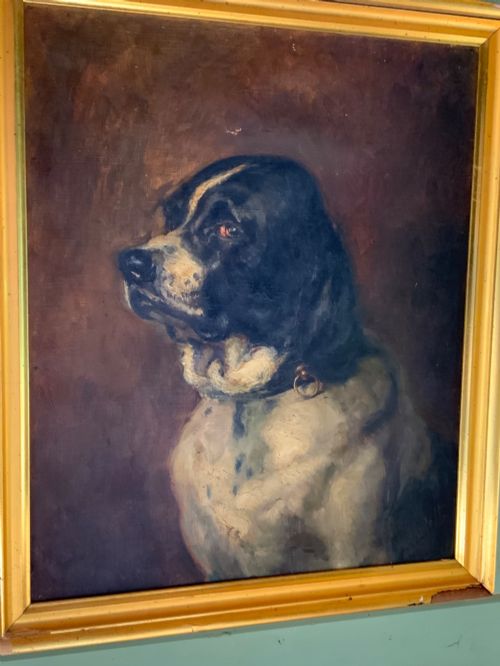


Vintage Hound Portrait
A vintage hound portrait captures the character and athleticism of sporting dogs through enduring brushwork.
Vintage Hound Portrait
A vintage hound portrait encompasses various portrayals of hunting and sporting dogs, ranging from Victorian watercolours to mid-century depictions. Buyers seeking a vintage hound portrait will encounter framed oil paintings, watercolours, and etchings spanning from the Georgian era through to the mid-twentieth century.
The pieces on this page reflect diverse traditions, including British sporting art, Victorian realism, and nineteenth-century French styles. Canvases and paper works frequently depict individual hounds or entire hunt packs within rural landscapes.
Materials and technique
Artists relied primarily on oil paint applied to canvas or wood panels, alongside detailed watercolour on paper and occasional etchings. The use of gold leaf and gilt frames adds traditional ornamentation to many of these framed artworks.
Techniques range from precise academic realism to looser mid-century interpretations, capturing the texture of coats and the intensity of the animals through layered pigments.
Vintage Hound Portrait Retail Price Guide 2026
Typical asking prices for vintage hound portrait among the pieces listed under this phrase on Sellingantiques today, from the lower quarter to the upper quarter. They describe what is for sale here now, not the wider market.
Several portraits capture hounds so intently focused they appear ready to leap straight off the canvas and chase a rabbit.
Markers of distinction
Quality rests in the anatomical accuracy of the dogs and the handling of light within the landscape setting. Superior works demonstrate a nuanced understanding of canine form and expression rather than mere mechanical reproduction.
The integration of the subject within its environment distinguishes accomplished academic pieces from simpler decorative works. Frame selection, particularly period gilt and gold leaf mouldings, also contributes to the overall cohesion of the piece.
Arthur Wardle·Sir Edwin Landseer·Jules Chardigny·Henri Schouten·Tom Carr·Richard Waitt·Henry Frederick Lucas-Lucas·Herbert Dicksee
The Vintage Hound Portrait Glossary
- Watercolour painting
- A work executed with water-soluble pigments on paper. This medium allows for translucent washes and fine illustrative detail.
- Etching
- A printmaking process where lines are incised into a metal plate with acid before being inked and pressed onto paper. It produces crisp, linear detail.
- Oil on canvas
- A traditional painting medium utilising pigments bound in drying oil applied to stretched fabric. This combination offers rich colour depth and durability.
- Sporting art
- Depictions of rural sports, horses, and dogs reflecting the traditions of the hunt. These works often carry historical documentation of specific breeds and packs.
Vintage Hound Portrait: Frequently Asked Questions
What periods do these paintings come from?
The selection spans several centuries, incorporating eighteenth-century Georgian works, nineteenth-century Victorian pieces, and mid-century modern examples.
This chronological spread shows how canine portraiture evolved from formal sporting traditions into more expressive twentieth-century styles.
How should I hang a framed oil painting?
Choose a wall away from direct sunlight and sudden temperature shifts to protect both the canvas and the gilt frame.
Ensure the hanging fixings match the weight of the piece and secure directly into solid wall studs or use appropriate cavity anchors.
Are these works original or copies?
The collection includes both original compositions by named artists and period copies after established masters, such as Victorian interpretations of earlier works.
Each listing specifies whether the artwork is an original production or a period copy from the same era.
How do I care for watercolour on paper?
Watercolour pieces require protective framing behind glass with a mat board to prevent the paper from touching the glazing.
Keep these works in rooms with stable humidity levels to avoid warping the paper or encouraging mould growth.