

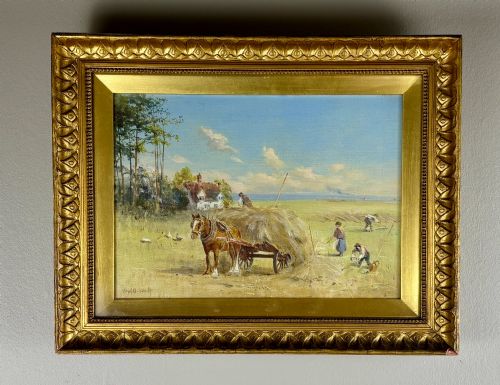


Vintage Hay Harvesting Artwork
These vintage hay harvesting artwork pieces capture the traditional rural landscape through British Impressionism, realism, and watercolour.
Vintage Hay Harvesting Artwork
Vintage hay harvesting artwork captures rural scenes of agricultural toil and pastoral landscapes, predominantly through paintings and watercolour works originating from the late nineteenth century to the mid twentieth century. Buyers seeking this subject matter will encounter depictions of hay carts, hay cutting, and harvest time recorded across various British art movements.
The pieces available span multiple decades, including works from eighteen eighty, nineteen hundred, nineteen ten, nineteen twenty, nineteen thirty, and nineteen fifty, alongside broader nineteenth century examples. Common formats include both framed watercolours on paper and oil paintings on canvas or wood panels.
Stylistically, these works range from Victorian Fine Art and Victorian Pastoral traditions through to Edwardian Realism and British Impressionism, with occasional naive school landscapes. Most examples focus squarely on the figures, fields, and machinery involved in gathering the harvest during the summer months.
Materials and methods
The physical construction of these works relies principally on traditional painting mediums applied to paper, canvas, or wood supports. Watercolour pigment on paper and oil paint on canvas or board represent the primary techniques employed by the artists.
Many of these works retain their period framing, which frequently incorporates gilt wood mouldings that complement the palette of the paintings. The combination of oil paint, watercolour, and wood framing reflects the standard studio practices of British artists working from the late Victorian era through the mid twentieth century.
Vintage Hay Harvesting Artwork Retail Price Guide 2026
Typical asking prices for vintage hay harvesting artwork among the pieces listed under this phrase on Sellingantiques today, from the lower quarter to the upper quarter. They describe what is for sale here now, not the wider market.
Listings incorporate works from the late nineteenth century up to nineteen fifty, using oil and watercolour on paper, canvas, and wood.
Assessing quality and execution
Quality in these pastoral scenes rests upon the artist's handling of light, atmosphere, and natural movement within the rural landscape. Stronger examples demonstrate confident brushwork and a sophisticated grasp of colour, particularly in depicting evening light or open fields.
The fidelity of the perspective and the depiction of human and animal figures distinguish finer academic and impressionist works from simpler naive school interpretations. Furthermore, the preservation of the pigment, the condition of the paper or canvas, and the integrity of the original wood frames influence the standing of any individual piece.
James William Booth·John Atkinson·J.C. Grey·Herbert Royle·Frederick William Jackson·Walter Duncan·George Hamilton Constantine·William Kay Blacklock·Robert Thorne Waite
The Vintage Hay Harvesting Artwork Glossary
- Watercolour
- A painting method in which the paints are made of pigments suspended in a water-based solution. This medium is typically executed on paper.
- Oil painting
- A work produced using pigments bound with a medium of drying oil, commonly applied to canvas or wood surfaces.
- Gilt
- A gold application or finish used on frames and decorative elements to impart a metallic sheen. This enhances the visual presence of the artwork.
- Impressionism
- An art movement focusing on accurate depiction of light in its changing qualities, heavily represented in British interpretations of rural life.
Vintage Hay Harvesting Artwork: Frequently Asked Questions
What periods do these paintings come from?
The available works span from the late nineteenth century through the eighteen eighties and nineteen hundreds, extending into the nineteen twenties, thirties, and fifties.
This broad chronological range encompasses Victorian pastoral traditions, Edwardian realism, and mid-century naive school interpretations.
Are these works painted on canvas or paper?
The pieces utilise a variety of supports depending on the medium chosen by the artist. Watercolours are executed on paper, whilst oil paintings utilise canvas or wood.
Both framed watercolours and oil paintings appear frequently across the selection.
How should I care for a vintage watercolour?
Watercolours on paper require protection from direct sunlight to prevent the pigments from fading over time. Maintaining stable indoor humidity levels also helps preserve both the paper support and any associated framing.
Glazing with appropriate conservation glass offers additional defence against environmental damage.