




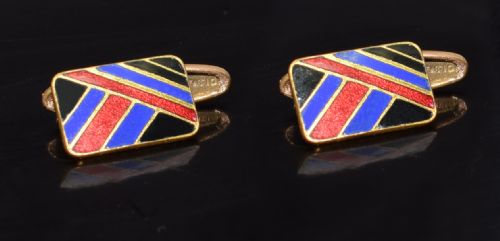
Vintage Gold Cuff Links
These vintage gold cuff links span decades of tailoring, offering solid metal construction and decorative finishes that suit everyday wear.
Vintage Gold Cuff Links
Vintage gold cuff links comprise paired fasteners designed to secure shirt cuffs, emerging across periods from the Victorian era through the mid-twentieth century.
The selections span styles from Edwardian foliate designs and Art Nouveau motifs to geometric Art Deco engine-turned patterns and Italian modernist work.
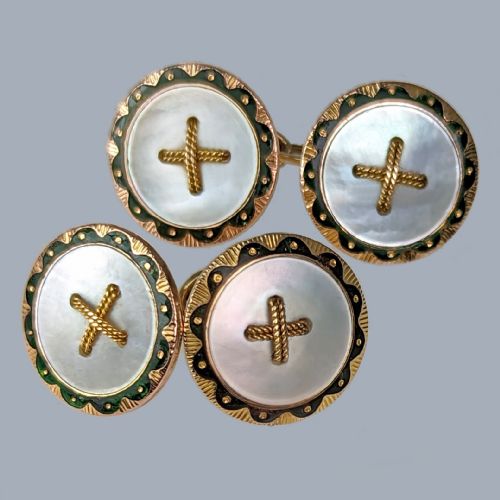
Makers utilise forms ranging from simple oval chain links to heavy hinged double-sided designs and pieces incorporating gemstones or vitreous enamel.
How they were made
Craftsmen shaped the pieces in 9ct, 14ct, 15ct, 16ct, and 18ct yellow, white, and rose gold, often applying hallmarks to record assay offices and dates.
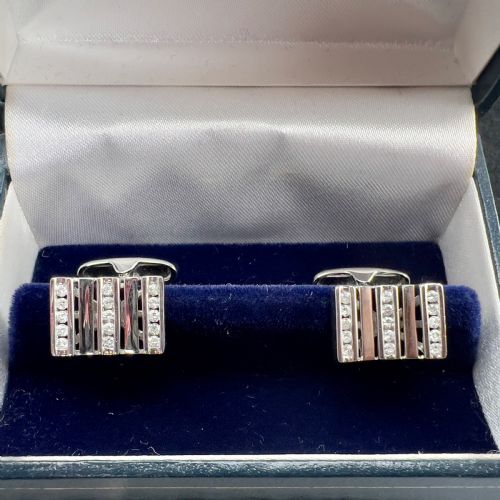
Surface decoration involved engine-turning, hand engraving, and bark texture designs, alongside applied elements such as mother of pearl, enamel, sapphire, and diamond.
Listings feature 9ct, 14ct, 15ct, 16ct, and 18ct gold variants alongside enamel, mother of pearl, diamond, and sapphire.
What varies in quality
The standard of execution depends on the weight of the metal and the crispness of the hand engraving or engine-turned patterns.
Pieces bearing identifiable maker marks and legible British or continental hallmarks generally command greater interest among collectors.
Solomon Blanckensee Son·R Lalique·Henry Griffiths·Roy King·Cartier·Kutchinsky·Henry Hobson
The Vintage Gold Cuff Links Glossary
- Hallmark
- An official stamp indicating the purity of the metal, the assay office, and the date of manufacture. These marks provide the most reliable evidence for dating a pair.
- Engine turned
- A mechanical decorative technique producing intricate, geometric patterns of fine lines on metal surfaces. This method was widely favored during the Art Deco period.
- Essex crystal
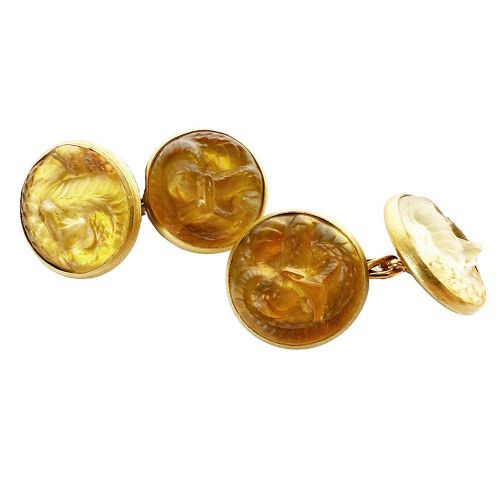
- A technique where a rock crystal cabochon is reverse-carved and painted to create a lifelike, three-dimensional image beneath the dome.
- Enamel
- Vitreous material fused to metal through high-temperature firing to add durable colour. It appears frequently in geometric designs and crests.
Vintage Gold Cuff Links: Frequently Asked Questions
How do I date my gold cufflinks?
Examine the metal for official hallmarks, which typically include stamps for the assay office, maker, and metal purity alongside a date letter. Comparing these symbols against established regional records reveals the exact year of production.
Stylistic cues such as geometric Art Deco engraving or flowing Edwardian foliate motifs further narrow the manufacturing period when hallmarks are rubbed or absent.
Are these cufflinks solid gold?
Many examples are fashioned from solid 9ct, 14ct, 15ct, or 18ct gold, as indicated by regional purity marks stamped directly onto the fixtures. The weight and internal stamps confirm the solid construction of the metal components.
Certain pieces pair solid gold frames with decorative faces set with enamel, mother of pearl, or gemstones rather than relying on gold plating.
How were double-sided cufflinks worn?
Double-sided pairs feature two decorative faces connected by a short chain or rigid bar, requiring the wearer to thread both ends through the shirt cuff buttonholes. This traditional configuration presents an identical motif on the outer and inner wrist.
They gained popularity during the Victorian and Edwardian eras, offering a symmetrical appearance compared to single-faced toggles.
What is engine turning?
Engine turning is a precision mechanical technique that etches intricate geometric patterns into the gold surface using a specialised lathe. This process creates light-catching textures such as sun rays or fine lines.
It became a defining finish for men's accessories during the 1920s and 1930s, adding visual depth without the need for gemstones.