

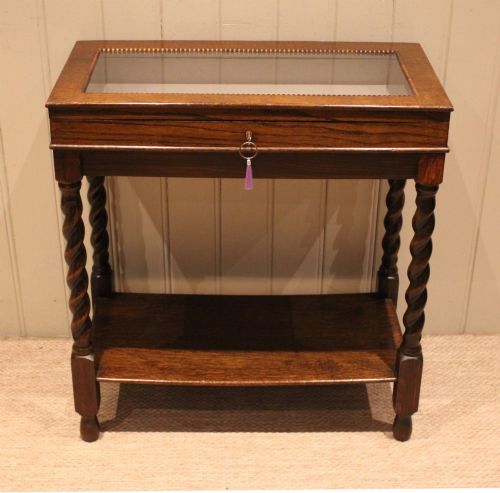


Vintage Glass Jewellery Case
A vintage glass jewellery case brings small treasures into plain view, offering a neat way to store and display precious pieces.
Vintage Glass Jewellery Case
When you search for a vintage glass jewellery case, you are looking at items designed to protect and exhibit small valuables, spanning countertop boxes, bijouterie tables, and shop display cabinets. The selection on this page leans heavily toward Edwardian and early twentieth-century examples, ranging from compact tabletop boxes to larger mahogany counters and French or continental bijouterie tables.
You will encounter pieces produced across several decades, from the late nineteenth century through the Art Deco period of the 1930s. The forms vary from simple brass and glass desktop cases to mahogany-inlaid display tables with hinged glass lids made for domestic or commercial use.
Many of these containers trace their roots to retail shops or domestic dressing rooms, serving dual purposes as secure storage and visual showcases. The recurring appearance of mahogany, brass, and velvet across the inventory points to an era when presentation mattered as much as the items kept inside.
Materials and construction
The construction of these pieces relies on combinations of timber frames and glazed panels, with mahogany, oak, and ebonised wood forming the structural carcass. Glazing allows light to enter from multiple angles, while internal linings of velvet provide a soft bed for jewellery and small collectables.
Metal components play a structural and decorative role, featuring brass fittings, locks, and occasional ormolu mounts. Joinery techniques from the Edwardian and Art Deco eras ensure tight corners and stable frames to support heavy glass lids and doors.
Vintage Glass Jewellery Case Retail Price Guide 2026
Typical asking prices for vintage glass jewellery case among the pieces listed under this phrase on Sellingantiques today, from the lower quarter to the upper quarter. They describe what is for sale here now, not the wider market.
Markers of quality
Quality in a vintage glass jewellery case rests on the crispness of the timber framing, the integrity of the glass panes, and the refinement of internal details like velvet lining and brass hardware. Superior examples display careful wood inlay, tight mitred joints, and well-fitted locks with functional keys.
Simpler commercial counters prioritise robust utility over decorative subtlety, whereas domestic bijouterie tables often feature finer veneers, such as kingwood, and slender cabriole or tapered legs. The presence of original bevelled glass and uncompromised internal fabric elevates a piece far above standard utilitarian boxes.
Quincy Showcase Works Illinois
The Vintage Glass Jewellery Case Glossary
- Bijouterie table
- A glass-topped display table specifically designed for showing small ornaments, medals, and jewellery. These pieces usually feature a hinged lid and a lined interior.
- Vitrine
- A glass-fronted or glass-sided cabinet used for displaying fine objects and porcelain. They appear in various heights from countertop versions to full floor-standing models.
- Ormolu
- Gilded bronze ornamentation applied to furniture and decorative objects. It adds a bright metallic highlight to timber cabinets.
- Ebonised wood
- Timber treated to resemble ebony, achieving a deep black finish popular in nineteenth-century and early twentieth-century cabinet making.
- Inlay
- A decorative technique where contrasting pieces of wood or metal are inserted into depressions in the base material to form patterns.
Vintage Glass Jewellery Case: Frequently Asked Questions
What is a bijouterie table?
A bijouterie table is a specialised display table featuring a glazed top and a shallow compartment lined with fabric. It was traditionally used in drawing rooms to exhibit small personal treasures and collectables.
Today, these tables function well in modern interiors as accent furniture that keeps delicate accessories visible yet protected from dust.
How do I date a glass display case?
Dating relies on observing the timber, hardware, and prevailing styles such as Edwardian inlay or Art Deco geometry. Construction methods, including screw types and joint execution, also offer strong clues to the decade of manufacture.
Comparing the piece against documented examples from specific periods helps narrow down the production year with reasonable accuracy.
Were these cases used in shops?
Many sturdy oak and mahogany units originated as countertop display cabinets for retail trade before finding their way into domestic settings. These commercial pieces often feature robust locks and larger proportions to withstand daily customer interaction.
Their utilitarian origins give them a practical edge for organising contemporary collections in a home environment.
How should I clean the glass?
Cleaning requires mild glass cleaner applied to a cloth rather than sprayed directly onto the surface, preventing moisture from seeping into old timber frames or fabric linings. Gentle wiping keeps the historic glass clear without risking damage to delicate corners or antique putty.
Taking care around brass hinges and velvet interiors ensures the longevity of both the materials and the structural integrity of the case.