



Vintage Girandole Mirrors
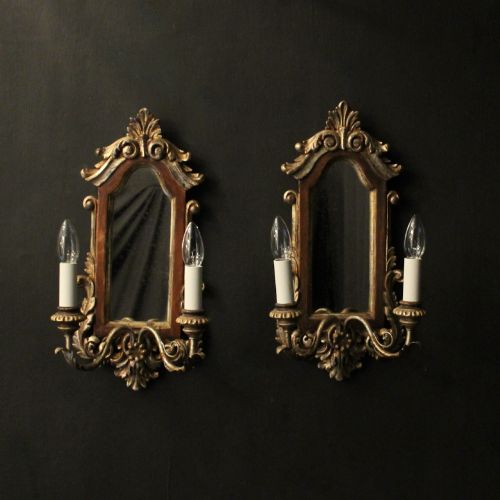
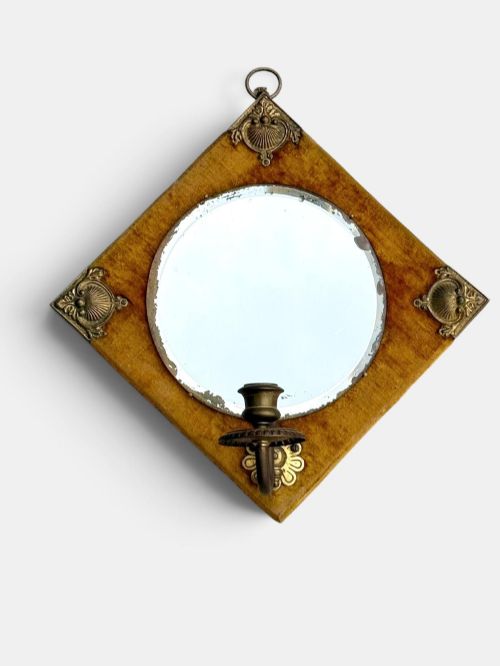
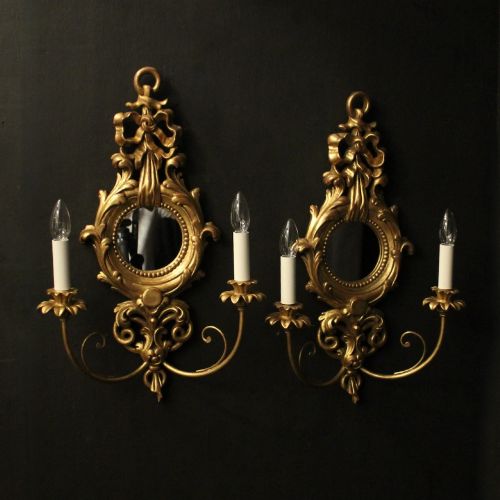
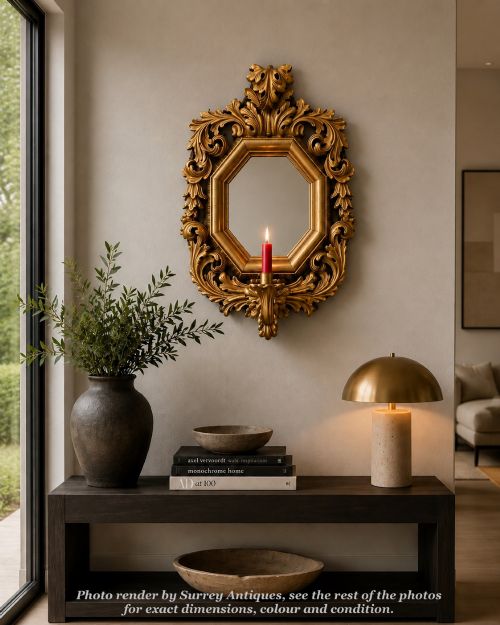
These vintage girandole mirrors combine reflective glass with integral candle sconces to throw ambient light across a room.
Vintage Girandole Mirrors
Vintage girandole mirrors serve as both wall illumination and decorative looking glasses, frequently appearing in pairs or single statement forms. When you search for vintage girandole mirrors, you encounter wall lights and sconces designed to hold candles alongside central mirror plates. The pieces span periods from the nineteenth century through the 1930s, taking forms such as convex circular frames, oval wall mirrors, and twin-arm branch fixtures.
The selection includes Florentine, French, and English regional interpretations manifesting styles like Rococo Revival, Neoclassical, and Arts & Crafts. You are most likely to meet giltwood and bronze twin-arm wall lights alongside carved wooden frames with pink or standard mirror glass. Object types range from simple brass-framed wall mirrors to large gilt girandoles with multiple candle branches.
Origins trace across Italy, France, and England, capturing aesthetic shifts from Victorian and Edwardian sensibilities to early twentieth-century production. Makers and workshops from Paris and Florence utilised local craft traditions to produce ornate wall sconces and hanging looking glasses. These objects remain functional wall fixtures that double as focal points in period interiors.
Materials and construction methods
Craftsmen built the structural frames of these mirrors using timber such as carved giltwood and silvered wood, frequently applying a layer of gesso to hold intricate surface detail. Metal components including brass, gilt bronze, and gilt metal form the structural mounts, candle arms, and decorative frames seen across the pieces. Silvered and standard mirror glass provide the reflective surface, occasionally rendered in pink tones.
Gilding techniques involved the application of gold leaf or gilt finish over wood and gesso substrates, creating the luminous surfaces characteristic of French chateau and Florentine baroque styles. Carvers shaped rope twists, floral motifs, and sculptural mounts by hand before assembling the twin-arm or three-branch candle holders. Bronze casting produced robust wall lights and sconces designed to support the weight of burning candles securely.
Vintage Girandole Mirrors Retail Price Guide 2026
Typical asking prices for vintage girandole mirrors among the pieces listed under this phrase on Sellingantiques today, from the lower quarter to the upper quarter. They describe what is for sale here now, not the wider market.
Assessing quality and craftsmanship
The distinction between standard examples and superior pieces rests upon the crispness of the hand-carved wood and the depth of the gilding. Finely articulated giltwood frames exhibit sharp relief in their scrollwork and foliage, whereas lesser pieces display softer, moulded details in gesso. The quality of the cast bronze or brass arms determines the structural integrity of the candle branches.
Original mirror glass retention significantly elevates an example, particularly when silvering shows authentic oxidation patterns rather than modern replacement. The integration between the mirror frame and the candle sconces indicates thoughtful design, ensuring the arms align harmoniously with the central looking glass.
E.G Paris
The Vintage Girandole Mirrors Glossary
- Girandole
- A decorative wall mirror fitted with branching candle sconces that reflect light into the room. These fixtures combine illumination with optical expansion of interior space.
- Giltwood
- Timber coated with gold leaf or a gold-coloured metallic finish. This material defines the opulent frames of many nineteenth- and twentieth-century wall mirrors.
- Gesso
- A plaster-like mixture applied to wood frames to create a smooth surface for carving or gilding. It allows for intricate relief ornamentation before the application of gold leaf.
- Convex mirror
- A round looking glass with a curved surface that provides a wide-angle reflection of the interior. These mirrors often feature elaborate gilded frames and ball-stud borders.
- Sconce
- A wall-mounted lighting fixture designed to hold candles or electric bulbs. In girandoles, these arms project directly from or alongside the mirror frame.
Vintage Girandole Mirrors: Frequently Asked Questions
How were girandole mirrors used historically?
These mirrors hung in principal rooms where candlelight was amplified by the reflective glass surface. The integrated arms held wax candles to illuminate dark corners before the advent of electric lighting.
Positioned between windows or above mantelpieces, they maximised the available light while serving as prominent decorative furnishings in domestic interiors.
Where should I hang a girandole mirror?
Ideal placement includes living rooms, hallways, and dining spaces where the candle arms and reflective glass can catch natural and artificial light. They work effectively as focal points above sideboards or fireplaces.
Ensure the wall construction can support the weight of wooden or bronze frames, particularly when the fixture includes heavy metal candle branches.
How do I identify a nineteenth-century girandole?
Examine the construction of the frame, backing boards, and the characteristics of the mirror glass. Nineteenth-century pieces frequently employ hand-carved giltwood, heavy cast bronze, or layered gesso over timber.
Look for period-specific joinery and subtle imperfections in the silvered glass plate that indicate historical manufacture rather than modern reproduction.
Can I burn real candles in the sconces?
While the arms were originally designed for wax candles, contemporary use requires caution regarding heat and dripping wax near antique surfaces. Many owners choose to use them unlit or fit them with modern drip catchers.
Inspect the stability of the metal or wooden candle arms before placing any candles in the sconces to ensure they remain secure.