





Vintage Garden Print
A vintage garden print brings botanical beauty and structured landscape scenes directly into your interior spaces.
Vintage Garden Print
When you search for a vintage garden print, you encounter framed watercolours, mixed media works, architectural drawings, and photographic portraits. These items span periods from the nineteenth century through the early twentieth century, capturing floral scenes and garden settings.
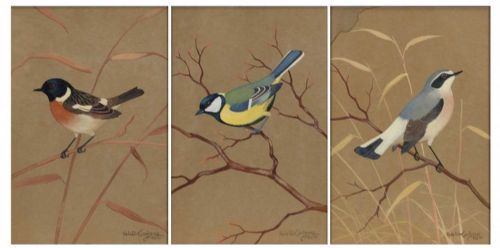
The most common forms you meet on this page include framed artwork and wall art featuring garden birds, architectural pavilions, and floral arrangements. Works by named artists like Ralston Gudgeon and Lilian Stannard appear alongside anonymous nineteenth-century blue and white transfer transferware.
These pieces encompass diverse stylistic movements, ranging from late Victorian and Edwardian aesthetics to mid-century British art and nineteenth-century neoclassical design. They function primarily as wall art or decorative serving dishes that introduce botanical and landscape motifs to a room.
Materials and techniques
Makers utilised paper, board, and glass as the foundational supports for watercolours, gouache, ink, and photographic prints. Framed items frequently incorporate gilt wood frames to house the artwork.
Techniques range from hand-painted watercolours and mixed media compositions to transfer printing on ceramic platters and convex glass chrystoleum work.
Vintage Garden Print Retail Price Guide 2026
Typical asking prices for vintage garden print among the pieces listed under this phrase on Sellingantiques today, from the lower quarter to the upper quarter. They describe what is for sale here now, not the wider market.
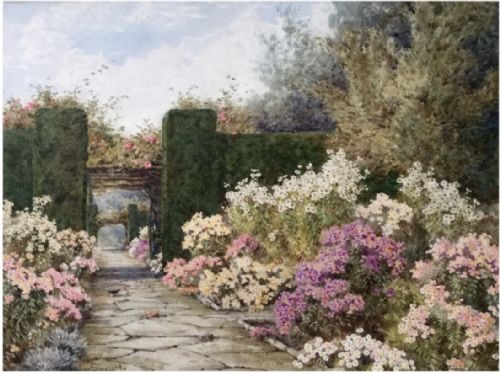
Michaelmas daisies immortalised by Lilian Stannard bring late-summer garden perennially indoors, regardless of the frost outside.
Judging quality
Quality rests upon the skill of the artist and the preservation of the medium, particularly how well watercolour pigments and ink lines retain their vibrancy on paper. Original framing in gilt wood elevates the piece compared to later replacements.
The precision of the transfer print on ceramic meat plates or the depth achieved in mixed media and chrystoleum works distinguishes finer examples from simpler production.
Ralston Gudgeon·K and K Hof Atelier Pietzner·Jane Utley·Lilian Stannard·Eduard Veith
The Vintage Garden Print Glossary
- Watercolour
- A painting method where paint is made of pigments suspended in a water-based solution. This technique appears frequently in botanical and garden artwork.
- Chrystoleum
- A historic method of applying a hand-coloured photograph to convex glass and finishing it with oil paints. This technique creates a distinct three-dimensional appearance.
- Transfer print
- A method of decorating ceramics by pulling an engraved design from a copper plate onto paper and pressing it onto the glaze. It defines nineteenth-century blue and white platters.
- Gilt wood
- Wood carved and coated with gold leaf or a gold-coloured metallic finish. It frames many traditional artworks on this page.
- Gouache
- An opaque water-based paint that provides solid, flat areas of colour. It often supplements watercolour in mixed media garden scenes.
Vintage Garden Print: Frequently Asked Questions
How do I hang a framed artwork safely?
Use appropriate wall fixings that match the weight of the gilt wood frame and the wall construction.
Position the piece at eye level to ensure the garden scene is viewed comfortably within your interior layout.
What periods do these pieces represent?
The listings span from the nineteenth century through the early twentieth century, including Victorian and Edwardian examples.
Mid-century British art also appears among the mixed media works and watercolours.
How do I care for antique paper and watercolours?
Keep watercolours and paper works away from direct sunlight to prevent the pigments from fading over time.
Maintain stable indoor humidity levels to protect both the paper support and the original frames.
Where were these decorative items used?
Artwork like architectural prints and floral watercolours typically hung in parlours, drawing rooms, and studies.
Ceramic platters with garden scenes served dining functions during the nineteenth century.
What is a chrystoleum?
A chrystoleum is a convex glass piece featuring a hand-coloured photograph finished with oils.
This Victorian technique gives the portrait a layered, luminous quality.