



Vintage Flame Light
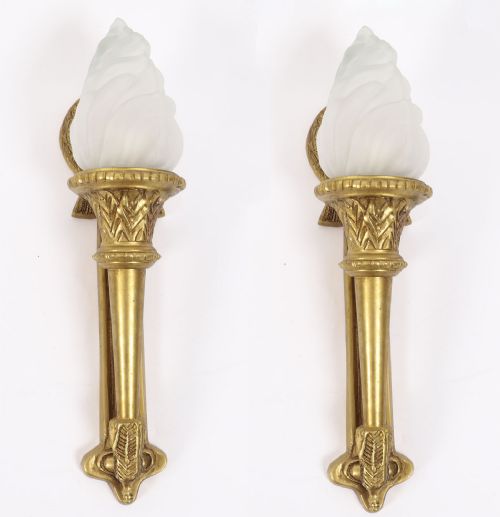
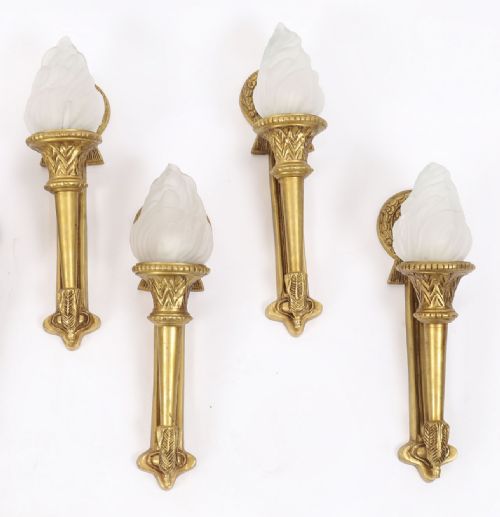
These vintage flame light fixtures bring a striking torch-like glow to an interior, channelling classical and modernist motifs into domestic lighting.
Vintage Flame Light
A vintage flame light encompasses decorative wall sconces, ceiling fixtures and table lamps designed to mimic burning torches or leaping flames. These pieces draw heavily on neo-classical, Art Deco and Art Nouveau aesthetics, transforming a practical light source into a sculptural feature.
The selections on this page lean heavily towards wall lights and sconces from the 1920s and 1930s, alongside earlier Victorian and Edwardian examples. Buyers frequently encounter ormolu and brass mountings paired with frosted glass or shaped shades that evoke a flickering fire.
Beyond standard wall sconces, the broader category accommodates ceiling lights and table lamps utilising materials from bronze and chrome to catalin and bakelite. Each period brings a distinct interpretation to the flame motif, shifting from ornate 19th-century casting to clean, geometric Art Deco lines.
How they were made
Metalworking forms the structural backbone of these pieces, utilising cast brass, ormolu, chrome, bronze and iron to build heavy wall mounts and frames. Artisans shaped these metals through casting and pressing, capturing the intricate contours of torchieres and foliate motifs.
Glass is the primary medium for the flame elements, employing frosted finishes and moulded profiles to diffuse light softly. Mid-century and Art Deco variations also incorporate early plastics such as bakelite and catalin for bases and fittings, marking a shift toward modern industrial production.
Vintage Flame Light Retail Price Guide 2026
Typical asking prices for vintage flame light among the pieces listed under this phrase on Sellingantiques today, from the lower quarter to the upper quarter. They describe what is for sale here now, not the wider market.
Several pieces boldly pretend to be burning torches, ensuring your hallway lighting comes with a hint of medieval theatre.
What varies in quality
The calibre of a vintage flame light rests in the crispness of its metal casting and the weight of the materials used. Finer examples display sharp, hand-finished chasing on ormolu and bronze, whereas simpler production pieces rely on softer lines and lighter gauge brass.
The integrity of the glass shades dictates much of the visual appeal, with thicker, evenly frosted or moulded elements holding greater presence than thin or later replacement glass. Original period wiring components and matching sets further elevate the desirability of these lighting fixtures.
The Vintage Flame Light Glossary
- Ormolu
- Gilded bronze, where a gold-mercury amalgam is applied to a bronze base, creating a rich metallic finish often seen on neo-classical pieces. This technique imparts a deep, enduring lustre distinct from modern electroplating.
- Torchere
- A standing or wall-mounted light fixture modelled in the shape of a classical torch. In lighting design, this form directs illumination upwards to mimic a burning flame.
- Catalin
- A cast phenolic resin developed in the 1920s and 1930s, celebrated for its vibrant colours and depth. It appears frequently in Art Deco electrical fittings and lamp bases.
- Sconce
- A wall-mounted lighting fixture affixed directly to a vertical surface. These pieces project outward to illuminate hallways, reception rooms and fireplace surrounds.
- Spelter
- An alloy of zinc and lead, often cast and bronzed to imitate solid bronze or brass. It provided a cost-effective alternative for decorative lamp bases during the early 20th century.
Vintage Flame Light: Frequently Asked Questions
Where should I mount a wall sconce?
These fixtures suit hallways, flanking a fireplace, or framing a mirror in a dining room. Their projecting profile creates focused upward illumination that draws the eye.
Ensure they are positioned at eye level or slightly above to balance the room and avoid direct glare from the bulb.
Are these lights compatible with modern wiring?
Most antique and vintage fixtures can be adapted to current electrical standards by a qualified electrician. The internal sockets and leads are usually updated while preserving the exterior metalwork and glass.
It is advisable to check the lamp holders and conduit before installation to ensure safe operation with contemporary bulbs.
How do I identify an Art Deco light?
Art Deco lighting relies on geometric symmetry, streamlined metallic finishes, and the introduction of modern plastics like bakelite. The forms are often more linear and abstract than earlier styles.
Look for stepped motifs and chrome plating which define the manufacturing aesthetic of the 1930s.
Can I mix brass and chrome fittings?
Mixing metals is common in eclectic interiors, provided there is a unifying theme in the room's period or colour palette. Matching sets within the same room create a more formal appearance.
Consider the surrounding hardware and lighting tones before introducing contrasting metal finishes to a single space.