


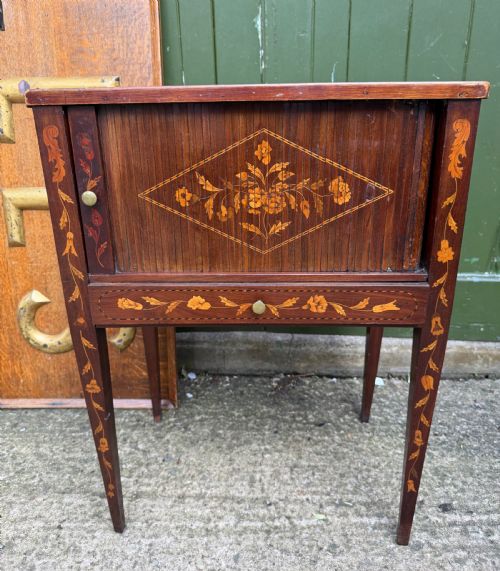


Vintage Dutch Marquetry Furniture
Vintage dutch marquetry furniture brings elaborate floral wood-inlay to practical household storage and display pieces.
Vintage Dutch Marquetry Furniture
When you search for vintage dutch marquetry furniture, you encounter items designed for storage and display, ranging from desks and bureaus to chests of drawers, display cabinets, and bedside cupboards. These objects serve everyday functions while presenting elaborate decorative surfaces.
The most common forms on this page include chests of drawers, dressing tables, and display cabinets. You also find pedestals, plate racks, and bedside tables, all ornamented with detailed inlaid designs.
Pieces span multiple periods from the eighteenth century through the nineteenth century and into the early twentieth century. Makers drew upon Dutch Baroque, Rococo, Neoclassical, and traditional styles to shape these functional items.
How they were made
Craftsmen built carcases using primary timbers such as walnut, mahogany, and fruitwood. These solid foundations provided stable structures for supporting the complex decorative veneers applied to the exterior surfaces.
The characteristic floral decoration relies on marquetry techniques utilising contrasting woods like boxwood and satinwood, often enhanced with kingwood and brass elements. Artisans cut thin sections of these various timbers and fitted them together to form intricate pictorial patterns before gluing them to the furniture.
Listings feature woods including walnut, mahogany, fruitwood, boxwood, satinwood, kingwood, and brass.
What varies in quality
Quality rests upon the precision of the wood-inlay work and the harmonious selection of contrasting timbers. Pieces featuring refined floral motifs executed in varied woods demonstrate superior craftsmanship compared to simpler geometric or repetitive designs.
The architectural form of the carcase and the choice of primary timber also dictate standing. Items utilising dense mahogany or figured walnut provide a more substantial foundation for the intricate marquetry than secondary fruitwoods.
The Vintage Dutch Marquetry Furniture Glossary
- Marquetry
- A technique where small pieces of coloured wood veneer are assembled to create decorative patterns and pictures on a furniture surface. This method defines the primary visual appeal of these items.
- Bombé
- A swelling, outward-curving shape found on the front and sides of certain chests and commodes. This rounded profile creates a dramatic silhouette.
- Vitrine
- A glass-fronted cabinet designed for the display of precious objects and porcelain. These display pieces protect contents while offering visibility from multiple angles.
- Torchere
- A tall stand or pedestal originally intended to support a candle or light. These decorative supports frequently feature elaborate inlay work.
- Secretaire
- A desk incorporating a writing flap that folds down to reveal inner compartments and small drawers. This form combines storage with a dedicated writing surface.
Vintage Dutch Marquetry Furniture: Frequently Asked Questions
How do I clean marquetry furniture?
Dust surfaces regularly with a soft, dry cloth to prevent dirt accumulation in the veneer seams. Avoid harsh chemical cleaners that can damage the polish and lift the inlaid wood.
Apply a traditional beeswax polish occasionally to nourish the timber and maintain a gentle sheen. Buff the surface lightly after application to protect the delicate wood-inlay without building up heavy residue.
Where should I place these pieces?
Position your cabinet or chest away from direct sunlight and strong heat sources. Extreme temperature fluctuations cause wood to expand and contract, which threatens the delicate veneer.
Keep the item in a room with stable humidity levels to preserve the structural integrity of the carcase. Adequate space allows the decorative floral patterns to be appreciated fully from a distance.
What styles are represented here?
The selection includes items influenced by Dutch Baroque, Rococo, and Neoclassical traditions. These stylistic periods dictate the overall silhouette and the complexity of the carved and inlaid details.
Earlier items often display exuberant floral compositions, while later pieces incorporate refined neoclassical symmetry. Examining the leg shape and moulding helps identify the specific design era.
Are these pieces suitable for daily use?
Many items serve practical storage roles, including chests of drawers, dressing tables, and bedside cupboards. They function reliably for ordinary household storage when handled with reasonable care.
Surface protection using coasters or mats prevents accidental moisture rings on the polished wood veneer. Regular use adds to the living history of the piece without compromising its structure.