

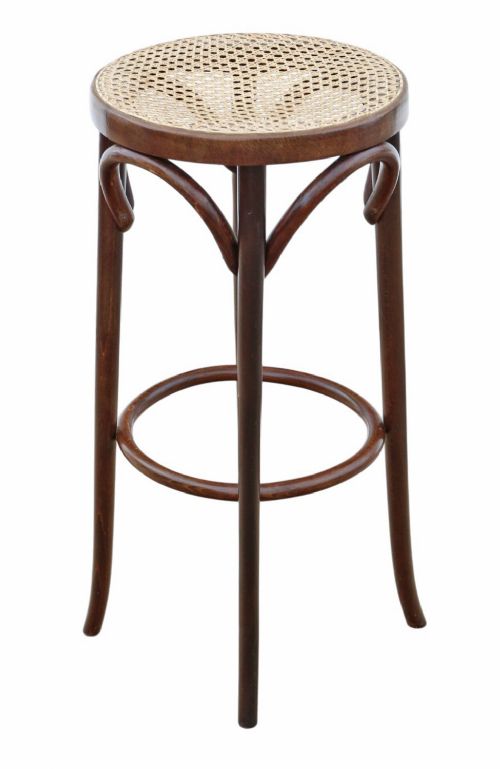


Vintage Circular Stool
A vintage circular stool brings compact character and practical seating to any corner, spanning piano stools, bar stools, and occasional footstools.
Vintage Circular Stool
When you search for a vintage circular stool, you encounter a diverse range of forms including piano stools, bar stools, and footstools spanning the nineteenth century through the Art Deco period. These pieces appear in varied styles such as Victorian, Arts and Crafts, Louis XVI style, and European Bistro, reflecting British, French, and Canadian origins.
The most common forms you meet on this page are piano stools with adjustable heights, alongside sturdy elm country stools and walnut dressing seats. Makers often integrated storage beneath circular tops or utilised screw mechanisms for height adjustment.
How they were made
Cabinet makers utilised solid timbers such as walnut, mahogany, oak, elm, and general hardwood to construct the frames and circular tops. Selected pieces incorporate bentwood techniques or carved wooden frames finished with gilt paint.
Upholstery details include fitted fabric, textile, and tan leather coverings. Brass components appear in adjustable screw mechanisms and decorative footrest accents.
Vintage Circular Stool Retail Price Guide 2026
Typical asking prices for vintage circular stool among the pieces listed under this phrase on Sellingantiques today, from the lower quarter to the upper quarter. They describe what is for sale here now, not the wider market.
Several piano stools hide storage compartments under their circular tops, perfect for stashing sheet music or small household secrets.
What varies in quality
The distinction between standard examples and superior pieces rests upon the precision of the carved decoration and the mechanical integrity of adjustable screw tops. Solid hardwood frames with intricate carving demand greater joinery skill than plain turned legs.
Material selection and finish also divide the range, with figured walnut and matched mahogany showing superior cabinet work compared to simpler painted or softwood alternatives.
James Shoolbred
The Vintage Circular Stool Glossary
- Piano stool
- A seat designed for keyboard players, frequently featuring a revolving or screw-adjusted top to alter the seating height. These often include internal storage compartments beneath the lid.
- Bentwood
- A furniture manufacturing technique where wooden rods are steamed until pliable and bent into curved shapes. This method creates lightweight yet strong frames found in tall bar seating.
- Adjustable screw top
- A mechanism allowing the seat disk to be raised or lowered by rotating it on a threaded central spindle. This engineering is common in nineteenth-century music seats.
- Elm
- A durable hardwood with an interlocking grain favoured by country makers for robust seating. It resists splitting under heavy daily use.
Vintage Circular Stool: Frequently Asked Questions
How do I adjust the height?
Many piano stools utilise a central threaded screw mechanism that raises or lowers the circular top when rotated.
Others rely on fixed-height frames or simpler pegged adjustments depending on the specific period and design.
Were these used for pianos?
Numerous circular stools from the nineteenth and early twentieth centuries were specifically built as piano seating to give musicians proper reach.
Their compact footprints and revolving tops made them versatile for other domestic uses over time.
How do I identify Art Deco pieces?
Art Deco examples from the 1930s often feature streamlined walnut frames paired with materials like tan leather.
They favour geometric simplicity over the heavy carved ornamentation seen in earlier Victorian styles.
What rooms suit these stools?
Their compact circular tops make these pieces ideal for dressing tables, tight corners, or as extra seating around living spaces.
Bar-height variants also serve well beside kitchen counters and home cocktail areas.