

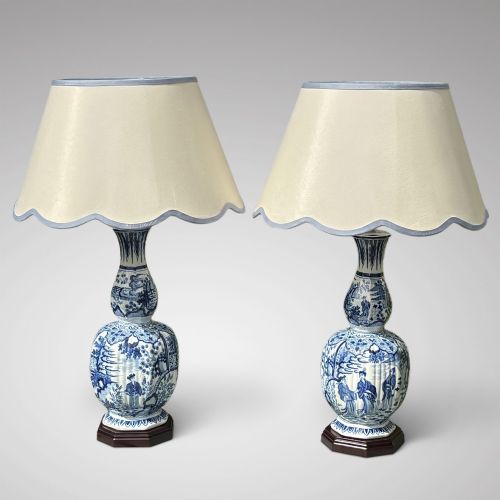


Vintage Ceramic Side Lamps
These vintage ceramic side lamps bring sculptural weight and painted colour to a room, and you want one for the way it anchors a corner with soft light.
Vintage Ceramic Side Lamps
Vintage ceramic side lamps comprise converted porcelain and earthenware vessels, ranging from 18th Century Japanese Arita Imari and Meiji period Satsuma to 19th Century French Sèvres style pieces and Dutch Delftware. The selection includes Chinese blue and white porcelain alongside European interpretations like Paris porcelain and Majolica, often paired with brass fittings and fabric shades.
Many examples begin life as vases before conversion into table lamps, retaining their original hand-painted glazes, famille verte palettes, or Chinoiserie motifs. Forms span classical baluster shapes and globular vases mounted on stable bases, serving both functional illumination and decorative presence on side tables.
How they were made
The foundation of these pieces lies in traditional ceramic bodies such as hard-paste porcelain, earthenware, and Majolica, shaped by hand or wheel before glazing. Artisans applied cobalt blue, polychrome enamels, and famille verte pigments directly to the surface, often firing the pieces multiple times to fix the colours.
Metal components, predominantly brass, were cast and turned to mount the ceramic bodies securely for electrical wiring, frequently accompanied by wooden or oak elements and silk or fabric shades.
Vintage Ceramic Side Lamps Retail Price Guide 2026
Typical asking prices for vintage ceramic side lamps among the pieces listed under this phrase on Sellingantiques today, from the lower quarter to the upper quarter. They describe what is for sale here now, not the wider market.
The listings here feature ceramics spanning from the 18th Century to the Edwardian era, incorporating porcelain, earthenware, oak, brass, and silk.
What varies in quality
Quality rests upon the crispness of the hand-painted decoration, the depth of the glaze, and the historical integrity of the ceramic body. Pieces featuring finely detailed Chinoiserie or intricate Arita Imari work display a superior level of artistry compared to later mass-produced interpretations.
The integration of the conversion matters significantly; the quality of the brass mounts and the stability of the fixture determine how well the original vase serves as a lamp without compromising its historical material.
The Vintage Ceramic Side Lamps Glossary
- Majolica
- A type of earthenware coated with an opaque tin-glaze and painted with brightly coloured metal oxides. It produces a glossy surface with vibrant hues.
- Imari
- A style of Japanese export porcelain decorated in underglaze blue and overglaze red, gold, and green. These pieces originated from the town of Arita.
- Famille Verte
- A palette of green enamels complemented by other colours, used on Chinese porcelain particularly during the Qing dynasty. The name translates to green family.
- Chinoiserie
- European artistic styles reflecting Chinese motifs and techniques, popular in decorative arts and furniture. It interprets Asian aesthetics through a Western lens.
- Delftware
- Tin-glazed earthenware originating from the Netherlands, traditionally finished in blue and white. It mimics the appearance of imported Chinese porcelain.
Vintage Ceramic Side Lamps: Frequently Asked Questions
Are these lamps converted from old vases?
Many of these pieces begin as antique vases or jars from periods like the 18th and 19th centuries before receiving electrical fittings and mounts for modern use.
This method of adaptation preserves the original hand-painted artistry while giving the ceramic body a new domestic purpose.
What is Majolica pottery?
Majolica is a form of earthenware defined by its porous clay body covered in a tin-lead opaque glaze, which provides a smooth white surface for painting. Artisans then apply coloured metal oxides that melt during firing.
This technique creates rich, saturated colours and a glossy finish that characterises Edwardian and Victorian decorative wares.
How do I place a side lamp in a room?
These ceramic lamps function best on low tables where their painted surfaces and metallic brass mounts can be appreciated at close range. They provide ambient light and introduce historic texture to an interior.
Pairing them with simple fabric or silk shades allows the decorated ceramic body to remain the visual focal point of the setting.